A warehouse worker can easily pick up a package from a conveyor belt and place it in the right bin. However, for a robot, even such a simple task takes several steps.
It needs to recognize the package, locate it, decide how to pick it up, and move it without hitting anything nearby. If the package moves or something gets in the way, the robot has to quickly adjust what it’s doing.
That gap between seeing something and knowing what to do with it is the central theme of computer vision in robotics. Computer vision itself is the branch of artificial intelligence (AI) that interprets images and video. On a robot, it turns camera input into decisions about where to move and what to touch.
For a long time, robots followed the same basic process. They detected an object, figured out where it was, and then acted. Many robots still work this way, but cutting-edge systems go further. Ask Google DeepMind’s Gemini Robotics-ER 1.5 to “point to everything I can pick up,” and it reads the whole scene, understands the request, and marks each item it can grasp.
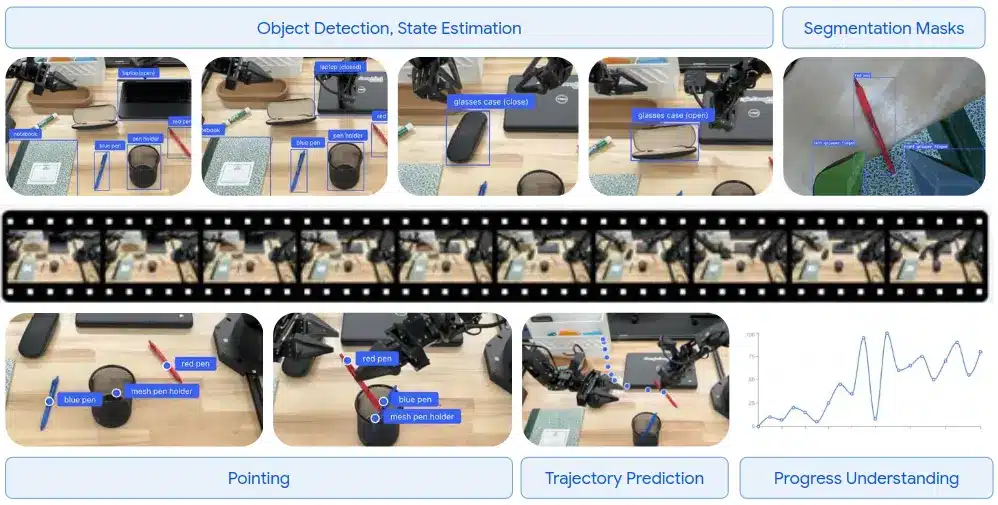
This shift from simply detecting objects to understanding entire scenes has led to new ways of building robot vision. Most systems today fall into one of three approaches. Modular pipelines break perception into separate steps like detection and pose estimation. In contrast, foundation models interpret entire scenes and follow open-ended instructions. Meanwhile, end-to-end policies skip the hand-offs altogether and map what the robot sees straight to how it moves. Some systems even combine all three.
Beyond how they work, these approaches differ in the training data they rely on, whether that’s labeled images, 3D measurements, image-text pairs, or recordings of robots doing the job. That data shapes what a robot can do, how it handles surprises, and how much training it needs to get there. Pair the right approach with the right data, and robots become far more dependable outside labs.
Let’s take a closer look at what computer vision in robotics is, where it’s used today, how each approach works, and what data it takes to build one.
Computer vision in robotics makes it possible for robots to understand their surroundings using cameras and other visual sensors. Depending on the task, they may need to recognize objects, estimate positions, measure distances, or track movement.
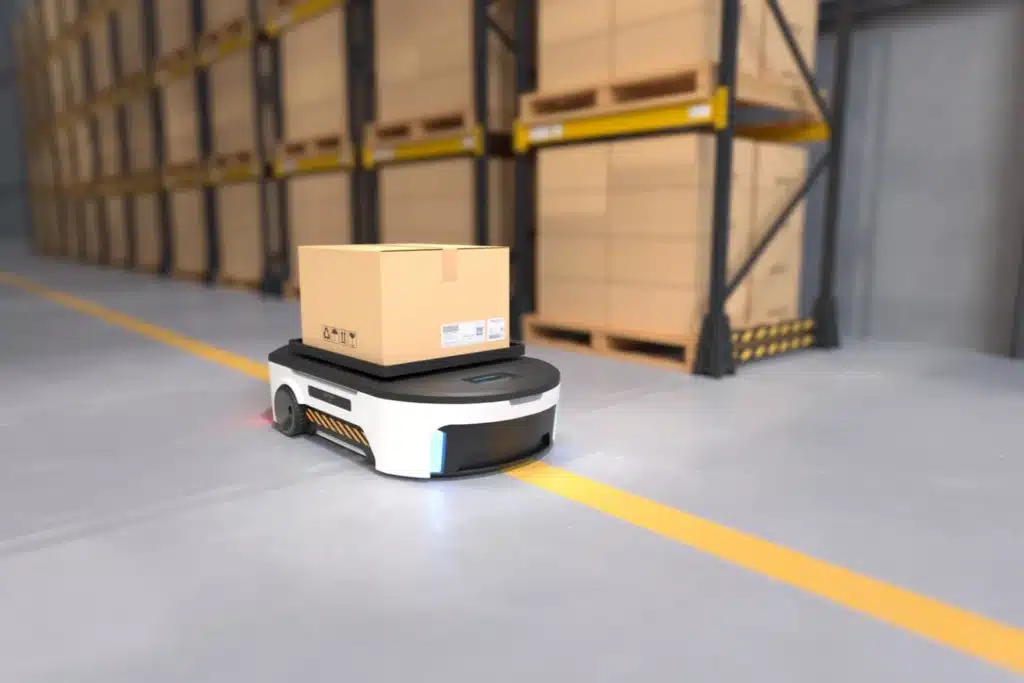
For example, a robot picking a box from a crowded warehouse shelf has to find the right box, figure out its exact 3D position, and check that its gripper can reach it without knocking anything over. Only then can it plan and carry out the move.
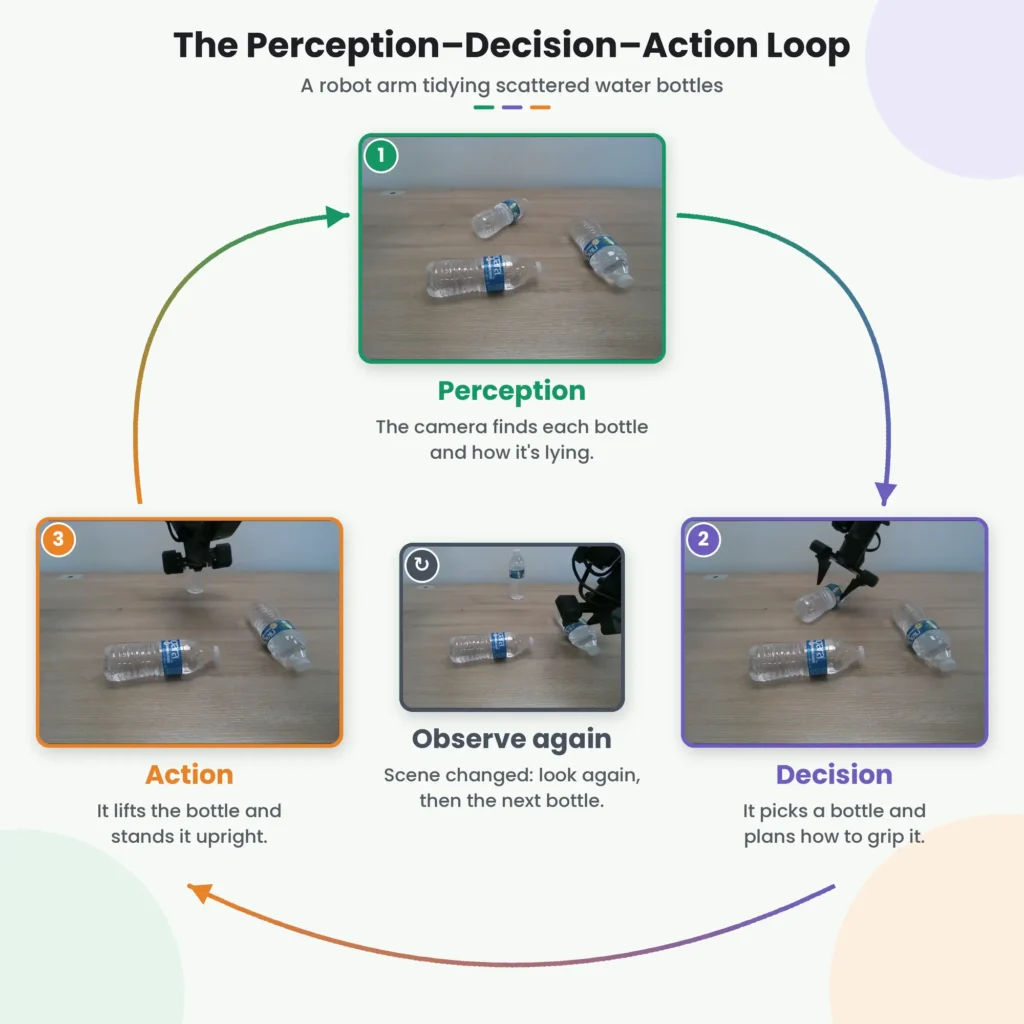
Of course, the world doesn’t stand still. If the scene changes, the robot has to update what it sees and adjust what it’s doing. This creates a continuous feedback loop. The robot observes its surroundings (perception), works out what to do (decision), carries it out (action), and then looks again.
Keeping this loop running smoothly is harder than it sounds. As a robot moves, its cameras see objects from new angles, so it has to keep working out where each object is, how far away it is, and how to grab it safely. All of this has to happen fast, or the robot may bump into things, drop what it’s holding, or damage something nearby.
This focus on movement and interaction is also what sets computer vision in robotics apart from related fields.
Computer vision, in general, enables machines to make sense of images and videos. Robot vision takes that understanding a step further and uses it to guide how a robot moves and handles objects. Machine vision, on the other hand, is mostly found in factories, where it inspects products, measures parts, and spots defects, though it can guide robots too.
Put simply, robot vision helps robots act in the real world, while machine vision usually sticks to quality checks and manufacturing. Both are already being used across various industries, from manufacturing and warehousing to healthcare and agriculture.
Computer vision lets robots make sense of their surroundings and work with objects across all kinds of industries. The tasks may look different, but the goal is always the same. Robots need to turn what they see into smart decisions and precise, reliable actions.
Here are some common applications of computer vision in robotics:
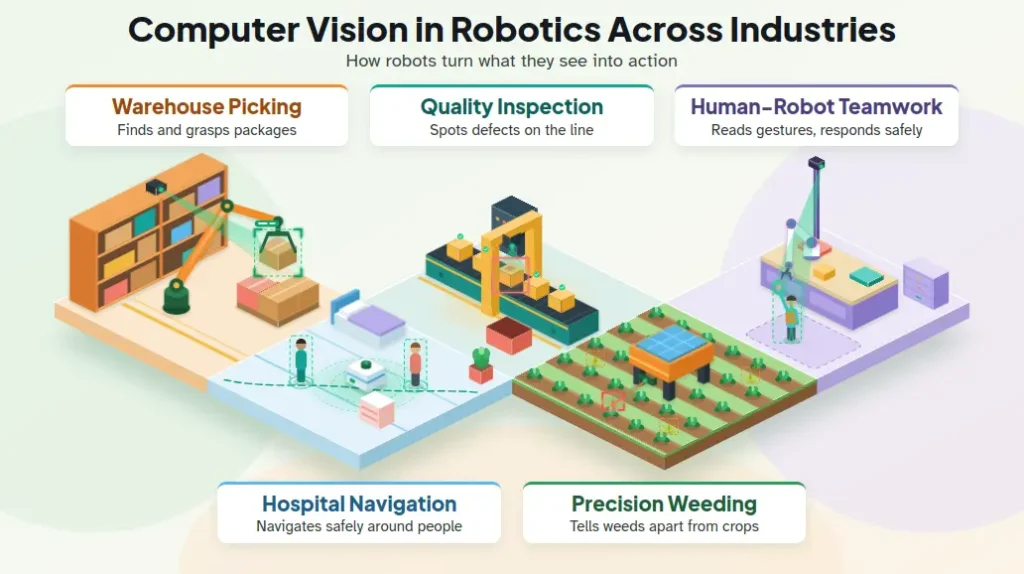
An interesting example is Carbon Robotics’ LaserWeeder system. Its vision model was trained on more than 150 million plant photos and related data points from over 100 farms in 15 countries. This allows the system to recognize many plant types, and farmers use it to target unwanted weeds.
Babé Farms, a US grower of 60–70 specialty vegetable varieties, uses the LaserWeeder G2 to find weeds and remove them with computer vision and precision lasers. Since it leaves nearby crops undisturbed, the farm can grow more uniform, higher-quality vegetables for the chefs and fine-dining restaurants it supplies.
What makes the LaserWeeder effective is the huge variety of plant images behind it. Every robot works in a similar way, since it can only be as reliable as the data it learns from.
So, how do robots actually turn what they see into action? Traditional computer vision in robotics does it by breaking perception into separate steps, each with its own job.
For example, take a robot picking up a water bottle lying on a table. It first detects the bottle, then separates it from the background (segmentation). Next, it estimates the bottle’s position and orientation in 3D space, known as its 6D pose. Finally, it plans how to grab it.
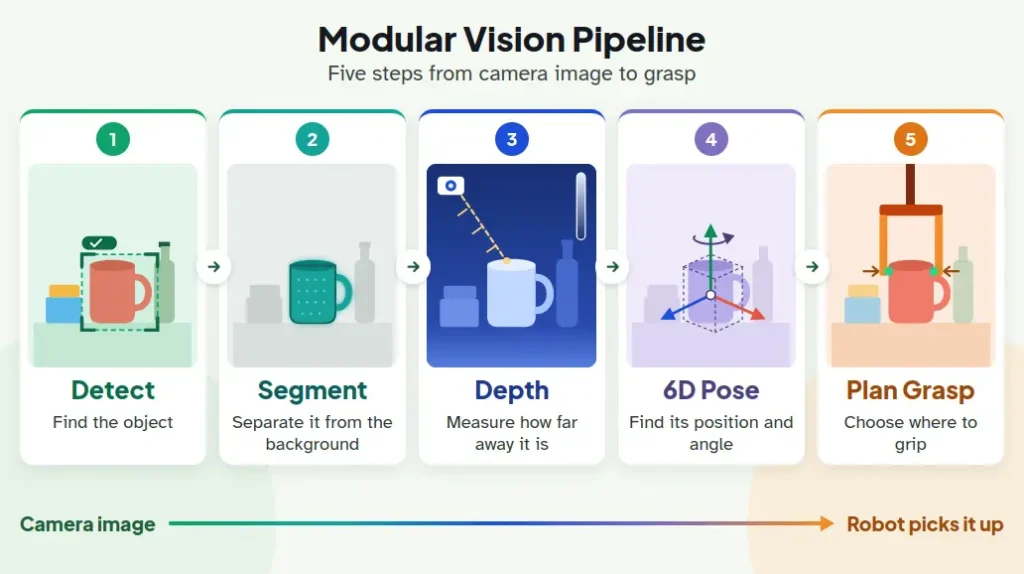
Not every robot follows these exact steps, but the idea stays the same, with each stage handling one job. This modular design is common across computer vision applications in robotics because each part can be tested, fixed, and improved without changing the whole system.
The trade-off is that errors carry forward. If the robot doesn’t capture the bottle’s full shape during segmentation, it may misjudge the pose and miss the grasp.
Since each stage is separate, researchers can also upgrade one step at a time. Pose estimation is a good example.
Older methods often needed a detailed 3D model or lots of reference images for every object a robot might handle. Newer models can work out an object’s position and orientation from far less, sometimes just a single reference image. Developers can swap in one of these more flexible models and keep the rest of the robot’s vision and motion systems as they are.
Swapping in better models helps, but each one is still trained for a narrow task. What if a single model could handle almost anything you point it at? That’s the idea behind foundation models.
Unlike traditional vision systems designed for specific objects or environments, foundation models learn from large, diverse datasets and can recognize and analyze objects they haven’t been explicitly trained to handle.
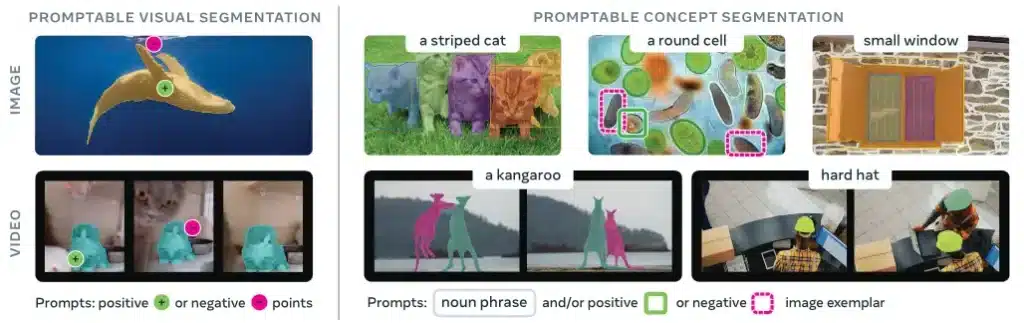
One such exciting development is open-vocabulary segmentation. These models can find objects based on a text description. For example, Meta’s SAM 3 can pick out and outline every object that matches a phrase like “hard hat,” then keep tracking each one across video frames.
Depth estimation is also improving. Models like Depth Anything 3 can use regular images to estimate how far away objects are and where the camera is positioned. In other words, robots get a much clearer picture of where everything sits around them.
Advances like these are making computer vision in robotics far more flexible. Instead of training a new model for every object, developers can start with a pretrained model (an AI model already trained on large amounts of data that can be reused for new tasks) and simply describe what the robot should look for. The robot’s other systems can then use those results to plan its next move.
However, these models still have their limits. They can struggle with unusual industrial objects, glass or shiny surfaces, and objects that are partly hidden. Robots may also have trouble accurately tracking their own grippers and how close they are to nearby objects.
Besides, spotting an object is only half the battle. To pick things up safely, avoid obstacles, and get the job done without mistakes, a robot also needs to know exactly where objects are and how to interact with them.
You might be wondering how a robot goes from recognizing an object to actually knowing what to do with it. The newest approach to robot vision tackles that by learning both at once.
In a classic pipeline, perception and action planning are separate stages. Vision-language-action (VLA) models take a different approach to computer vision in robotics. They learn to connect camera images, language instructions, and robot movements within a single trained system. That way, the robot can predict its next move from what it sees and what it’s been asked to do, then adjust as new observations come in.
Figure’s Helix is a great example. It pairs two systems that work together. A 7-billion-parameter vision-language model (System 2) interprets the scene and the instruction about 7 to 9 times per second. Meanwhile, an 80-million-parameter visuomotor policy (System 1) turns that understanding into actions 200 times per second. Between them, they control a robot’s hands, fingers, torso, and head.
Such use cases of computer vision in robotics depend heavily on training data. VLA models learn from examples that pair visual observations, robot states, instructions, and demonstrated actions. This way, a robot learns not only what objects look like, but also how to handle them.
Camera placement plays a big role too. Head-mounted cameras give a wide view of the environment, while wrist- or hand-mounted cameras capture fine detail up close to the object being handled. Combining both viewpoints helps robots see around obstacles and grasp objects more reliably, which is why this setup shows up in so many computer vision applications in robotics.
As computer vision in robotics advances, the training data needed to build these systems is also changing. Traditional vision pipelines rely on labeled images and geometric information, while foundation models and end-to-end policies need different types of data to handle real-world tasks.
Here’s a closer look at what each approach needs:
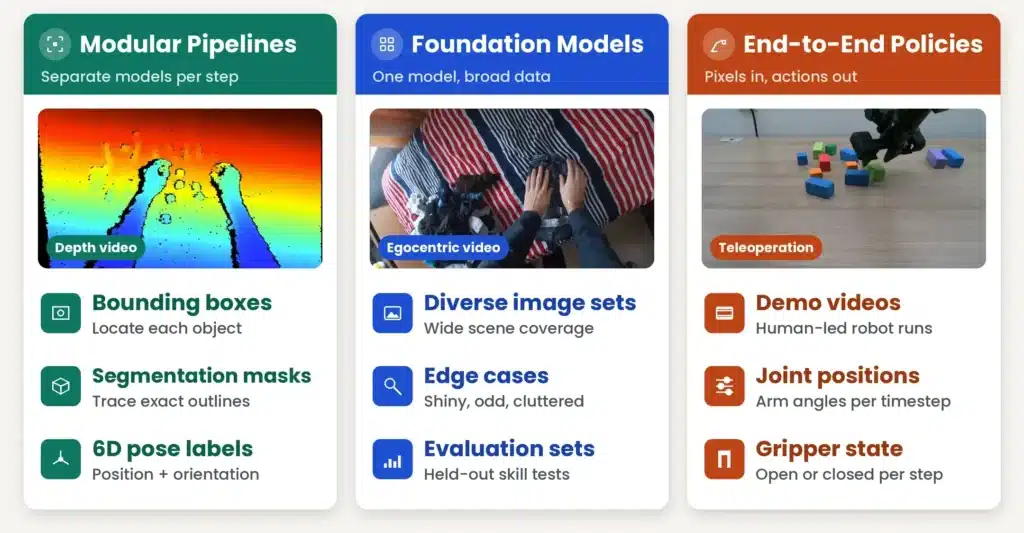
The goal isn’t simply to collect more data, but to collect the right data for each approach. Labeled images teach robots to recognize and locate objects, while synchronized demonstrations show them how to interact with those objects over time.
At Objectways, we support both sides of this. Our image and video annotation services help teams build accurate perception datasets, and our robotics data collection services, including egocentric recordings and teleoperation demonstrations, capture the real-world interactions that action-focused models learn from. With the right mix of both, teams can train and evaluate robots that see and act reliably.
Computer vision in robotics now covers much more than spotting objects and locating them. Modular pipelines, foundation models, and end-to-end policies each take their own route from seeing to acting, and all three still have a place in robotics today.
As these approaches evolve, so do their data needs. Labeled images and spatial measurements are still important, but robots now also need synchronized recordings of real-world actions and interactions. In the end, a robot can only perform reliably when its training data reflects the objects, environments, and challenges it will actually face.
If your team is building robots that need to see and act in the real world, Objectways can help. We provide data annotation and collection services to create datasets for training and evaluating robots. Get in touch to see how we can support your next project.
Computer vision is a subfield of artificial intelligence that trains machines to see, process, and understand visual data like digital images and videos.

Learn how computer vision for quality inspection helps detect defects, improve product accuracy, and maintain quality control in production lines.

Learn how computer vision in transportation enhances safety, efficiency, and sustainability through real-time traffic insights and smart mobility systems.