
TL;DR
- Class boundaries are the rules that decide where one label ends and the next begins in an annotated dataset.
- They are set by people through guidelines, and they shape what a model later learns as its decision boundaries.
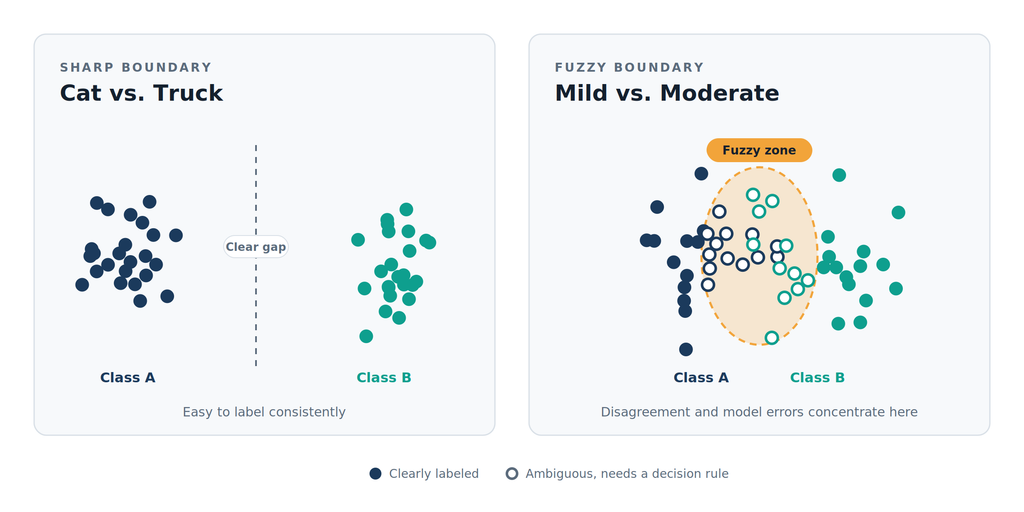
- Most labeling disagreement and model error happens at the edges between classes, not in the easy middle of each class.
- Fuzzy boundaries cannot be removed, but they can be managed with decision rules, numeric thresholds, borderline examples, and an “uncertain” option.
- Measure boundary quality per class pair, using agreement scores, confusion matrix hot spots, and reviewer correction rates, then rewrite the rules where scores are weakest.
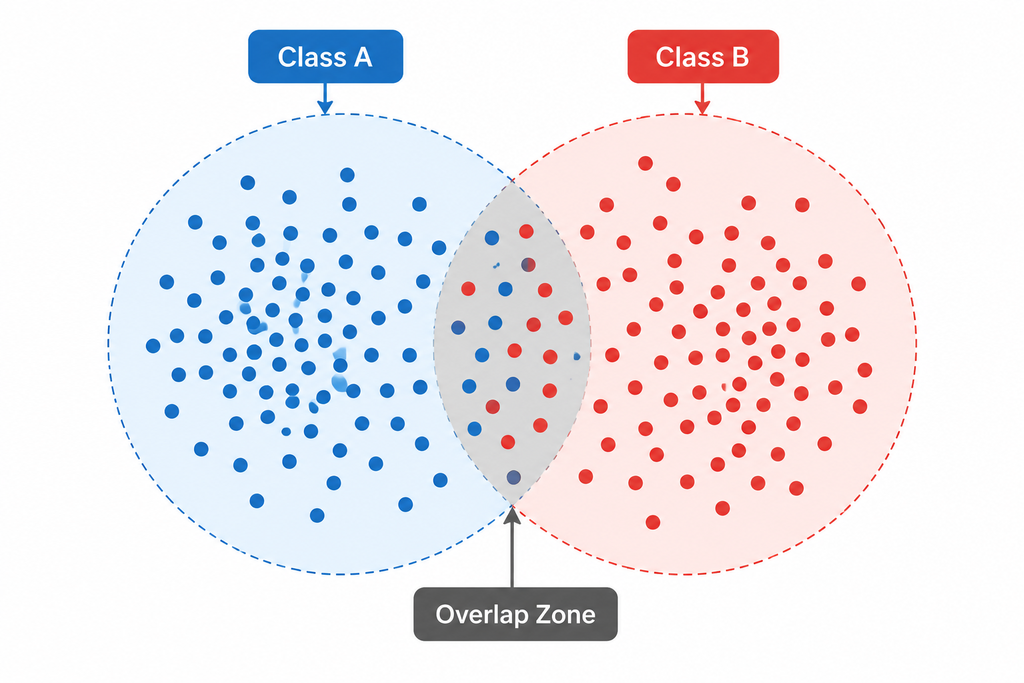
Class boundaries are the rules that decide where one label ends and the next begins in an annotated dataset. They tell annotators how to handle items that could fit two categories, such as a review that is somewhere between neutral and negative, or an object that is half hidden behind another.
Why class boundaries matter
Most model errors do not come from obvious examples. They come from the edges, where two classes look alike and annotators have to choose. If your guidelines leave that choice open, different annotators will choose differently, and the model absorbs the inconsistency as label noise exactly where it needs the most clarity.
Clear boundaries lead to higher agreement between annotators, better precision and recall on borderline cases, and datasets that stay consistent as teams and volumes grow.
Sharp vs. fuzzy boundaries
Some boundaries are naturally sharp, like “cat” versus “truck.” Others are inherently fuzzy, like “mild” versus “moderate” severity or “happy” versus “excited.” Fuzzy boundaries cannot be removed, but they can be managed with numeric thresholds, decision rules, and an “uncertain” option for items that genuinely do not fit.
A worked example
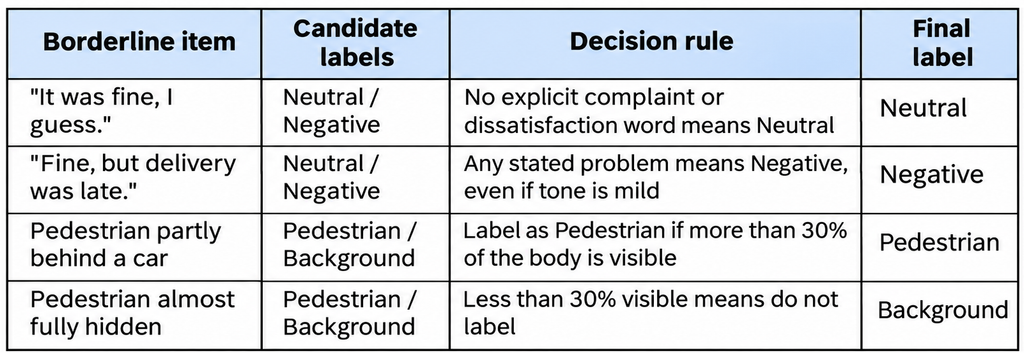
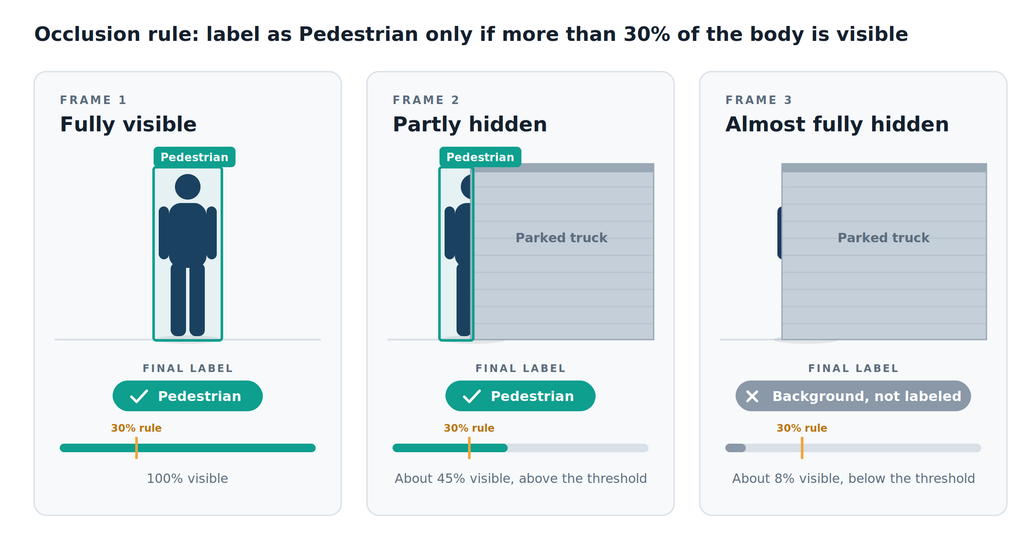
Here is how a borderline decision gets resolved with explicit rules instead of judgment:
Vague guideline vs. clear guideline
Before: “Label a review as negative if the customer is clearly unhappy.”
After: “Label a review as negative if it names a specific problem (for example late delivery, damage, poor quality) or uses an explicit dissatisfaction phrase. Mild or ambiguous tone with no stated problem is Neutral.”
The first version depends on what “clearly” means to each annotator. The second can be applied the same way by anyone.
How to measure boundary quality
You cannot fix a boundary you cannot see. Three signals show where boundaries are weak:
- Inter-annotator agreement by class pair: Overall agreement can look healthy while one pair of classes sits at a low score. Track metrics such as Cohen’s kappa for each pair, not just the whole dataset.
- Confusion matrix hot spots: If your model repeatedly mixes up two specific classes, the boundary between them is probably inconsistent in the training data.
- Reviewer correction rate: If reviewers keep changing the same label to the same alternative, the guideline for that boundary needs rewriting.
Best practices for defining and annotating class boundaries
Write decision rules, not just definitions, so the guideline says what separates two classes and not only what each one means. Pair every rule with labelled borderline examples and the reasoning behind each. Give each class include and exclude criteria.
Run a pilot batch before full production and review where annotators disagree, because disagreement points straight at weak boundaries. Send ambiguous items to consensus or expert review instead of leaving them to a single annotator. When new edge cases appear, update the guidelines, version every change, and relabel earlier data if the change affects it.
Common challenges
Overlapping classes share features, so one example fits two definitions. Ambiguous guidelines rely on judgment words like “mostly” or “clearly” without defining them. Annotator drift happens when interpretations shift over time as people build their own habits. Edge cases are rare examples nobody planned for, so they get labelled inconsistently. Class imbalance leaves rare classes with too few examples for the model to learn their edges.
Conclusion
Class boundaries decide how consistently a dataset is labelled, and consistency is what a model learns from. Clear categories are not enough on their own. The edges between them need explicit rules, because that is where annotators disagree and where models make their costliest mistakes.
The practical path is the same on any project. Write decision rules instead of loose definitions, back them with labelled borderline examples, measure agreement for each pair of classes, and revise the guidelines wherever the numbers show a weak boundary. Treat the guidelines as a living document, version every change, and relabel earlier data when a rule changes.
Teams that do this spend less time on rework and get training data that behaves predictably. Teams that skip it usually find the problem later, in the model’s errors.