
Classification
What is Classification?
Classification is the task of assigning a data item, such as an image, sentence, audio clip, or video, to one or more predefined categories so a machine learning model can learn to make the same decision on new data.
In supervised learning, a classification model studies thousands of labelled examples and learns which patterns point to which category. The quality of those labels decides how well the model performs, which is why classification sits at the heart of data annotation.
- Classification assigns predefined labels to data, such as images, text, audio, or video, so a model can learn to sort new data on its own.
- The main types are binary, multi-class, multi-label, and hierarchical.
- Label quality decides model quality. Clear guidelines, edge-case examples, and a review step prevent most errors.
- Measure both sides: inter-annotator agreement for the labels, and precision, recall, and F1 for the model. Accuracy alone can mislead.
- Use classification when you need to know what something is. Move to detection or segmentation when you also need to know where.
Why classification matters
Most AI products begin with a sorting decision. Is this transaction fraudulent? Does this scan look abnormal? Is this message a complaint or a question? Classification turns each of those decisions into something a model can learn, which makes it one of the most widely used techniques in machine learning.
It is also one of the most approachable annotation tasks, so many teams use it as their first labelling project. That makes early mistakes common, and expensive, because a model trained on inconsistent labels learns the inconsistency.
How classification works
- Define the classes: Decide the categories and write a rule for each one.
- Label the data: Annotators assign a class to every example using those rules.
- Review the labels: Reviewers check a sample, measure agreement, and resolve disputes.
- Train the model: The model learns the link between each input and its label.
- Evaluate and improve: Test on unseen data, find weak classes, and add or correct labels where results are poor.
The classification workflow
Types of classification
Classification tasks differ mainly in how many labels an item can receive and how those labels are organized.
- Binary classification, every item falls into one of two classes, such as a transaction that is either fraud or not fraud.
- Multi-class classification widens the choice to three or more categories, but each item still gets exactly one label, like a support ticket sorted into billing, technical, or account.
- Multi-label classification removes that limit, so a single item can carry several labels at once, such as a news article tagged with both politics and economy.
- Hierarchical classification arranges labels in nested levels, moving from broad to specific, as when a product is placed under Electronics, then Phones, then Smartphones.
The right type depends on your data and your goal: use binary for yes or no decisions, multi-class when categories are mutually exclusive, multi-label when topics overlap, and hierarchical when your categories naturally branch into sub-categories.
What a labelled example looks like
Here is a small text classification task with three intent classes: Billing, Technical Issue, and Cancellation.
| Customer message | Assigned label | Why |
| “I was charged twice this month.” | Billing | Refers directly to a payment problem |
| “The app crashes when I upload a file.” | Technical Issue | Describes a product malfunction |
| “I keep getting errors, so I want to stop my plan.” | Cancellation | The final intent is to leave, even though a technical issue is mentioned |
The third row shows why guidelines matter. The message touches two classes, and without a rule such as “label by the customer’s final request,” two annotators could reasonably choose differently.
Classification by data type
- Image classification: labelling a whole image, such as “damaged” or “undamaged” for a product photo.
- Text classification: labelling documents or messages by topic, sentiment, intent, or language.
- Audio classification: labelling clips by sound type, speaker, or emotion.
- Video classification: labelling a clip or scene by activity or event.
Classification vs. object detection and segmentation
These three tasks differ in how much detail they capture about the data, and that detail determines how much annotation work each one needs.
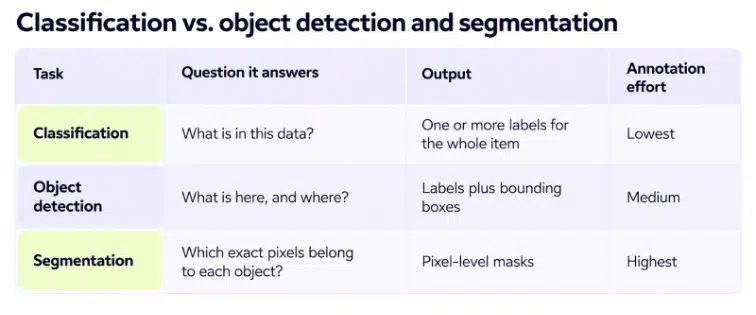
Classification vs. object detection vs segmentation
Classification is the simplest of the three. It answers the question “what is in this data?” by giving the whole item one or more labels, such as marking a product photo as “damaged.” Annotators make just one decision per item, so it takes the least effort.
Object detection goes a step further and answers “what is here, and where?” Annotators label each object and draw a bounding box around it, so a model learns both the identity and the location of things in an image. This takes more time per item, which puts it in the middle for annotation effort.
Segmentation is the most detailed. It answers, “which exact pixels belong to each object?” by producing a pixel-level mask that follows the true outline of every object. This demands the most annotation effort of the three.
In practice, choose the simplest task that answers your business question. If you only need to know whether a part is defective, classification is enough. If you need to know where the defect sits on the part, move to detection. If you need its precise shape or size, use segmentation.
How to measure classification quality
Quality has two sides: how consistent the labels are, and how well the model performs.
Label quality
- Inter-annotator agreement: how often different annotators give the same label to the same item. Low agreement usually means the guidelines or the classes are unclear, not that the annotators are careless.
- Gold-standard set: a small group of items with expert-verified labels, used to check annotators and catch drift over time.
Model performance
- Accuracy: the share of predictions that are correct. It can mislead when one class dominates.
- Precision: of the items the model labeled as a class, how many truly belong to it.
- Recall: of the items that truly belong to a class, how many the model found.
- F1 score: a single number that balances precision and recall.
- Confusion matrix: a grid showing which classes the model mixes up. It points straight to the labels and guidelines that need attention.
For example, a model that labels 95% of emails as “not spam” can reach 95% accuracy while catching no spam at all. Precision and recall expose that problem; accuracy alone hides it.
Classification in generative AI workflows
Classification is no longer limited to traditional models. It now supports large language model development in several ways:
- Labelling model outputs as helpful, harmful, accurate, or off topic
- Classifying prompts and responses for content moderation and safety
- Tagging responses by quality to build preference data for model tuning
- Sorting user queries by intent to route them to the right system
These tasks depend on the same fundamentals: clear classes, consistent labelling, and measured agreement.
Common challenges
- Ambiguous classes: Overlapping categories cause annotator disagreement. Add edge-case examples to the guidelines.
- Class imbalance: When one class dominates, the model ignores the rare ones. Targeted data collection can rebalance the set.
- Label noise: Mislabelled examples quietly reduce accuracy. Gold-standard checks and review sampling catch them.
- Subjectivity: Tasks like sentiment and tone vary between people. Calibration sessions bring annotators into line.
- Taxonomy drift: Classes added or changed mid-project can leave older labels inconsistent. Version your guidelines.
Best practices for classification labeling
- Write a guideline with a definition, positive examples, and negative examples for every class
- Include another or “unsure” option rather than forcing a guess
- Define a tie-break rule for items that fit more than one class
- Run a pilot batch and measure agreement before scaling
- Keep a human review step for edge cases and low-confidence items
- Version the guidelines and re-check labelled data when they change
Conclusion
Classification is simple to describe but easy to get wrong at scale, because a model only learns what its labels teach it. The real work happens before training: clear classes, guidelines that cover edge cases, and checks that annotators agree. Treat it as a loop of labelling, review, evaluation, and correction, and you catch problems early instead of after deployment, when they cost the most to fix.