Manufacturing facilities today face pressure from two key directions: increasing production volumes and rising expectations for product quality. Products have to be produced rapidly and at scale while still meeting strict quality standards throughout the manufacturing process.
As production lines move faster, maintaining consistent quality inspection becomes more difficult. Inevitably, some defects go unnoticed during production.
Studies suggest this number may be as high as 20%, meaning many defects are only discovered after products reach the market. This contributes to an estimated $1.3 trillion in global losses each year.
To keep pace with production and prevent defects from reaching customers, we are seeing manufacturers increasingly turn to computer vision-based quality inspection systems. By analyzing images captured directly from production lines, computer vision systems can automatically identify defects ranging from surface scratches to deeper structural issues.
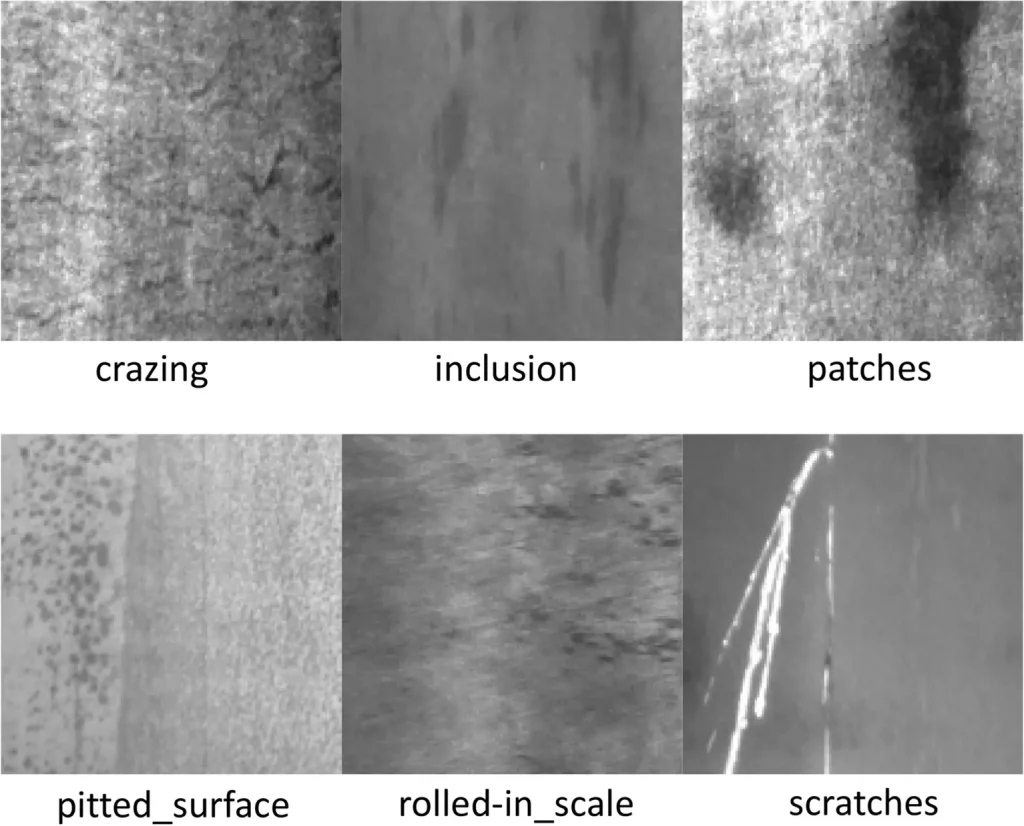
Examples of Different Types of Surface Defects (Source)
Let’s explore how computer vision systems work in quality inspection and the different types of defects they can identify.
Quality inspection has always been a critical step in manufacturing. However, as production lines move faster, traditional approaches like manual checks or rigid automation are falling behind.
Computer vision in manufacturing provides a more practical way forward. By combining cameras, sensors, and AI models, manufacturers can analyze visual data from the production line and automatically determine whether each product meets quality standards.
Earlier automated inspection systems attempted to solve this problem with rule-based methods and simple image processing techniques. Engineers defined fixed thresholds, such as acceptable color ranges, shape measurements, or contrast levels, to flag defects. These systems worked well in controlled environments, but even small changes in lighting, materials, or product design could throw them off.
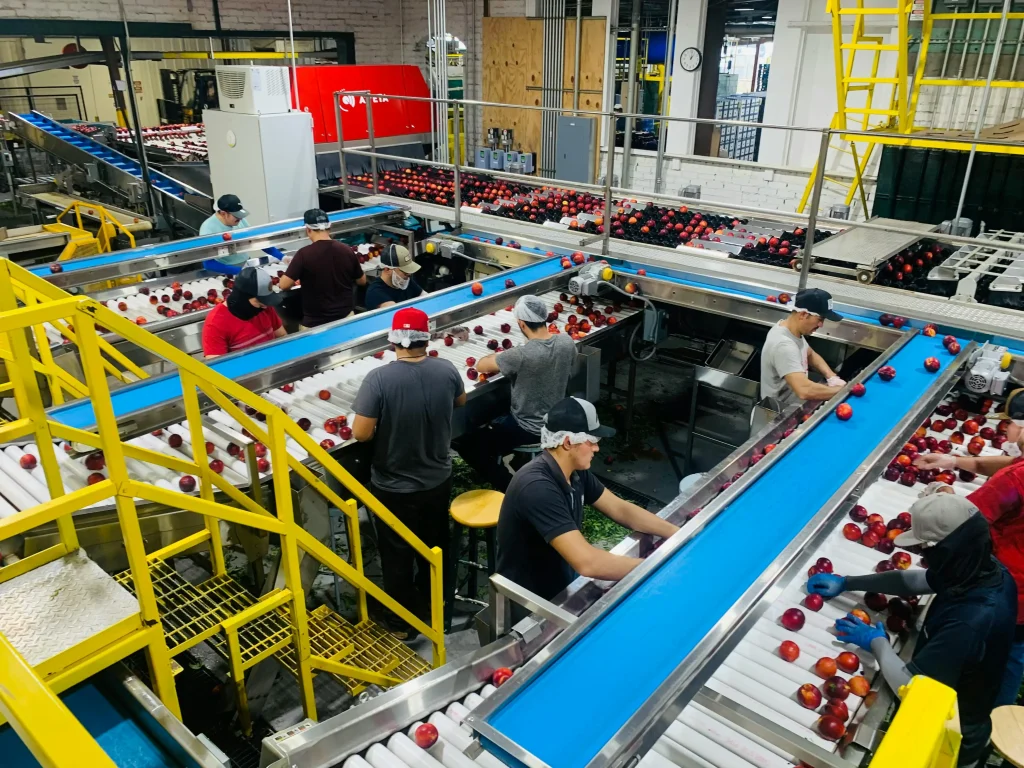
A Traditional Assembly Line With Manual Quality Checks
Computer vision systems driven by deep learning models take a different approach. Instead of depending only on predefined rules, these models learn from real production data. By training on images of both acceptable products and known defects, the system learns to recognize the visual patterns that indicate quality issues.
Once deployed on the production line, such computer vision quality inspection systems can continuously capture and analyze images as products move through manufacturing. It can detect issues such as scratches, dents, discoloration, or subtle structural inconsistencies in real time.
Most computer vision-driven quality inspection systems rely on various vision techniques to understand the images and videos they process. You can think of a computer vision technique as a specific capability that a deep learning model uses to interpret visual information.
Each technique helps answer a different question during inspection. Some can tell whether a product is defective or non-defective. Others pinpoint exactly where a defect appears in an image, such as a crack, scratch, or missing component.
Here’s a closer look at some common computer vision techniques used for quality inspection:
So what do computer vision techniques look like in action? Let’s take pipeline inspection as an example, where the goal is to detect corrosion or cracks on the pipe surface.
Image classification could broadly determine whether a section of pipe is defective or not. Meanwhile, object detection goes a step further by highlighting where the defect appears, typically by drawing a box around it.
Similarly, instance segmentation provides even more detail by outlining the exact shape of the defect, making it easier to assess its size and severity. Also, if the defect type is unknown, anomaly detection can flag unusual patterns on the pipe surface that differ from normal conditions.
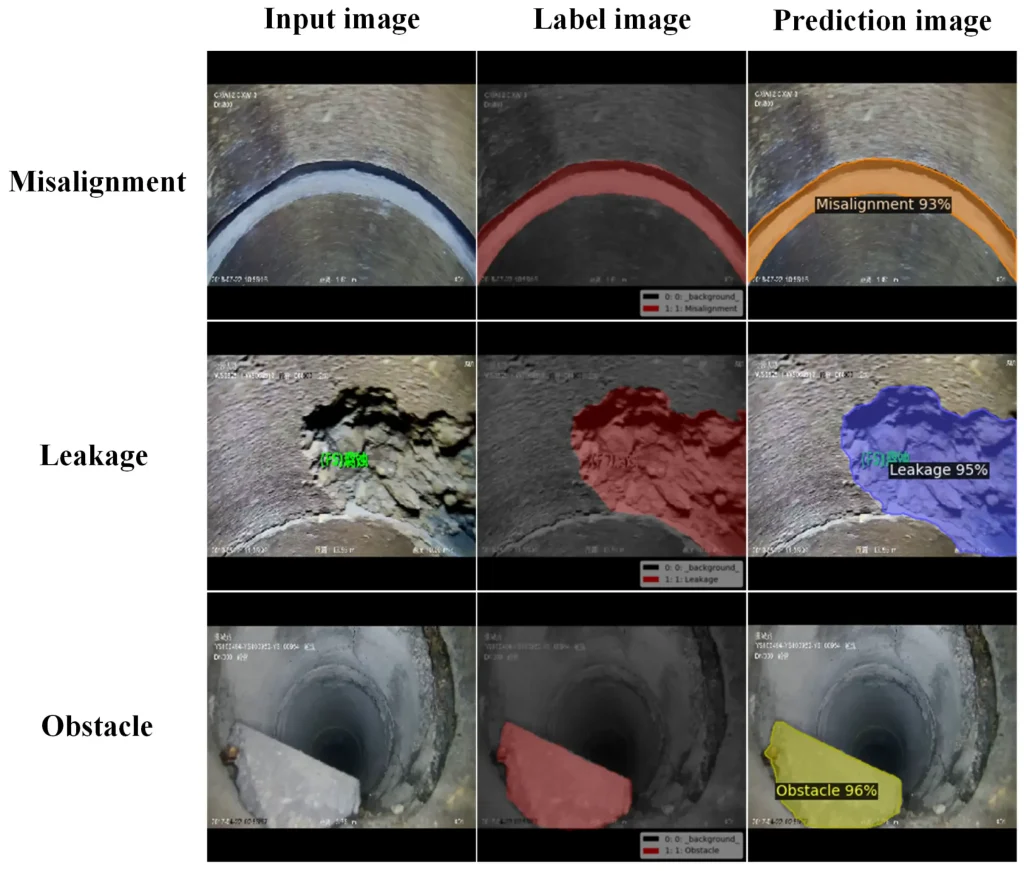
A Look at Using Instance Segmentation to Identify Pipeline Defects (Source)
Next, let’s walk through how a computer vision-enabled defect detection system typically works on an automated manufacturing production line.
The process generally begins with image capture. Industrial cameras placed at inspection points capture high-resolution images of each product as it moves through an assembly line.
Before analysis, these images are preprocessed to ensure they are consistent and ready for inspection. This may include adjusting brightness or contrast, reducing visual noise, and isolating a specific area of the product in the image that needs to be inspected.
Once the images are prepared, a computer vision system can analyze them to identify potential defects. By evaluating visual features such as edges, textures, and shapes using different vision techniques, the system can detect issues like scratches, cracks, dents, or missing components.
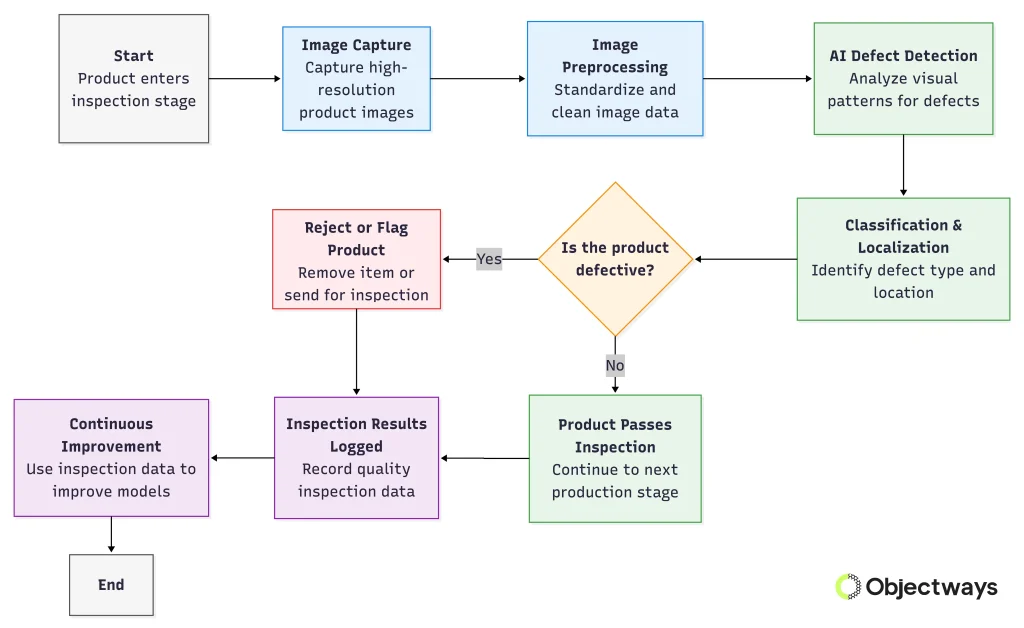
Inside an AI-Powered Quality Inspection System
When a defect is detected, the system can also determine the type of issue and identify where it appears within the image, giving manufacturers a clear understanding of both what the problem is and where it occurs. Finally, the system can trigger an inspection decision.
Based on the results, products may proceed through production or be rejected, flagged for review, or sent for rework. At the same time, inspection results can be recorded, making it possible for manufacturers to track defect trends and monitor production quality over time. This data can also be used to improve the system’s performance, helping it become more accurate as it processes more production data.
Manufacturing defects come in all shapes and sizes. Some are easy to spot on the surface of a product, while others are more subtle and harder to detect during fast-moving production.
Computer vision quality inspection systems mimic how human inspectors visually check products and work best at detecting visible defects. Since these systems analyze images, they are most effective at identifying issues that create noticeable changes in a product’s appearance, such as scratches, cracks, dents, or missing components.
Here are some examples of defects that computer vision systems are commonly used to detect:
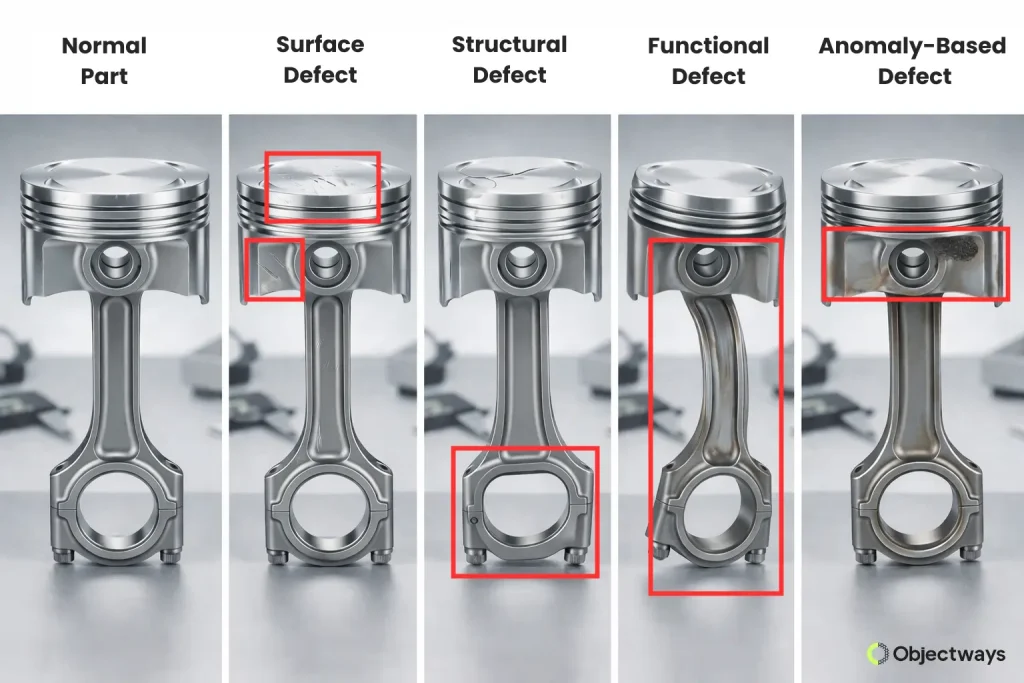
Different Types of Defects in Parts Manufacturing
In manufacturing, the later a defect is discovered, the more expensive it becomes to fix. This idea is often captured in the 1-10-100 rule: a defect that costs $1 to fix early may cost $10 during production and $100 once the product has shipped.
Because of this, manufacturers are investing more heavily in technologies that can detect problems earlier in the process. According to McKinsey, 93% of manufacturing COOs plan to increase spending on digital and AI over the next five years.
Computer vision is playing a growing role in that shift by enabling automated quality inspection directly on the production line. Next, let’s explore how it’s being used across different manufacturing sectors.
When it comes to automotive manufacturing, even the smallest surface defect can affect both product quality and brand perception. A minor paint inconsistency on a vehicle body, for instance, may require rework or repainting, which adds time, labor, and cost to the production process.
To catch these issues early, manufacturers like the BMW Group are using computer vision quality inspection systems to monitor painted surfaces during production. High-resolution cameras scan the paint finish as vehicles move through inspection stages, capturing detailed images of the surface in real time.
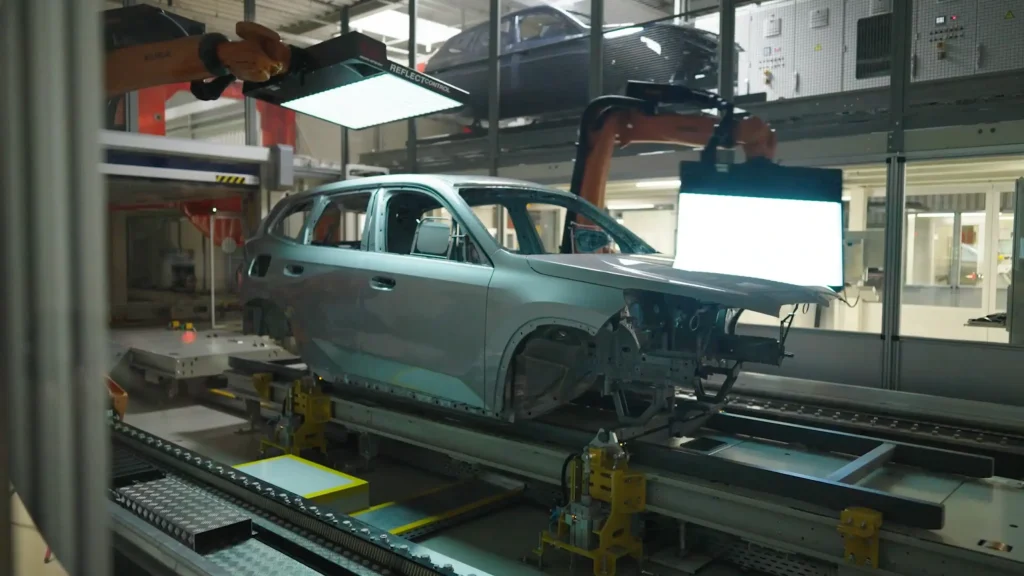
Using Vision-Based Cameras to Scan the Paint Surface of a Car Body (Source)
AI models then analyze these images to identify irregularities such as scratches, dents, or paint inconsistencies that may not always be visible during manual inspection. When a defect is detected, the system can record its exact location, letting technicians focus on affected areas.
Defects can occur at an extremely small scale in electronics and semiconductor manufacturing. Components such as wafers, microchips, and printed circuit boards are produced with tight tolerances, where even tiny imperfections can affect performance and lead to costly production losses.
Detecting these defects through manual inspection can be tricky, especially when irregularities exist at the microscopic level. To tackle this challenge, manufacturers are relying on computer vision systems that capture and analyze high-resolution images of components during production.
The pharmaceutical and packaging industries operate under strict quality and safety requirements. Even seemingly small issues such as an improper seal, packaging misalignment, or tiny leaks can compromise product safety and create regulatory risks.
Computer vision can streamline quality inspection by automatically checking packaging as products move through the production line. Cameras can capture images of bottles, blister packs, and cartons during the filling and sealing process, allowing inspection systems to verify that products are correctly packaged and labeled.
These systems can detect issues such as missing tablets in blister packs, damaged packaging, incorrect labels, or containers that aren’t sealed properly. When a defect is identified, the product can be flagged and removed from the line before it moves further through the supply chain.
Metal production and fabrication environments often operate at very high speeds, with materials moving rapidly through processes such as casting, rolling, and finishing. During these stages, defects such as cracks, scale marks, inclusions, or surface scratches can develop on metal sheets and components.
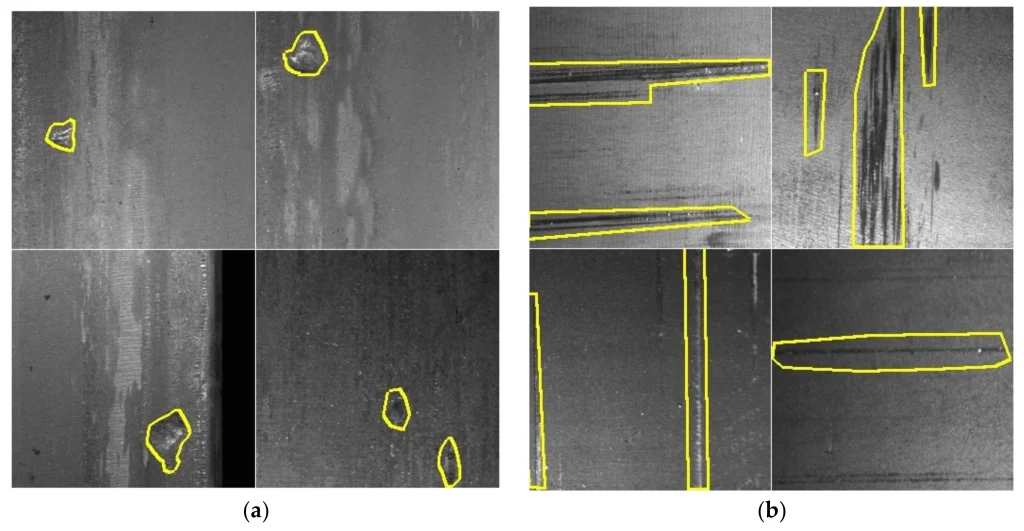
Steel Surface Defects (Source)
To monitor these issues, manufacturers use computer vision systems to inspect metal surfaces as they move through production lines. For example, Nippon Steel, a global steelmaker, uses AI-powered vision systems to monitor steel surfaces during production.
Computer vision-driven defect detection is becoming an essential tool for manufacturers looking to maintain quality in fast-moving production environments.
Here’s an overview of the benefits of using computer vision for quality inspection:
While computer vision offers many advantages, implementing these systems in real production environments requires careful planning. Manufacturers have to consider several technical and operational factors to ensure the inspection system works reliably.
Here are some of the key factors to keep in mind:
These limitations highlight how vital high-quality training data, reliable annotation, and ongoing model validation are when building computer vision inspection systems. That’s why collaborating with an experienced data partner can make a big difference.
At Objectways, we work with manufacturers to provide high-quality data annotation and scalable workflows designed for industrial inspection applications.
From automotive paint inspection to pharmaceutical packaging and metal manufacturing, companies are already using computer vision-powered quality inspection systems to improve quality control without slowing down production. By automatically analyzing images from production lines, these systems can detect defects earlier and help manufacturers maintain consistent quality at scale.
As production continues to speed up, computer vision-driven defect detection will likely play a bigger role in how manufacturers handle quality inspection. For organizations exploring this technology, having good training data and reliable workflows in place will be key to making these systems work effectively.
If you’re exploring computer vision quality inspection or defect detection systems, reach out to learn how Objectways can support your computer vision projects.


Learn how computer vision in transportation enhances safety, efficiency, and sustainability through real-time traffic insights and smart mobility systems.
Explore how occlusion impacts computer vision, its challenges, and solutions like generative AI, multi-sensor fusion, and self-supervised learning.