Procurement is the engine that quietly keeps a business running. Every time a factory gets raw materials on time, a hospital restocks critical supplies, or a retailer avoids empty shelves, procurement is doing its job. For years, it’s been the function that balances cost, risk, and supplier relationships to make sure operations never skip a beat.
But today, supply chains stretch across many countries, and supplier networks are larger than ever. This means every purchasing decision can impact cost, risk, and compliance.
Expectations have also increased. Procurement teams are now expected to react quickly to market changes, manage supplier risks more accurately, support sustainability goals, and deliver cost savings without interrupting operations. These demands are growing much faster than what traditional tools and basic automation can handle.
In particular, the increase in data is a challenge. As data increases and procurement becomes more complex, manual processes aren’t enough. Many procurement teams still rely on manual tracking, scattered documents, and slow approval processes that limit visibility and slow down progress. This is slowly changing.
Organizations are beginning to use generative AI to handle data at scale, automate routine work, and support better decision-making. This makes it possible for procurement professionals to focus on strategy and relationship building rather than repetitive tasks. Early adopters of generative AI in procurement are already seeing impactful results, including 5–15% reductions in total procurement spending and 50–80% improvements in efficiency across sourcing, negotiations, and contract management.

In this article, we’ll look at how generative AI is changing procurement and how leading companies use it for various tasks, such as decision support, risk simulation, etc. Let’s get started!
Before we look at how it works in detail, let’s first understand what generative AI means in the procurement world.
You can think of generative AI like a skilled assistant within an organization who can read, write, and reason. It can be used to support everyday tasks such as drafting supplier messages, summarizing long documents, and running quick scenario checks. Such an AI system can also spot trends in spending and supplier performance, giving procurement teams an extra layer of insight, like having a second set of eyes throughout the entire process.
Earlier tools were more like calculators. They processed structured data, followed fixed steps, and helped with routine tasks such as PO creation, invoice matching, and record updates. These tools helped get work done faster, but they didn’t provide much support when a task needed a deeper understanding or context.
As procurement got more complex, the tech had to keep up. Teams moved from basic automation to predictive tools that spot trends and risks. Generative AI is the next step. Using large language models with retrieval from enterprise sources, it can parse unstructured content such as contracts, emails, policies, and market reports, extract relevant entities and obligations, and generate context-aware summaries and recommendations for procurement decisions in near real time.

Smart procurement keeps supply chains flowing and warehouses full
This shift brings in abilities that weren’t possible earlier. Generative AI can write procurement documents, compare supplier proposals, simulate risk scenarios, and learn from new information to improve its recommendations. It acts as a smart partner by assisting teams in processing complex data and making faster, more informed decisions.
Procurement has many connected steps, and each one depends on having the right information and making clear decisions. This involves teams having to manage diverse supplier data, navigate changing market conditions, handle complex contracts, and keep up with rising expectations.
As the work becomes more demanding, basic automation isn’t enough. Generative AI can help by understanding the vast and complex information, identifying patterns, and giving real-time guidance when important decisions need to be made. It supports the entire procurement process, providing a reliable layer of intelligence from sourcing to supplier management.
Here’s a closer look at how generative AI fits into the procurement lifecycle:
Using generative AI across these steps helps teams see the full picture faster, catch issues early, and surface insights that are easy to miss in manual work. This lets procurement spend less time on admin and more time driving strategy and long-term value for the business.
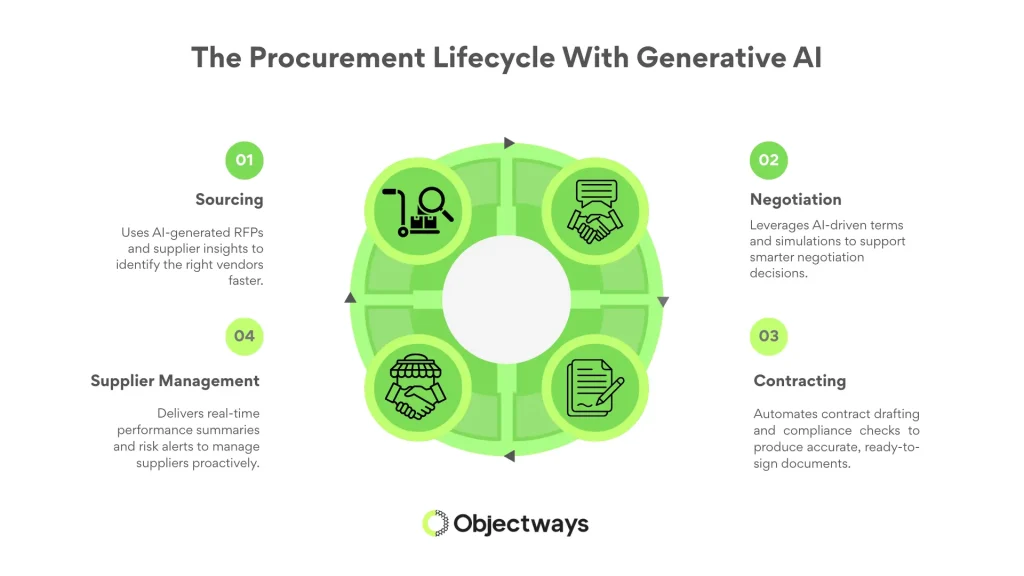
Stages of the Procurement Lifecycle Where Generative AI Creates the Most Impact
Generative AI in procurement works through a connected system that understands the information it receives, produces helpful results, and fits into the tools teams already use. The final output may look simple, like drafting a contract, summarizing supplier data, or comparing bids, but each task relies on several parts working together.
Here is how the system typically functions:
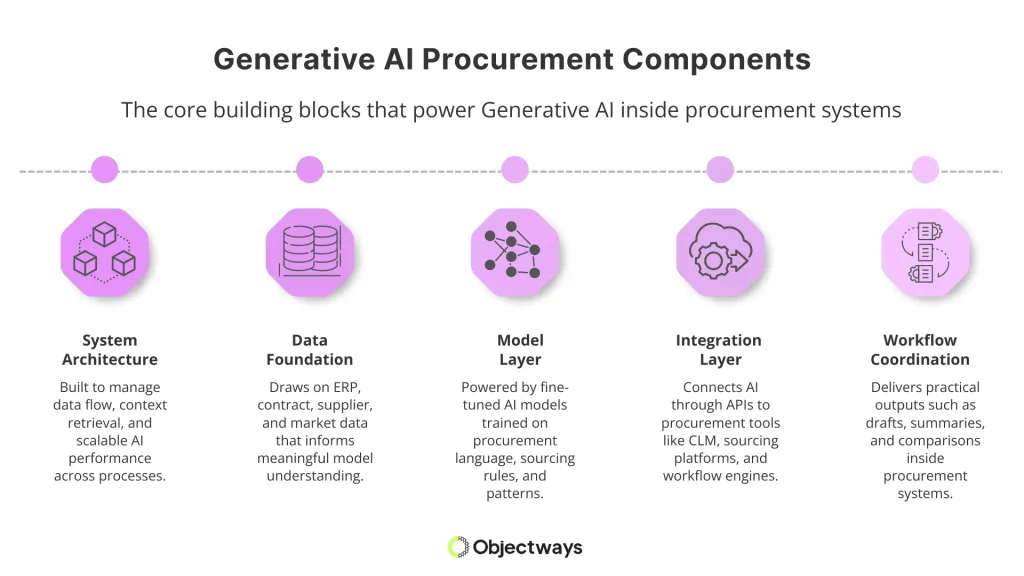
The Essential Layers that Power Generative AI Impact Inside Procurement Workflows
Generative AI enables procurement teams to work faster and manage information better by writing documents, reviewing contracts, summarizing data, and supporting decisions without repeating manual tasks.
Here are the key generative AI techniques used in procurement:
Now that we have a better understanding of how generative AI works in procurement, let’s take a closer look at some real-world applications.
In large manufacturing companies, reviewing supplier offers is a daily but high-stakes task. It is the process of evaluating proposals from different suppliers. Each proposal includes pricing, technical specifications, timelines, and compliance terms. Even a slight mismatch or overlooked clause can affect budgets, production schedules, and long-term partnerships.
Instead of manually scanning hundreds of pages, teams can use generative AI to receive clear summaries and flagged discrepancies that they can act on immediately. This helps speed up review cycles, reduce human error, and improve collaboration between purchasing and technical teams.
A good example of this can be seen at BMW factories. A generative AI solution is used to support its procurement teams during offer evaluation. The system reads supplier documents, compares them against internal requirements, and highlights key differences, gaps, and risks across competing bids.
Sustainability is now part of everyday supplier decisions for big global brands. But in most companies, the data needed to judge supplier sustainability is scattered across scorecards, audits, certifications, and long reports, which makes it tough for procurement teams to act quickly or consistently.
That’s why companies such as Johnson & Johnson, L’Oréal, and Unilever are leaning on generative AI-powered sustainability intelligence in procurement. These tools can pull together large volumes of supplier data, explain performance in plain language, and highlight what really matters, like carbon hot spots, compliance gaps, or improvement areas. Instead of spending days piecing information together, teams get fast, decision-ready summaries and clear risk signals they can use during sourcing and supplier reviews.
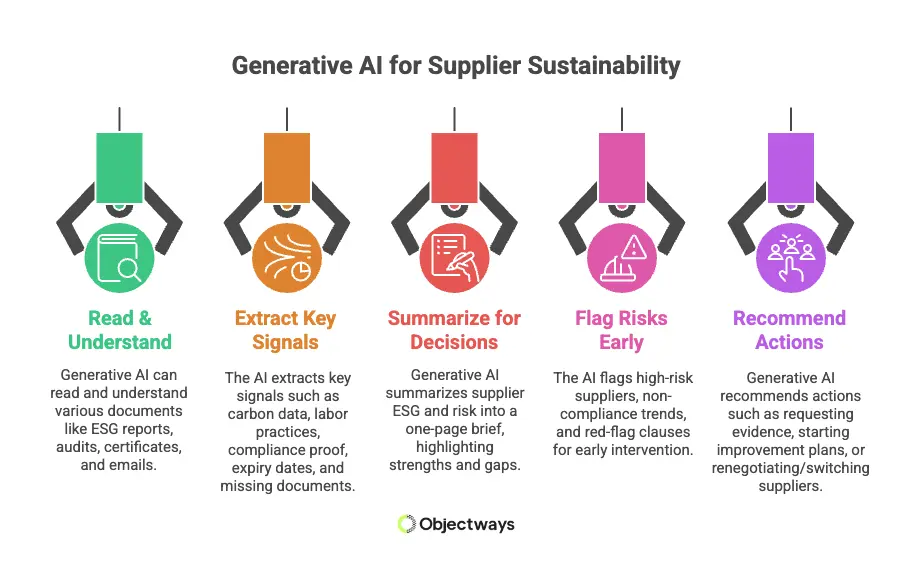
Generative AI makes supplier sustainability and compliance easier to manage
Routine procurement work often runs in the background of large organizations. For instance, reviewing contracts, handling basic negotiations, answering stakeholder questions, and checking process compliance may seem small. Still, at scale, they consume a huge amount of time and attention.
Heineken’s use of agentic AI is a great example of how AI tools can change this dynamic. The company uses agentic AI, built on generative AI capabilities, to take over everyday procurement tasks.
These include running simple supplier negotiations, pulling market intelligence on demand, summarizing long documents, and guiding stakeholders through compliance steps. Such tasks don’t need to depend on human availability anymore. They move forward through intelligent AI-led actions.
With this shift, Heineken’s procurement teams spend far less time on operational effort and far more on supplier strategy, commercial planning, and long-term value creation. The result is faster execution, stronger consistency across markets, and procurement that operates with greater speed and control at a global scale.
Here are some key benefits of using generative AI in procurement:
While generative AI in procurement brings significant advantages, it also comes with limitations that teams need to manage carefully, such as:
Partnering with the right experts makes these challenges easier to manage. At Objectways, we help procurement teams structure data and build reliable AI workflows so generative AI can support every stage of the lifecycle.
Generative AI is changing how procurement teams source, draft contracts, and make decisions by bringing speed and clarity to complex tasks. It streamlines work that was traditionally slow and manual, but its real value comes from pairing automation with human judgment.
With AI as a co-pilot, procurement becomes more agile, consistent, and data-driven without losing control or governance. Teams that adopt this balance will move faster, negotiate smarter, and manage suppliers with greater confidence.
Ready to bring AI into your procurement function? Connect with Objectways to implement it responsibly with the right mix of technology, oversight, and domain expertise.

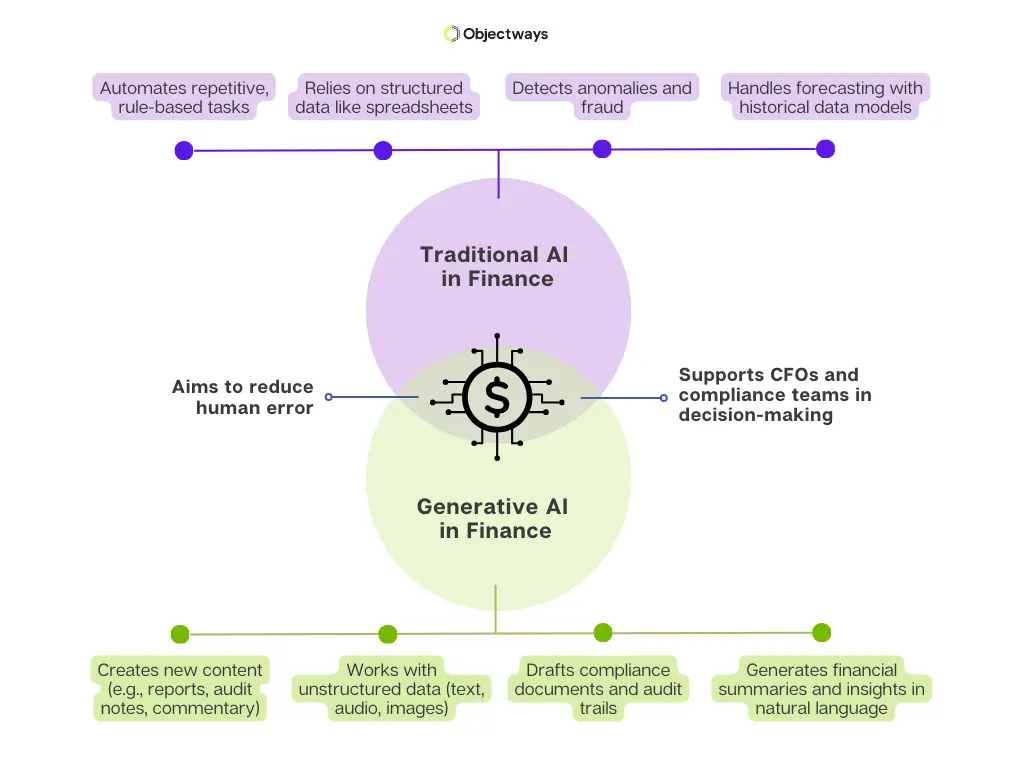
Generative AI in accounting is changing finance workflows with faster reporting and insights. Learn about the various applications, benefits, and risks.
Discover how model distillation makes large language models more efficient, affordable, and scalable for real-world AI applications.