September 2026 has been a very busy month for humanoid robot news. OpenAI stepped into the robotic race, XPENG moved its IRON humanoid onto an automated production line, and China’s TianGong Ultra robot made headlines after surpassing Usain Bolt’s 100-meter record.
Humanoid robot news updates like these make it clear that such robots are no longer just lab projects, and the race to put them to work is speeding up. What makes that possible goes beyond the machines themselves. Physical AI gives robots the ability to perceive their surroundings, learn from real-world interactions, operate safely, and handle increasingly complex tasks in factories and warehouses.
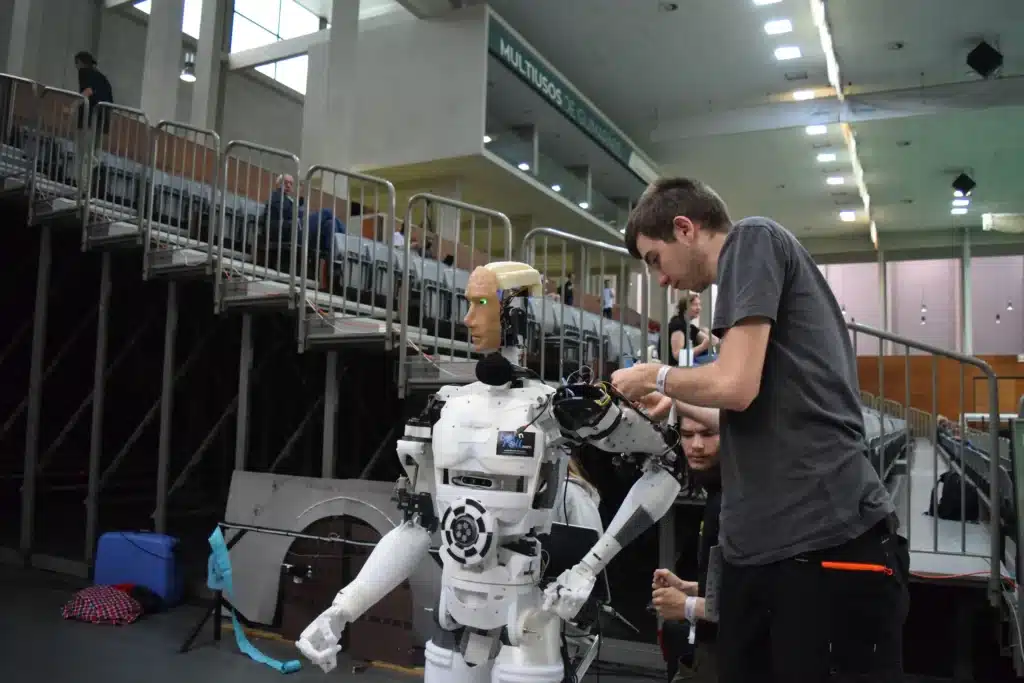
As more of these robots enter warehouses, factories, and other real-world settings, the data used to train them becomes just as important as the hardware. Robots need large amounts of diverse, high-quality data to navigate new environments, interact with people and objects, and respond to situations no one planned for.
In this article, we’ll cover the key humanoid robot news from September 2026 and the physical AI trends behind it. We’ll also look at what it means for the teams collecting and labeling robot training data to make humanoid robots more capable. Let’s get started!
After years at the forefront of generative AI, OpenAI is now setting its sights on the humanoid robotics space. In September, Sam Altman said the company will “definitely do a humanoid,” although OpenAI hasn’t announced a ship date, production target, or manufacturing partner.
The move shows how AI companies are extending their work from digital systems, like generative AI models, into the physical world. Humanoid robots could provide a direct connection between AI models and real-world perception, movement, and interaction. They can use sensors to perceive their surroundings, process that information through AI models, and turn the model’s decisions into physical actions.
Data plays an important role here. If OpenAI eventually develops both AI models and robots, it could create a feedback loop where the robot’s experiences and mistakes help improve the data used to train future AI models. This makes high-quality data from real-world environments crucial, along with simulation and controlled testing.
Tesla’s Optimus program also highlights the gap between building robots and deploying them effectively. Tesla began producing Optimus at its Fremont facility around August 2026, but as of September, customer units haven’t shipped yet.
In January, Elon Musk acknowledged that no Optimus robots were doing useful work inside Tesla factories and that Tesla had missed its target of producing roughly 10,000 units in 2025. For data teams, the lesson is simple. Scaling hardware is only part of the challenge. Robots also need real-world tasks, interactions, failures, and edge cases that generate useful training data.
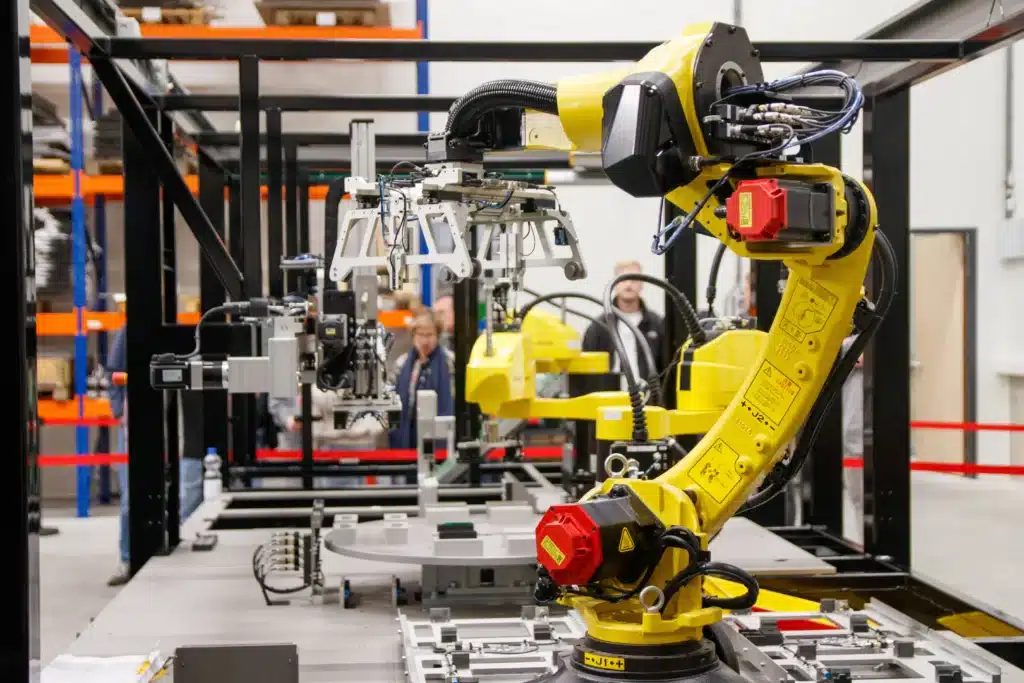
Another recent trend in humanoid robot news is that robots are starting to move beyond prototypes and into real manufacturing environments. For instance, Chinese EV and Physical AI company XPENG’s IRON production line has more than 80% of its core processes automated. They also have mass production targeted for the end of 2026 and initial deployments planned for their stores and campuses.
This shift is crucial outside the factory floor, too, especially when it comes to data. As humanoids enter real-world settings, they can generate more data from actual tasks, interactions, failures, and edge cases, creating feedback that can be used to improve future robot models.
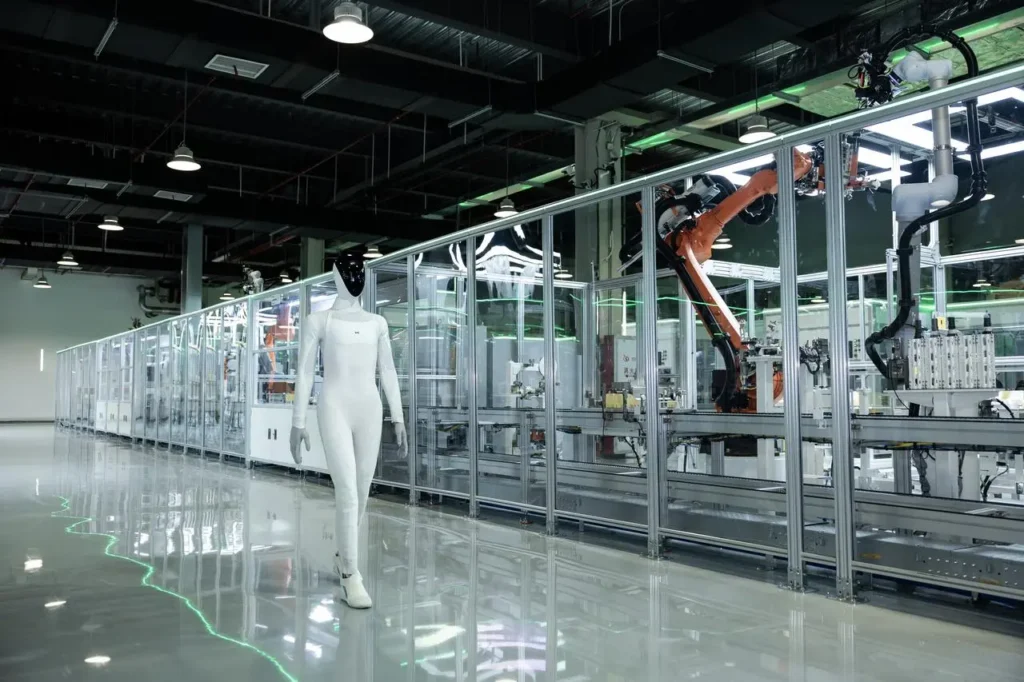
Figure is taking a similar approach from the data side. In August, the company introduced Index, a large-scale physical dataset built from real-world human activity, and said its goal is to address the data needed to make robots more capable. Figure’s Index surpassed 69,000 weekly active users just two weeks after launch, with contributors uploading around 35 minutes of first-person video every second.
The company is also scaling its robot fleet. Figure says that putting more robots into operation generates more data for its Helix model, while real-world deployments expose failures that are difficult to identify at smaller scale. The takeaway from this humanoid robot news is that scaling physical AI takes more robots, more real-world data, and the infrastructure to turn that data into better-performing models.
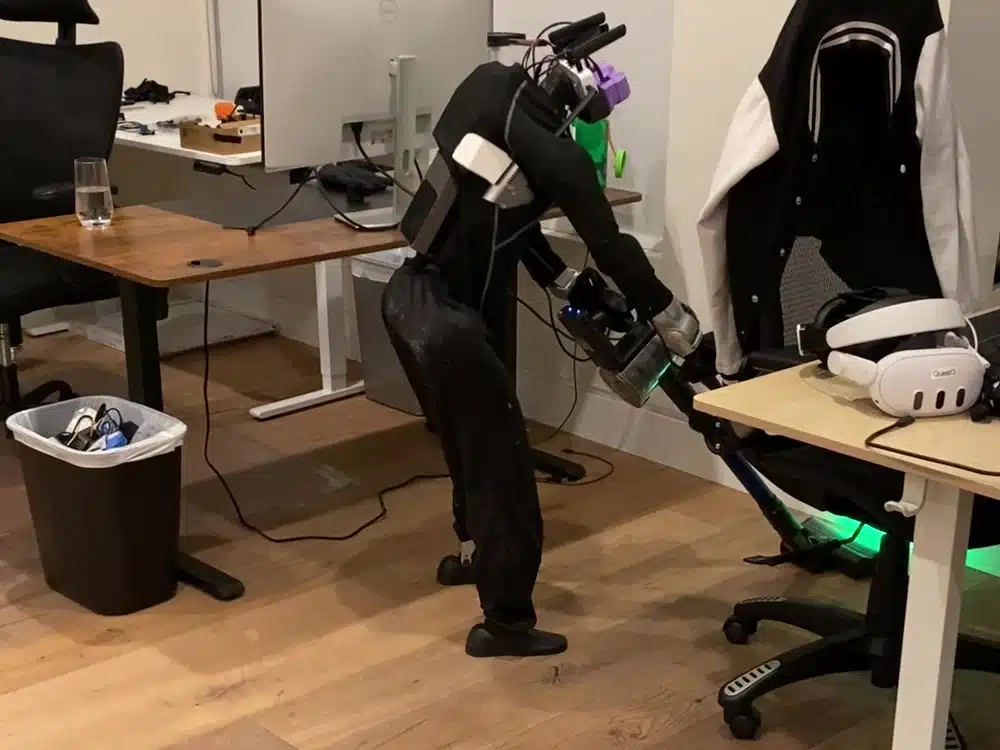
Humanoid robots are increasingly being tested outside controlled lab settings, where they have to deal with the unpredictability of everyday environments. Tau Robotics, for example, is using remotely supervised humanoids for home and office cleaning. The robots can handle tasks autonomously, while a remote human can step in to guide or control them when they encounter something they can’t handle.
Agility Robotics’ Digit 5 is taking a similar step toward real-world work, with a focus on operating safely alongside people. Unlike many traditional industrial robots that work behind fences or in separate zones, Digit 5 is designed to share space with people. That kind of safety depends heavily on data, since robots need examples of how people actually move, including sudden turns, close encounters, and moments when someone reaches into the robot’s workspace.
As humanoids move into homes, workplaces, and other shared spaces, they encounter much more variation than they would in a lab or simulation. That makes real-world deployment valuable for data.
Every task can generate information about what the robot sees, how it moves, where it struggles, and when human intervention is needed. Human guidance can also provide useful signals for improving how the robot handles similar situations in the future.
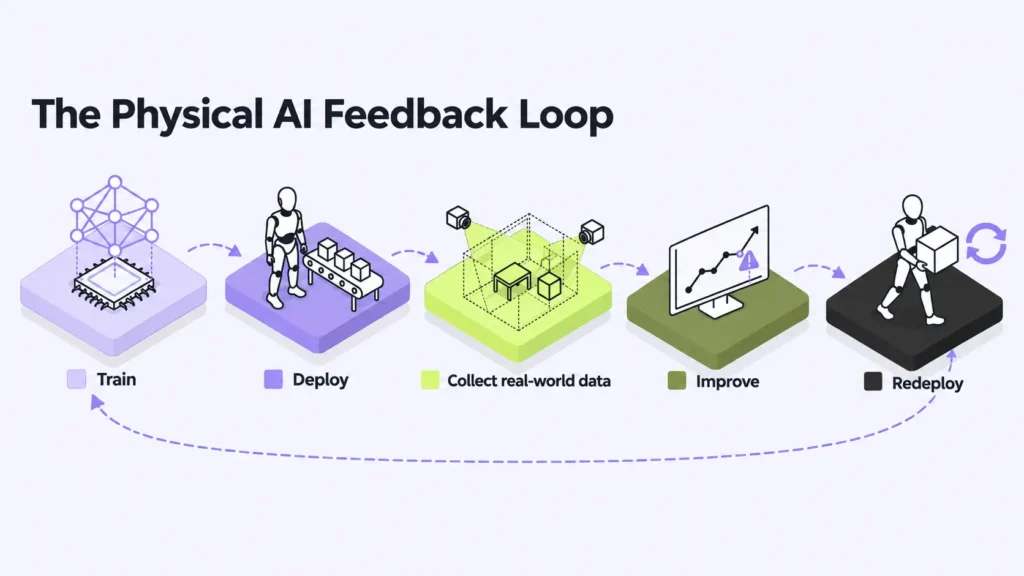
This creates a simple feedback loop: deploy, collect real-world data, train, improve, and deploy again. For physical AI teams, deployment is becoming a part of the training process rather than simply the final step.
As demand for physical-world data grows, a market is forming around sourcing and selling robot training data. Recent humanoid robot news reflects this shift, with a new marketplace launching in September to offer egocentric video, teleoperation recordings, and robot execution data for robotics and humanoid teams.
Platforms like this are also putting more weight on data quality. Features such as dataset scoring, standardized formats, and chain-of-custody documentation can help teams understand where data came from, how it was collected, and whether it’s suitable for training.
This makes it easier for robotics teams to discover, evaluate, license, and integrate data into their training pipelines. Instead of collecting every type of data internally, companies can rely on specialized providers to fill gaps in their existing datasets. Objectways, for example, offers embodied AI datasets spanning egocentric, teleoperation, and depth data for robotics teams.
As this market grows, robot training data is becoming something teams can source, evaluate, license, and buy on top of what they gather in-house. Better access is a big step forward, but the real measure of progress is how quickly robots can turn that data into useful, real-world capabilities.
Meanwhile, China’s humanoid robotics sector is moving quickly, with TianGong Ultra reportedly completing a 100-meter race in 8.64 seconds. Running that fast takes serious advances in actuators, balance, control systems, and real-time coordination. Still, a fast robot isn’t automatically a useful one.
Robots working in factories, warehouses, or other real-world settings need to navigate changing environments, recognize objects, and perform tasks safely around people. They also need to handle things going wrong.
Dropped objects, unexpected obstacles, changing lighting, or people moving nearby can all require a robot to adjust its behavior. That makes task data essential. Robots need examples of successful actions as well as mistakes, recoveries, and different ways of completing the same task.

TianGong’s development illustrates this process. After its record-setting run, engineers returned to their test site to push the robot’s programs further and adjust different controls and settings.
The same principle applies beyond running. Data teams need to capture perception, manipulation, navigation, and human-robot interactions, not just movement. JD.com, for example, has said it plans to eventually involve 100,000 employees and 500,000 external workers in its data-collection operations. The challenge is shifting from making robots move to making them understand and act in the real world.
As the scope of robot training data expands, so does the importance of the hardware used to collect it, and regulations are shaping that hardware. In July 2026, the U.S. Federal Communications Commission (FCC) added foreign-produced advanced robotic devices to its Covered List, giving companies that build and deploy robotics systems something new to plan around.
The rules mainly cover mobile ground robots with sensors, software, and connectivity for tasks like navigation, perception, data collection, or remote control. That can include humanoids, quadrupeds, autonomous mobile robots (AMRs), and some service robots, while several types of traditional industrial robots are excluded.
Some companies are already feeling the effects. Unitree, for example, has warned that its U.S. sales could be at risk and that future models may face approval hurdles.
For data teams, the challenge is less obvious. The robot used to collect training data today may not be the one a company is allowed to deploy tomorrow. Each platform can have its own cameras, depth sensors, joints, grippers, and control systems, so a dataset built on one robot may not carry over cleanly to another.
Because of this, companies building physical AI datasets may need to plan for several types of hardware from the start. A switch in platforms could mean recalibrating sensors, adapting existing datasets, or collecting new data altogether.
On top of this, regulations can affect where physical-world data can be collected, since they define which robots can be sold and used in each market. Hardware and regulation are quickly becoming a core part of any data strategy.
The common thread across these pieces of humanoid robot news is simple. More robots are moving into real environments, more humans are interacting with them, and real-world robot data is becoming critical. The next generation of physical AI will need to learn from much more than controlled demonstrations or simulated environments.
For data teams, that means collecting data that captures the variety of real-world tasks and environments, including different objects, people, movements, mistakes, and outcomes. Human interaction is another important part of this, especially when robots need to learn from demonstrations or respond naturally to people.
Teams also need to think about what happens to that data over time. Provenance, licensing, labeling standards, consistency, and hardware compatibility can all affect how useful a dataset is as robots and models evolve. Data collected on one robotic platform may also need to be adapted before it can support another.
This is where specialized data-collection partners can help. Objectways provides teleoperation and egocentric data collection services for robotics teams building and scaling real-world training datasets. The goal isn’t simply to collect data once, but to build a pipeline that can continuously generate useful data for training and improving physical AI systems.
The humanoid race involves more than building the fastest, strongest, or most human-looking robot. The bigger challenge is turning a capable machine into one that can understand its surroundings, perform useful tasks, and learn from real-world experience.
For humanoid robots, news from OpenAI, XPENG, Figure, Tau, Agility, and China’s broader robotics push all point to the same challenge from different directions. Hardware is advancing, production is scaling, and robots are moving into more real-world environments. At the same time, this progress is creating a growing need for high-quality data.
Behind every factory deployment, robot demonstration, and new capability is a need for training data that reflects how robots actually operate in the physical world. As physical AI develops, the teams that can collect, organize, and scale this data will play an increasingly important role in the robotics ecosystem.
If you’re building physical AI systems, we’d be glad to help. At Objectways, we collect and structure real-world robot data, from teleoperation to egocentric video, so your robots can learn from the environments they’ll actually work in. Reach out anytime to talk through your data needs.
Humanoid robots are slowly moving from prototypes and lab demonstrations toward real-world testing and early production. Humanoid robot companies are deploying them in factories, warehouses, homes, and other environments, while improving their ability to perceive, move, interact with people, and perform useful tasks. However, reliable large-scale deployment is still developing, and challenges around real-world performance, safety, training data, and hardware remain.

See where the sim2real gap has closed, where it still breaks, and why robotics teams are investing in real-world data collection over just simulation.
Explore why evaluating a vision language action model is so hard, which benchmarks teams use today, and what a credible benchmark report should contain.