Every time you order something online, there’s a good chance a robot played a part in getting that package to your doorstep. For instance, at Amazon, fleets of robots move shelves across warehouse floors, robotic arms sort and pack products, and AI systems coordinate thousands of tasks behind the scenes.
In fact, by mid-2025, Amazon had deployed its one-millionth robot across more than 300 facilities worldwide, making it the largest operator of mobile robotics on the planet. Yet most customers never think twice about it.
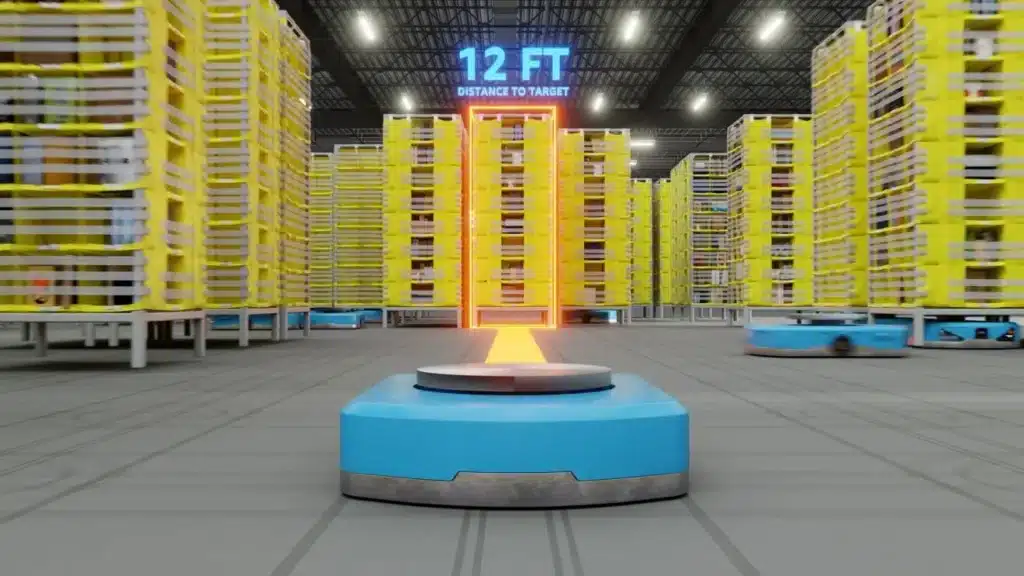
An autonomous mobile robot carries inventory through the storage racks at an Amazon fulfillment center. (Source)
Amazon’s fulfillment centers are just one of many real-world applications of robotics that are becoming part of everyday work. Robots now operate across warehouses, factories, hospitals, farms, and many other industries.
Unlike traditional industrial robots that repeat the same programmed motion, physical AI systems use cameras and sensors to understand their surroundings. They can make decisions and adjust their actions as conditions change, which lets robots work in environments where objects move, layouts shift, and every task differs slightly from the last.
Today, physical AI helps robots assemble vehicles, inspect aircraft, assist surgeons, and harvest crops, bringing intelligent automation into industries that once depended entirely on human workers. In this article, we’ll explore various real-world applications of robotics, how physical AI works, and how it’s enabling more capable robots across every major industry.
A lot like a toddler learning to move around a room, some robots figure out their next move by sensing the environment around them, adjusting as each new situation arises rather than following a script. This approach is known as physical AI, meaning AI systems are embedded in machines that can perceive, plan, and act in the physical world. Using cameras, sensors, and AI models, they read their surroundings, decide on an action, and respond as conditions change.
A good example of robotics enabled by physical AI is NEURA Robotics’ 4NE-1, a humanoid designed to navigate unstructured industrial environments and respond to changing conditions in real time. Instead of repeating a fixed sequence of movements, it relies on full-body sensing, including 360-degree perception and a sensor skin, to understand its surroundings before deciding how to respond.
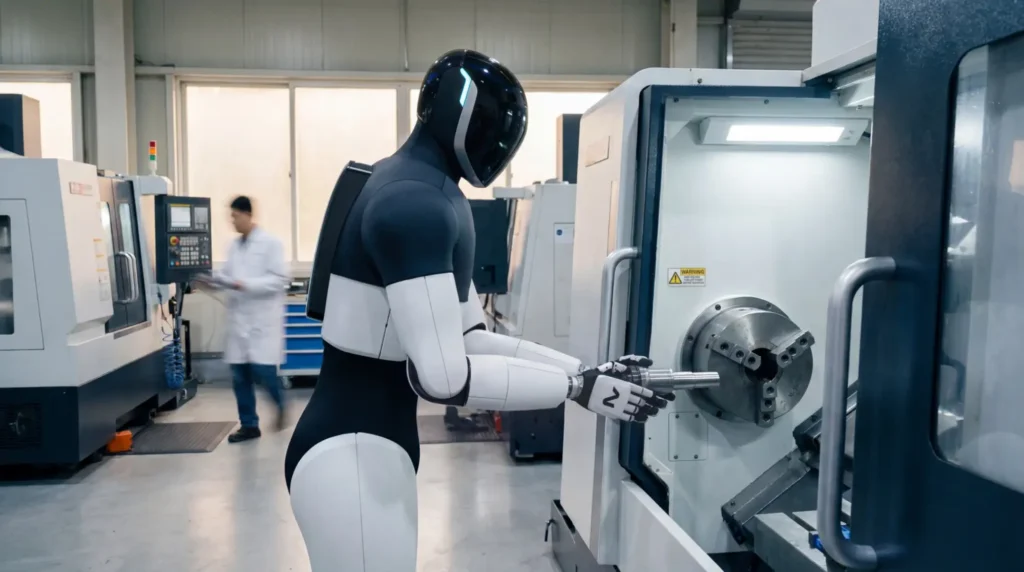
NEURA Robotics’ 4NE-1 humanoid tends a CNC machine in real time, an example of physical AI in action. (Source)
Behind every one of these capabilities is data. Robots learn from large volumes of images, videos, sensor readings, and human demonstrations that teach AI models to recognize objects, understand their surroundings, and make better decisions.
Now that we’ve covered how physical AI works, let’s look at the most common applications of robotics and the real-world examples driving them across industries.
Amazon’s fulfillment centers are one of the clearest robotics examples you’ll find anywhere. Rather than relying on a single machine, Amazon runs a fleet of specialized warehouse robots that work alongside employees at every stage of the fulfillment process.
Sequoia, for instance, uses AI and computer vision to identify and store inventory up to 75% faster. Robotic arms like Sparrow then recognize and pick individual products from storage bins, even when those products vary in shape, size, or packaging.
Once an order is packed, Robin uses computer vision to identify and separate individual packages on a conveyor belt, even in a cluttered pile. Cardinal then places those packages into containers ready for transport.
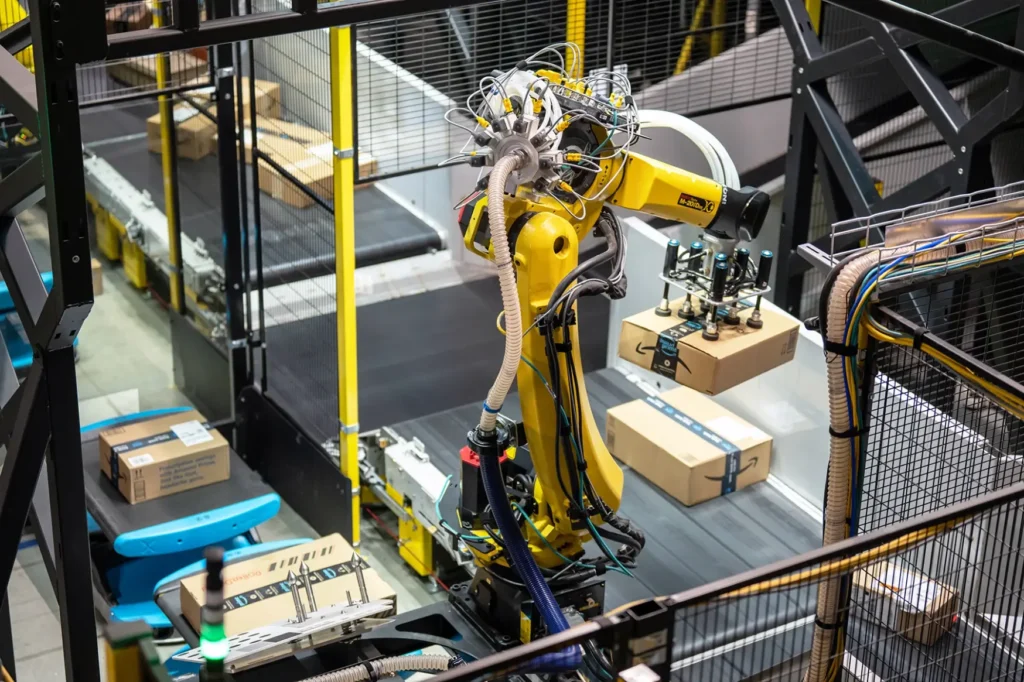
Robin’s vision system spots and picks individual packages from the conveyor. (Source)
Proteus, Amazon’s first fully autonomous mobile robot, moves those containers across the warehouse. Using AI and onboard sensors, it navigates safely around employees without relying on fixed paths or fenced-off work areas.
Managing thousands of robots under one roof takes another layer of AI. Amazon’s DeepFleet foundation model optimizes robot routes, eases congestion, and improves travel efficiency by 10%. According to Amazon, these gains reduce repetitive lifting, improve workplace safety, and free employees to focus on more technical work.
Automakers are increasingly turning to humanoid robots for assembly tasks once handled entirely by people. Unlike conventional industrial robots, these systems are built to operate in human spaces while taking on a wide range of production tasks.
One of the largest deployments comes from Hyundai Motor Group and its robotics subsidiary, Boston Dynamics. Hyundai plans to deploy 25,000 Atlas humanoid robots across its Hyundai and Kia facilities, accounting for most of the 30,000-unit annual production target it aims to reach by 2028. The rollout begins with parts sequencing at Hyundai’s Metaplant in Georgia, then expands to more assembly tasks over time.
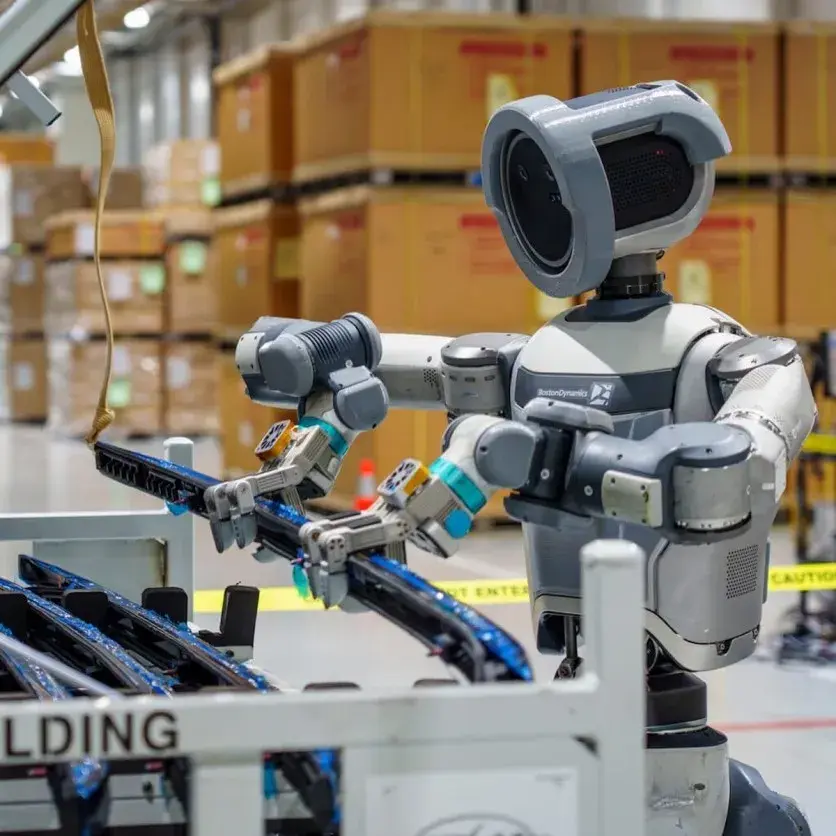
Boston Dynamics’ Atlas Humanoid Performing Material-Handling Tasks on a Factory Floor (Source)
Atlas isn’t the only Boston Dynamics robot on Hyundai’s floors. Its four-legged Spot robot is already at work inspecting weld quality, using AI and computer vision to flag defects while keeping workers out of hazardous areas. Together, the two show how a single manufacturer is layering humanoid and mobile robots across different stages of production.
Other automakers are also moving in the same direction. For example, at BMW’s Spartanburg plant, Figure’s humanoid robot spent 11 months inserting sheet metal parts into chassis fixtures, contributing to the production of more than 30,000 BMW X3 vehicles. Similarly, Mercedes-Benz is training Apptronik’s Apollo humanoid robot through teleoperation to move components and perform quality inspections before carrying out these tasks more independently.
If automotive assembly is about flexibility, aerospace is about precision and that changes what robots need to do. Consider a single commercial aircraft. It contains more than one million fasteners, many of which must be positioned or drilled to millimeter or even micrometer accuracy. Doing this by hand is physically demanding and leaves room for error.
Airbus uses robotic systems to drill the thousands of precision holes needed to assemble the A350 XWB’s composite wings and fuselage, improving accuracy while cutting production time. Meanwhile, Boeing has integrated robotics throughout aircraft production as well. Its Flex Track automated drilling system travels along the exterior of the 777, drilling and countersinking holes faster and more consistently than manual methods.
Painting is another strong example. Boeing’s 19-axis robotic painting system can coat a 777 wing in about 24 minutes, compared with roughly four hours by hand, and delivers a more uniform finish. Simply put, in aerospace, even small variations can affect the quality of the final aircraft. Robotic systems let manufacturers repeat these high-precision tasks reliably while reducing errors and the physical strain of repetitive work.
Factories and aircraft plants are controlled environments. But farms are the opposite, with shifting weather, uneven terrain, and obstacles that change from one day to the next.
Those demands only grow as farmers face deepening labor shortages. The American Farm Bureau Federation estimates that about 2.4 million farm jobs need filling each year, while the average U.S. farmer is now 58 years old. In response, manufacturers are building autonomous machines that can take on more fieldwork with minimal human supervision.
John Deere’s autonomous 9RX tractor is an interesting example. It uses 16 cameras for a 360-degree view of its surroundings, while dual NVIDIA processors continuously analyze the environment, detect obstacles, and steer the tractor through the field on its own.
Compared with the previous generation, the autonomous 9RX runs at up to 40% higher top speeds, letting farmers cover more ground during the narrow planting and harvesting windows each season. Autonomous equipment like this helps farmers manage larger areas with far less manual effort, making it easier to keep pace with the demands of modern agriculture.
Applications of artificial intelligence in robotics related to humanoid robots grab most of the headlines, but many of today’s most valuable robotics examples are far quieter like routine inspection and maintenance. Across factories, warehouses, and industrial facilities, robots enable teams to inspect products, monitor equipment, and catch problems before they halt production.
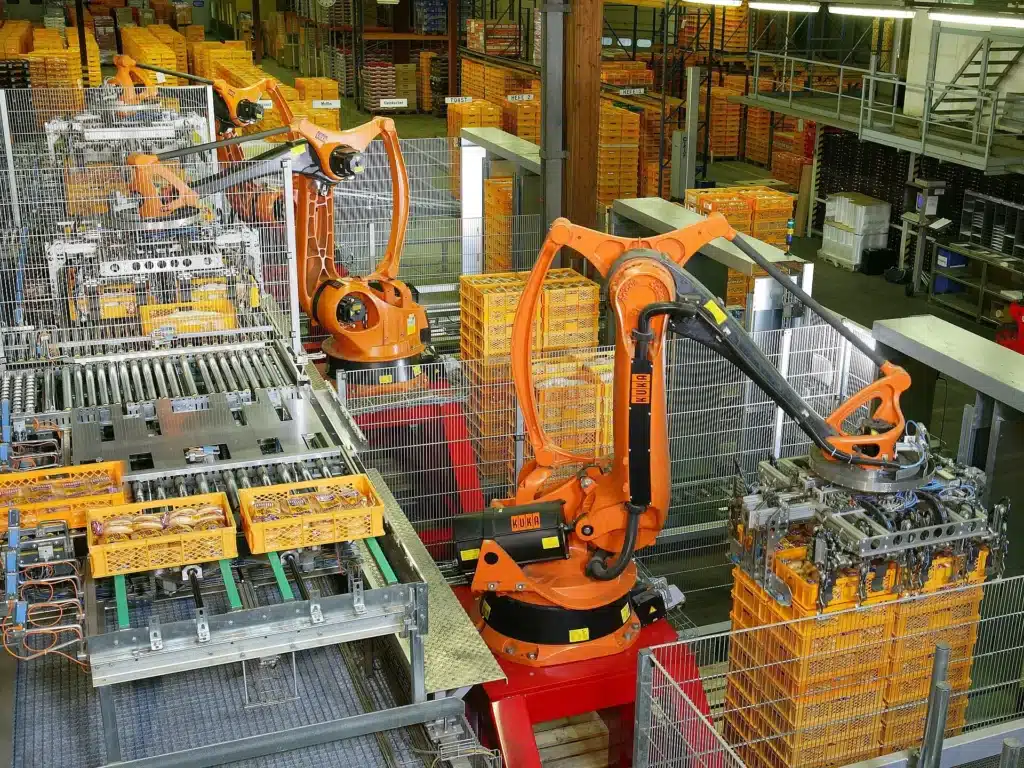
Industrial Robots Palletizing Packaged Goods on a Factory Line (Source: Wikimedia Commons)
For instance, AI-powered vision systems can inspect products as they move along conveyor belts, identifying defects in real time. At a technical textile plant, Robro Systems’ Kiara Vision AI reduced defect rates by 30% and increased inspection speed by 25%.
Also, inspection doesn’t stop at production lines. Robots are being used to monitor equipment in places that are difficult or hazardous for people to access.
Boston Dynamics’ Spot performs routine inspections in factories, power plants, construction sites, and other industrial facilities. At AB InBev’s brewery in Leuven, Spot performs around 1,800 inspections every week. During its first six months, it detected nearly 150 anomalies, helping reduce average repair times from several months to just 13 days.
Similar results have been seen at Michelin’s tire plant in Lexington, South Carolina. Spot completed inspection missions across about 700 assets, generating 72 maintenance work orders that made it possible for teams to identify potential issues before they led to equipment failures.
These applications of robotics show how physical AI is letting companies detect problems earlier, reduce downtime, and improve workplace safety by taking on repetitive inspection and maintenance tasks.
So far, we’ve discussed how robots can sort packages, assemble vehicles, inspect equipment, and navigate open fields. These examples of robotics look nothing alike, yet they all depend on the same key factor behind the scenes: high-quality training data.
That robot data is what teaches robots to recognize objects, read their surroundings, and make reliable decisions. However, building that kind of training robot data takes far more than collecting images or sensor readings.
That’s where a data expert like Objectways can help AI and robotics teams collect, process, and annotate multimodal data, spanning images, videos, sensor data, and human demonstrations. Paired with quality assurance, this work produces the production-ready datasets that reliable physical AI systems depend on.
If you’re weighing applications of robotics for your own operations, here are some practical tips to keep in mind:
The most successful companies don’t try to automate everything at once. They start with one well-defined problem, prove the value, and then expand from there.
Applications of robotics have moved well beyond the research lab. Robots are already automating work in warehouses, factories, farms, and countless other industries, and as they get better at reading their surroundings and adapting to change, they’ll take on even more real-world tasks.
Every one of those deployments rests on a data foundation. Robots need high-quality training data to learn how to see, understand, and interact with the world around them, and building it is where most projects stall.
That’s the gap Objectways closes, collecting, processing, and annotating the multimodal data that reliable physical AI systems depend on. If you’re building a robotics project, Objectways can support your data collection, annotation, and validation needs. Reach out to our team to learn more.
Robotics brings together engineering, computer science, and technology to build machines that can perform or replace human actions and decisions. Its applications range from assembling cars and sorting warehouse packages to inspecting hazardous sites and harvesting crops.

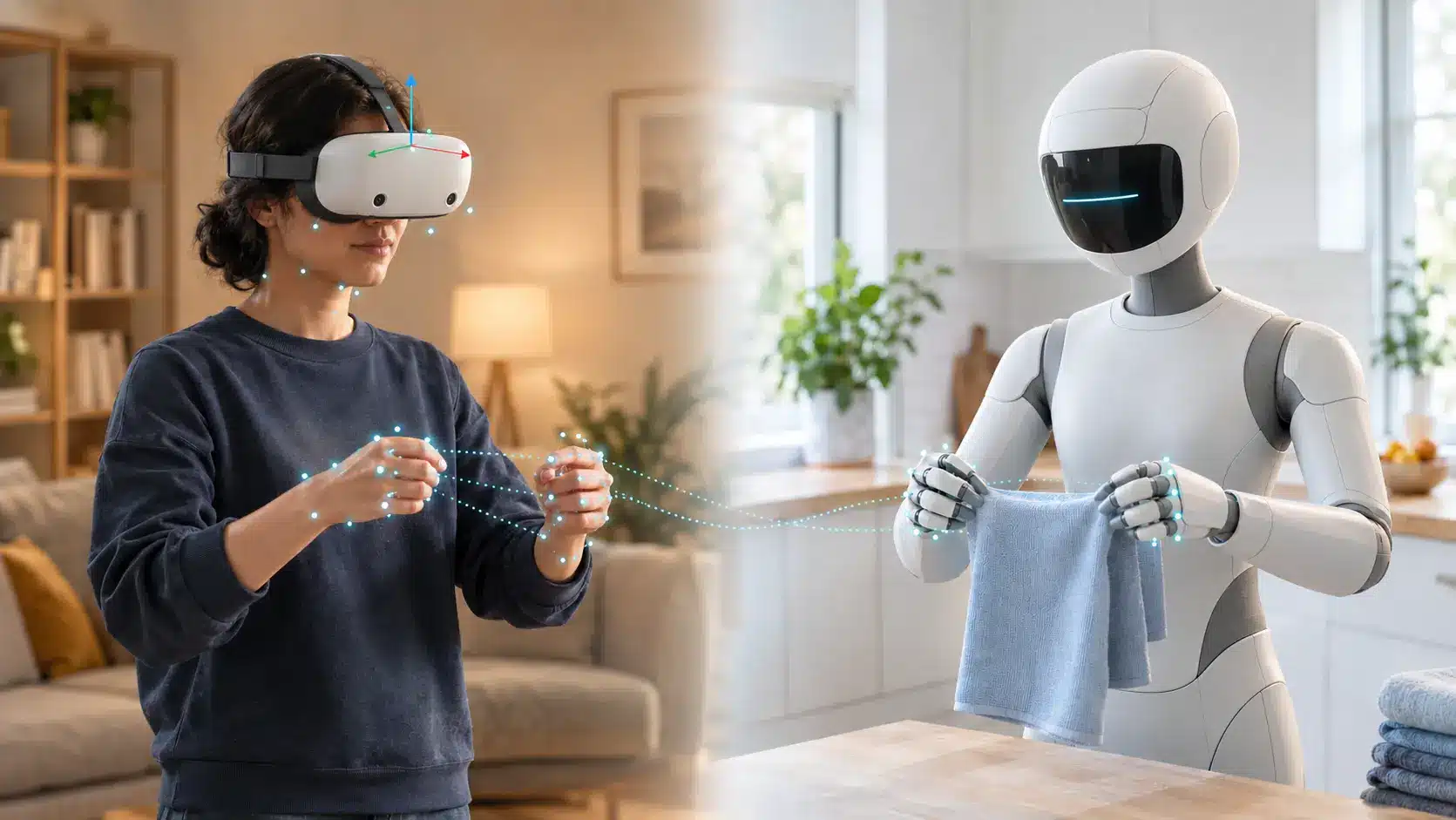
See how SLAM VR tracking works inside a headset, where it fails, and why a drifting head pose weakens egocentric and teleoperation data.
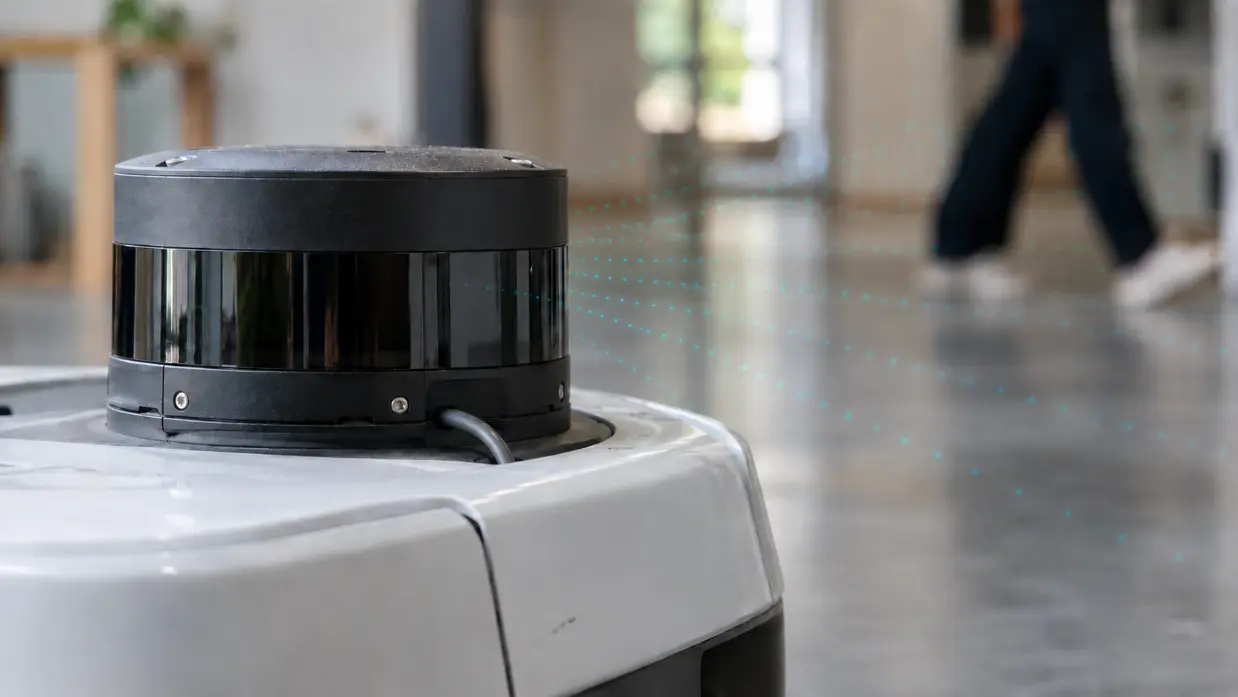
Explore the main types of lidar sensors, how they measure distance, and which types of robots are best suited to 2D, 3D, flash, and FMCW...