As humans, we pick up some skills by watching others, like copying a parent to tie our shoes. Others, like riding a bike, only come from falling and trying again.
Robots learn in much the same way. Some learn by copying human movements, while others practice a task repeatedly until they find a way to complete it. Interestingly, that forms the core difference in imitation learning vs reinforcement learning, the two main ways robots learn new skills.
Imitation learning trains robots to copy human demonstrations. Reinforcement learning, on the other hand, lets robots learn through trial and error, rewarding actions that bring them closer to a goal.
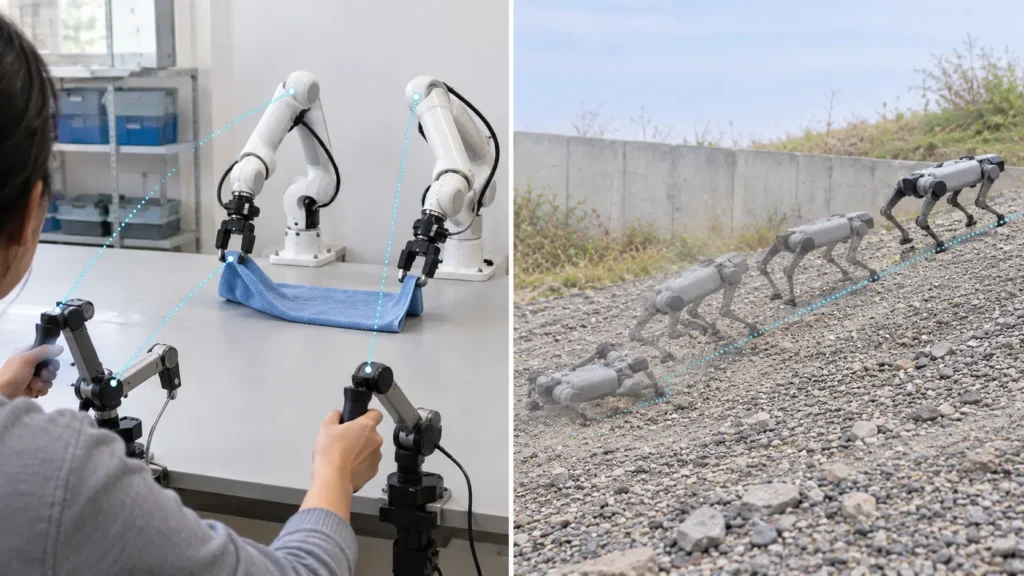
For example, Boston Dynamics used imitation learning to teach its humanoid robot Atlas to fold spare legs for Spot, the company’s four-legged robot. Operators wearing VR headsets guided Atlas through the task, and it later repeated these skills 1.5 to 2 times faster.
Meanwhile, Spot learned to walk more reliably through a different approach. It ran more than a million simulated trials before its upgraded controller reached customer robots through a software update.
So how does a team decide which learning approach works best for a robot? Often, it depends on the available training resources. Imitation learning needs good human demonstrations for a robot to follow. Reinforcement learning requires a clear reward signal and a safe environment, usually a simulation, where the robot can practice without causing damage.
Some robots even use both approaches together. Demonstrations give them a strong starting point, and practice helps them fix mistakes and handle situations the demonstrations didn’t cover.
In this article, we’ll break down imitation learning vs reinforcement learning in robotics, how each method works, and when to use one, the other, or both. Let’s get started!
Before we get into how each method works, let’s compare imitation learning vs reinforcement learning side by side. The key difference comes down to where a robot learns from.
With imitation learning, also called learning from demonstration, the robot learns from what a person shows it. Meanwhile, reinforcement learning lets it learn from its own attempts, keeping what works and dropping what doesn’t.
Here’s a closer look at how the two approaches differ:
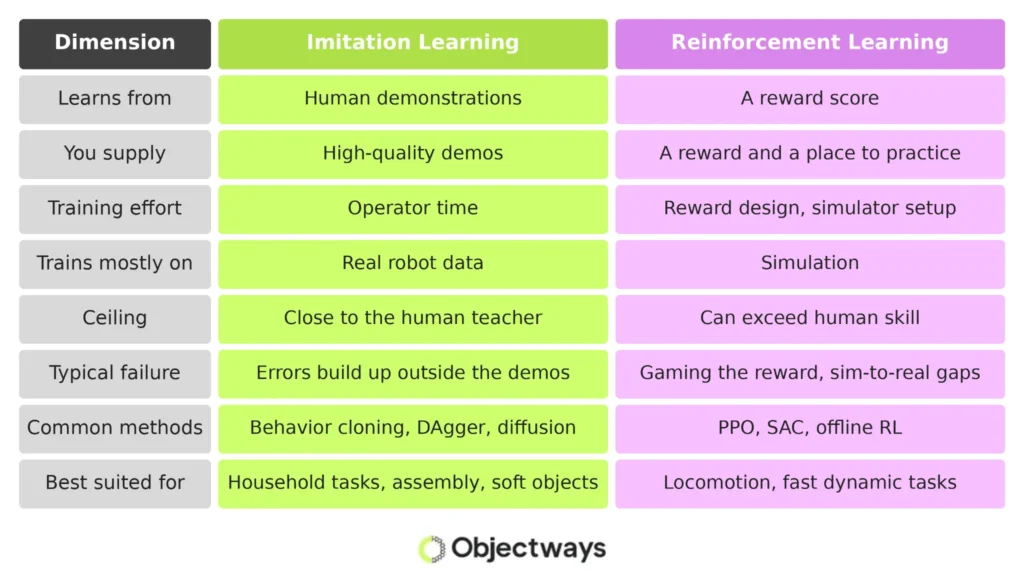
These differences become clear when you look at real robots. ALOHA, a low-cost robot that a person controls through a matching pair of smaller arms, shows both the strength and the limit of imitation learning. After just 10 minutes of demonstrations, it learned to slot a battery into a remote 96% of the time.
But it failed its first 10 attempts at unwrapping candy because even the person demonstrating struggled to spot the wrapper’s seam. The robot could only be as good as the demonstrations it learned from.
Reinforcement learning, on the other hand, can take a robot beyond what people show it. Sony AI’s table tennis robot, Ace, learned its rally shots entirely in simulation and went on to beat three of five elite players. In other words, the right approach depends on the task and the training resources available.
Most imitation learning systems start with behavior cloning, also called behavioral cloning. It treats learning as a supervised learning problem, where the robot learns from labeled examples of what a person does. Each example pairs what the robot sees, such as camera images and joint positions, with the action the person takes at that moment. After seeing enough examples, the robot learns which action to take in similar situations.
This approach has one key limit. The robot can only learn from situations covered by its demonstrations. Even a small mistake can put it in a position it never saw during training, where it has to guess what to do next. Each guess can lead to another mistake, pulling it further off course, a problem known as compounding errors.
To handle this, researchers developed methods like Dataset Aggregation (DAgger), which teach the robot to recover from its own mistakes. In DAgger imitation learning, the robot performs tasks on its own while a person labels the correct action in the situations it reaches, including ones its own mistakes led it into. These corrections are added to the training data, the robot learns from the updated data, and the process repeats.
A recent study put this approach to the test, training a robot to handle household tasks such as preparing breakfast bowls and boxing books. Operators took over whenever the robot was heading toward a failure and added corrections to its training data. The team repeated this process over four rounds, with the robot needing less help after each one.
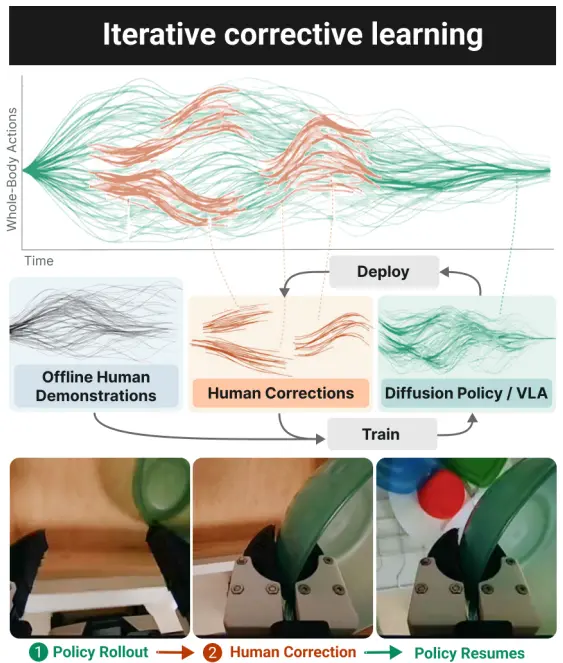
Those corrections made a big difference. The robot’s average success rate rose to 94%, compared with 58% when it received the same amount of extra data from regular demonstrations. Simply put, showing a robot where it went wrong and how to fix it can teach it more than giving it more examples of successful tasks.
What happens when a task can be done in more than one way? For example, a robot pushing a block around an obstacle could go left or right. Both paths work, but the robot needs to pick one.
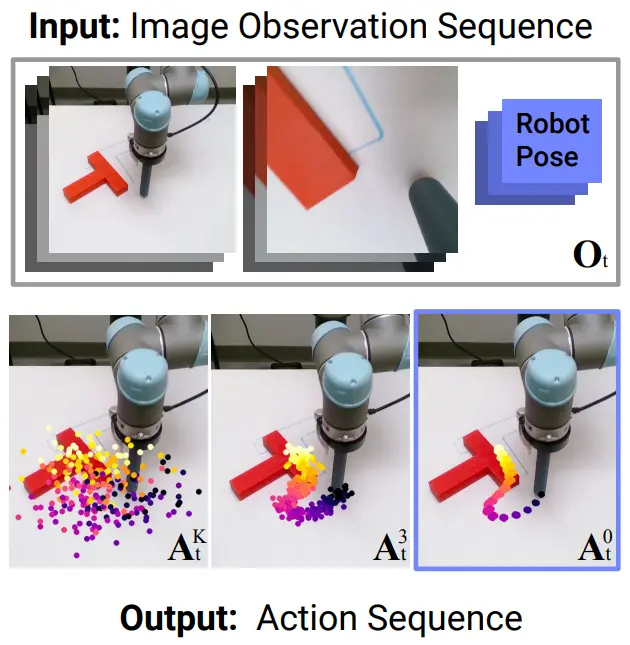
Older imitation learning methods have struggled with this. If demonstrations show two different ways to complete a task, the robot may average the movements and end up taking a path that leads straight into the obstacle. One way to solve this is through a diffusion policy. Like image models that create pictures, it starts with random noise and gradually turns it into a sequence of movements, so the robot commits to one workable path instead of mixing the two.
The original Diffusion Policy study tested this idea on a task called Push-T. The robot had to push a T-shaped block into a target area, and it could approach the block from either side. Since both routes worked, the task showed whether the robot could commit to one path instead of getting stuck between the two.
Another approach advancing robot learning is action chunking with transformers (ACT). It’s a lightweight method that predicts a few steps at a time, which reduces compounding errors.
Imitation learning is also the main method used to train vision-language-action (VLA) models. These models let robots follow written or spoken instructions.
Not every skill can be easily demonstrated. For tasks like walking or balancing, robots often learn better through practice, which is the idea behind reinforcement learning. It runs on a simple loop.
A robot tries an action, and a reward tells it how well that action went. Based on that feedback, the robot adjusts its policy, the rule it uses to decide what to do next. Over many rounds, it learns which actions lead to the best results.
All those rounds add up quickly, which is why teams often train in simulation. They can run thousands of virtual robots at once, each in slightly different conditions. If a virtual robot falls, nothing breaks. Training on real robots, on the other hand, takes longer, costs more, and each fall risks damaging the hardware.
Here are three key ideas behind reinforcement learning in robotics:
One research team tested these ideas by training 4,096 simulated four-legged robots in parallel on a single graphics processing unit (GPU) using PPO. Each robot received rewards for following speed commands, moving smoothly, and avoiding collisions.
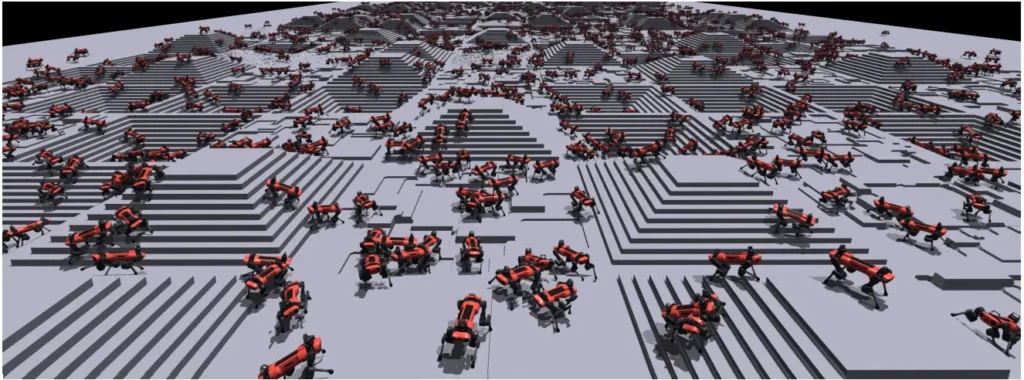
The robots learned to walk on flat ground in under 4 minutes and to handle stairs and slopes in about 20 minutes. During early training, some developed unwanted habits, such as dragging a leg. The team adjusted the reward weights to correct these movements before transferring the final policy to a real robot, which could walk up and down stairs.
However, skills learned in simulation don’t always transfer perfectly to physical robots. Differences between simulated conditions and the real world make sim-to-real reinforcement learning an ongoing challenge.
Copying a person’s movements only goes so far. What if a robot could figure out what the person is actually trying to achieve?
That’s the idea behind inverse reinforcement learning, which combines imitation learning and reinforcement learning. The robot watches a person complete a task and works out what they are trying to achieve. It then uses reinforcement learning to practice reaching the same goal on its own.
This is useful for tasks that are easy to demonstrate but difficult to describe with a reward. For example, a person can place a mug neatly on a plate without thinking about every movement. But turning “place it neatly” into a formula means deciding how close the mug should be, how gently it should be placed, and which grip to use. Missing one detail can lead the robot to learn the wrong behavior.
A related method, Generative Adversarial Imitation Learning (GAIL), skips the hand-written reward altogether. It uses a judge model that looks at movements from both the robot and an expert and tries to tell them apart. At first, the robot’s clumsy movements are easy to spot. It keeps adjusting until the judge can no longer tell the difference, and by then it moves much like the expert.
A recent example comes from MPAIL2, a method in which a real robot arm learned pick-and-place tasks, such as placing a mug on a plate, within an hour. It learned only by watching recorded demonstrations, with no action labels or hand-written reward. The trade-off was that the robot still needed to practice on real hardware during training.
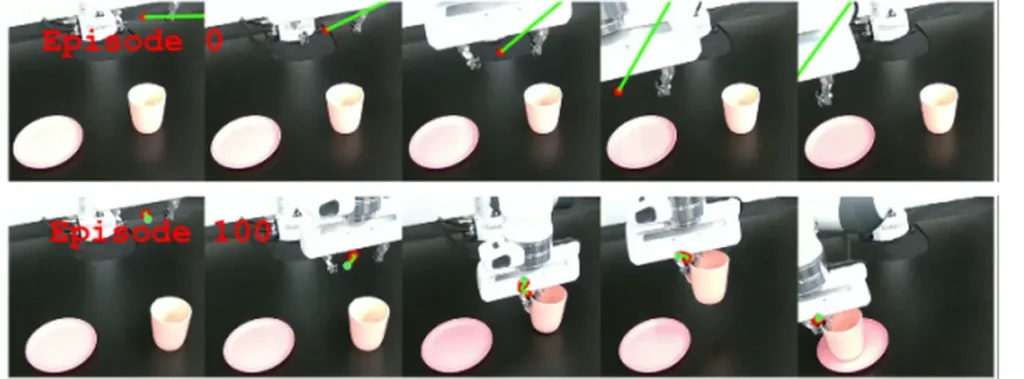
The results show how well MPAIL2 performed on one pick-and-place task. It succeeded 82% of the time, compared with 12% for behavior cloning. Reinforcement learning with a hand-written reward didn’t succeed at all. The robot also learned to retry missed grasps on its own, even though no one had taught it to do that.
Deciding on imitation learning vs reinforcement learning depends on the task and the training data available. Teams usually look at what they can obtain more easily, whether that’s clear examples of people doing the task or a good way to judge the robot’s attempts.
Let’s see which method works best for three common types of robot tasks:
An essential takeaway is that using both methods can make a robot far more reliable. RL-100, for example, is a training framework that builds on Diffusion Policy and combines imitation learning with reinforcement learning.
Researchers used it to train a robot in three stages. The robot first learned from human demonstrations, then improved by studying its own recorded attempts through offline reinforcement learning. Finally, it practiced briefly on the real robot.
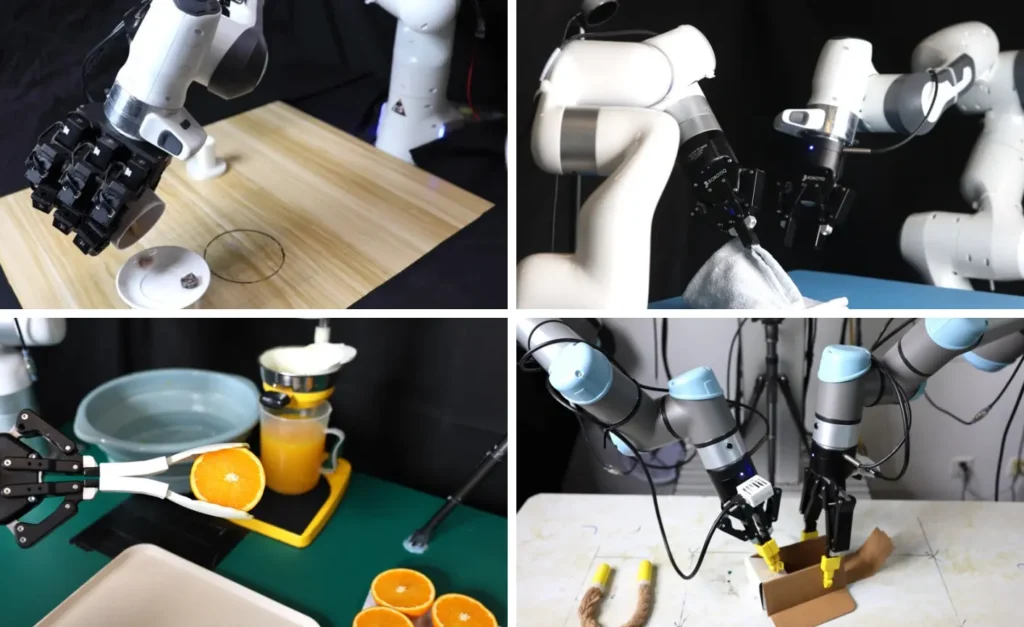
Across tasks such as pouring and folding cloth, the robot completed all 1,000 test runs successfully. On several tasks, it worked as fast as expert human operators or even faster. A version designed to make juice also served customers in a shopping mall for about seven hours without a single failure.
Beyond reliability, combined training helps robots handle change, a core idea in adaptive robotics. Many recent methods follow the same pattern, training robots on human demonstrations, their own practice, and human corrections.
Whichever method a team chooses, a robot is only as good as the data it learns from. What that data looks like, though, depends on how the robot learns.
Imitation learning relies on high-quality human demonstrations, usually collected through teleoperation or handheld grippers. Variety is just as important as quality. Recording the same task across different scenes, objects, and operators helps the robot handle situations it hasn’t seen before, not just repeat the exact ones it was shown.
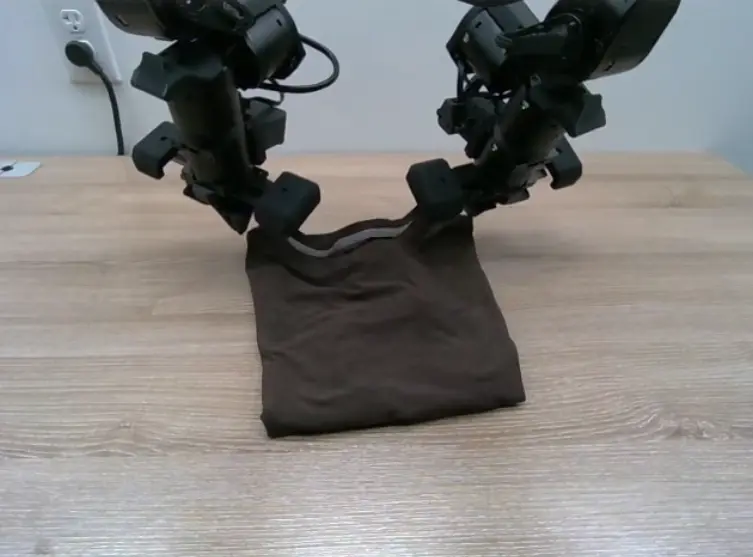
Different operators can record the same task, but each should follow a similar technique so the robot isn’t learning from conflicting examples. Camera frames, joint readings, and gripper signals also need to line up in time, so the robot can match what it sees with the right action.
Reinforcement learning needs a different kind of record. Each attempt should show whether the robot succeeded or failed, since this information shapes its rewards. Logs of human interventions are useful too. They show when someone stepped in, what went wrong, and how the robot was corrected.
Even when most practice happens in simulation, real-world recordings are still essential. Teams use them to check whether a robot can perform the same tasks on actual hardware.
Whether a team uses imitation learning, reinforcement learning, or both, collecting and labeling this data takes considerable effort, and many teams bring in a data partner to help. At Objectways, we enable robotics teams to build high-quality training datasets, including teleoperation and UMI gripper data collection and detailed annotation of robot episodes.
Like people, robots learn by watching or by practicing. Copying a person gives them a head start, while practice can take them further. Many of today’s most capable robots use both, so imitation learning vs reinforcement learning is rarely an either-or choice.
Either way, a robot is only as good as its training data. Poor demonstrations teach the wrong movements, and missing failure records or human corrections leave a robot unprepared when things go wrong. What teams record, how they label it, and which situations it covers all shape what the robot learns.
Looking for training data for robots that learn from demonstrations, practice, or both? Reach out to Objectways to learn more about our robotics data collection services.
Robots learn by copying people or by practicing on their own. Imitation learning teaches them from human demonstrations. Reinforcement learning rewards them for actions that bring them closer to a goal. Many robots use both.


Learn how keypoint annotation turns videos of people and objects into robot training data, from hand poses and skeletons to grasp points and quality checks.
Learn how a pick and place robot is trained to sort automotive parts using UMI gripper demonstrations, which parts suit it, and what to avoid