Watch, copy, repeat. That’s how humans learn most physical skills. From a child carefully pouring water to someone figuring out a new recipe in the kitchen, we rarely rely on only written instructions. Instead, we watch someone else do it, try to imitate their actions, and gradually improve with practice.
This way of learning is powerful because it works in messy, real-world situations where every detail can’t be spelled out in advance. We don’t calculate exact angles or forces. Instead, we rely on observation, intuition, and repetition.
Researchers are applying this same principle to machines. Instead of programming robots step by step for every possible scenario, they train them using human demonstrations. A robot might watch someone cook or handle objects, then learn to replicate those actions on its own. This approach, known as imitation learning, is a key method being used to build physical AI systems like robots

An Example of a Robot Handling Ingredients While Cooking (Source: Pexels)
As robots begin to move out of controlled lab settings and into real-world environments like factories, warehouses, hospitals, and even our homes, the challenge of teaching them becomes much harder. It isn’t practical to manually code every possible action or scenario. Real-world tasks are unpredictable, require fine motor control, and vary slightly every time they are performed.
That’s why imitation learning is making a positive impact. By observing and learning from human demonstrations, robots can pick up complex behaviors more quickly and adapt more flexibly, much like we do.
Let’s explore how imitation learning works, why it matters for physical AI, and how it stacks up against other ways of training robots.
Imitation learning has roots going back to the late 1980s as a way to teach robots by showing them examples instead of programming every step. Early systems like CMU’s ALVINN proved that machines could learn by copying human behavior, leading to today’s cutting-edge robots that learn tasks by observing demonstrations.
This method of learning closely mirrors how humans learn physical skills. By watching others and practicing ourselves, we gradually figure out which movements produce the right results. Imitation learning applies this same principle to robots and other physical AI systems.
Imitation learning focuses on connecting what the robot sees to what it should do. When it encounters a certain situation, it uses past examples to decide the next action. Instead of following a fixed set of rules, it learns patterns from demonstrations.
For example, a warehouse robot might watch a person pick up packages from a conveyor belt and place them into containers. Over time, it learns how to position its arm, adjust its grip, and handle small changes in where objects are.
Whereas in rule-based systems, engineers have to define instructions for every possible situation. But in the real world, things are always changing, which makes that approach difficult to scale.
Recent systems like GENE-26.5, a robotic brain trained on large amounts of human demonstrations, show how far imitation learning has come. Robots using these methods can perform complex, multi-step tasks like preparing meals, cracking an egg with one hand, coordinating both hands to make a smoothie, or carrying out precise lab work.

Genesis AI’s Dexterous Robotic Hands Preparing a Smoothie (Source)
So, where does traditional robot programming break down? Rigid rules and processes work well in controlled environments with fixed patterns. In factories, for instance, industrial robots have long been used to repeat the same movement thousands of times with high precision.
If an object always appears in the same place and nothing changes, engineers can program exact instructions using languages like RAPID or KUKA Robot Language. This works well for predictable, repetitive tasks.

A Look at Using a Robotic Programming Language (Source)
The problem is that most real-world environments aren’t that stable. Small changes in object position, shape, or movement can completely change how a robot needs to respond. Covering every possibility would require writing instructions for thousands of edge cases, which quickly becomes impractical.
Take a warehouse robot picking up boxes. The size, weight, and position of each package can vary throughout the day. Programming precise rules for every variation would be time-consuming and constantly need updates.
Imitation learning is a more flexible alternative. Instead of relying on hard-coded rules, robots learn from human demonstrations and apply those patterns to new situations. This makes them far better suited for environments where things are always changing.
Imitation learning makes a real difference when it comes to safety and reliability in real-world environments. In places like factories and hospitals, mistakes can be costly and sometimes dangerous, which makes trial-and-error approaches difficult to rely on.
By learning from human demonstrations, robots can start with examples of correct behavior instead of learning through repeated failures. This makes them more reliable from the beginning, especially in tasks where precision matters.
Another advantage is the type of data these systems can learn from. Demonstrations can be captured using egocentric video, teleoperation, motion capture, and sensor-equipped grippers, recording visual input along with motion, force, and timing. This makes it possible for robots to understand how tasks should be performed in physical environments, which is especially important for delicate operations like assembly or tool handling.
Imitation learning trains robots by enabling them to observe how humans perform a task and then learn to replicate those actions. The system learns patterns directly from demonstrations.
The process usually begins with a human expert performing a task. Here’s a quick look at the steps involved:
As you explore how robots learn using AI, you might be wondering how imitation learning compares to other approaches like reinforcement learning and rule-based systems. Each method takes a slightly different approach to helping robots act in the real world.
Imitation learning is often used to get robots started quickly by learning from human demonstrations. It makes the most sense for tasks where human expertise already exists, especially those that involve complex movements or coordination that are hard to describe with rules.
However, it depends on the examples it has seen, which can make it harder to handle unfamiliar situations. Reinforcement learning takes a different approach. Instead of learning from demonstrations, the robot improves through trial and error, using feedback from its environment to guide its behavior. This enables it to adapt and find solutions even when it hasn’t seen a situation before.
Next, let’s explore how imitation learning and reinforcement learning compare.
When it comes to reinforcement learning, an AI model integrated into the robot learns by interacting with its environment. The robot takes actions, observes what happens, and receives feedback in the form of rewards or penalties. Over time, it adjusts its behavior to improve its decisions and achieve better outcomes.
The system can discover effective strategies and handle more complex tasks. However, training reinforcement learning models for robotics can take a long time because the model may require thousands, millions, or even billions of interactions before learning an effective way to complete a task.

Reinforcement Learning Vs Imitation Learning (Source)
On the other hand, imitation learning takes a more direct approach. Instead of relying on trial and error, an AI model integrated with the robot learns by observing human demonstrations and imitating their actions. This often makes training faster for tasks where human expertise already exists, because the model begins with examples of successful behavior rather than learning entirely from scratch.
One key trade-off is that reinforcement learning can sometimes discover strategies that humans might not anticipate, while imitation learning depends heavily on the quality and variety of the demonstrations. If the training data is too limited or doesn’t cover enough scenarios, the robot may struggle to handle unfamiliar situations.
Because of this, many next-generation robotics systems use both approaches together. Imitation learning is often used to teach the robot the basics of a task, while reinforcement learning is used to refine performance, improve efficiency, and help the robot adapt to more complex environments.
Now that we have a better understanding of how imitation learning works, let’s dive into different types of imitation learning. The approach used usually depends on the task, how much expert input is available, and how well the robot needs to handle situations it hasn’t seen before.
We have already seen that reinforcement learning works using rewards and penalties. In inverse reinforcement learning, the process is reversed. Instead of learning behavior from a predefined reward, the AI model tries to infer the reward or objective behind an expert’s actions.
This is still a form of imitation learning because the system learns from human demonstrations. Instead of directly copying the actions, it tries to understand the goal the expert is aiming for.
Once that objective is inferred, reinforcement learning can then be used to help the robot perform the task in new situations while still aiming for the same outcome.
Since IRL focuses more on the intent behind the behavior rather than copying exact movements, it can sometimes handle new situations more effectively. However, it is also more computationally complex than simpler approaches like behavioral cloning.
Behavioral cloning is the most direct form of imitation learning. An AI model learns by mapping what it sees to the right action using examples from human demonstrations, similar to how supervised learning works with labeled data.

A robot playing chess is a classic example of imitation learning and behavioral cloning. (Source: Pexels)
When the robot encounters a situation similar to what it has seen during training, it tries to reproduce the demonstrated action. It makes behavioral cloning relatively simple and effective for structured or repetitive tasks.
However, it has its limits. If the robot ends up in a situation that was not part of the training data, small mistakes can start to add up. Over time, these errors can compound, making it harder for the robot to recover and complete the task correctly.
To tackle the issue of errors building up over time, DAgger, short for Dataset Aggregation, was introduced as an improvement to behavioral cloning. The key difference is that the robot doesn’t just learn from the original demonstrations.
It also learns from its own mistakes, with a human expert providing corrections that are added back into the training data. Over time, this helps the robot handle new situations more effectively and recover when things don’t go as expected.
Regardless of the imitation learning technique used, this robotic learning approach depends heavily on the quality of the data used to train the robot, making the data pipeline a crucial part of building reliable physical AI systems.
Here are some crucial factors to consider:
To ensure these factors are handled correctly at scale, working with specialized data partners like Objectways can help streamline data collection, annotation, synchronization, and validation for physical AI training workflows.
As imitation learning becomes more common in robotics, the quality of training data plays a major role in how well these systems perform in real-world environments. Building reliable robots involves more than just collecting videos. It requires well-structured data, consistent demonstrations, and datasets that capture how tasks are actually performed in physical environments.
At Objectways, we help teams build and manage these data pipelines for physical AI systems. This includes creating and curating embodied AI datasets using teleoperation, egocentric recording, motion capture (MoCap), and multimodal sensor setups, along with organizing and preparing the data for model training.
Imitation learning is on track to become a foundation for more general-purpose physical AI systems. One of the biggest developments is the rise of robotics foundation models trained on massive demonstration datasets collected across different robots, environments, and tasks. Instead of training every robot separately, these models aim to help robots generalize skills across multiple situations, similar to how large language models generalize across text tasks.
Other than reinforcement learning, imitation learning is also being combined with systems like Vision-Language-Action (VLA) models and world models. This allows robots to understand visual inputs and spoken instructions together, predict outcomes before taking actions, and improve performance through additional practice and feedback. These technologies are making it easier for robots to become more adaptive in dynamic real-world environments.
At the same time, companies are increasingly using simulation environments, multimodal sensor data, and synthetic training data to scale robot learning more efficiently. Major organizations like NVIDIA and Google DeepMind are already developing general-purpose robotics models, signaling a shift toward robots that can learn, adapt, and perform a wider variety of tasks with less manual programming.
Just like humans, robots can learn various physical skills by watching others perform them. Whether it’s picking up objects, assembling components, or assisting in surgery, these abilities come from demonstrations and gradual improvement rather than fixed instructions.
As physical AI systems become more common in factories, warehouses, hospitals, and homes, imitation learning is driving robots towards being more adaptable and reliable in real-world environments.
At the same time, their performance depends heavily on the data they learn from. High-quality demonstrations, well-aligned data, and strong training pipelines are what enable robots to operate safely and consistently.
Want help building the data behind your physical AI or robotics project? Our team at Objectways would love to talk.
Learning by imitation, or imitation learning, is a method in which robots or AI systems learn tasks by observing and copying human demonstrations rather than being programmed step by step. The system learns the connection between what it sees and the actions needed to complete the task successfully.

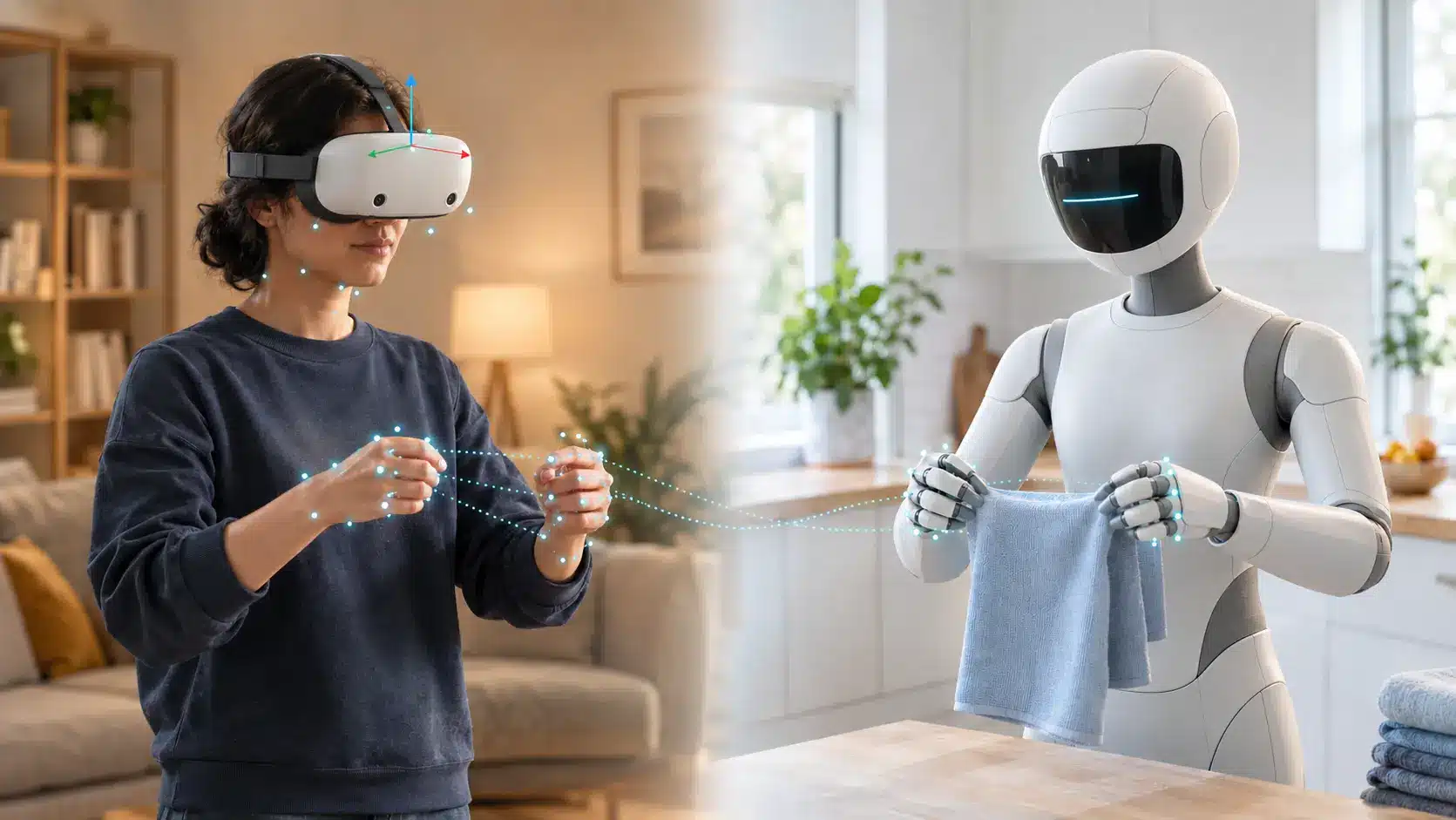
See how SLAM VR tracking works inside a headset, where it fails, and why a drifting head pose weakens egocentric and teleoperation data.
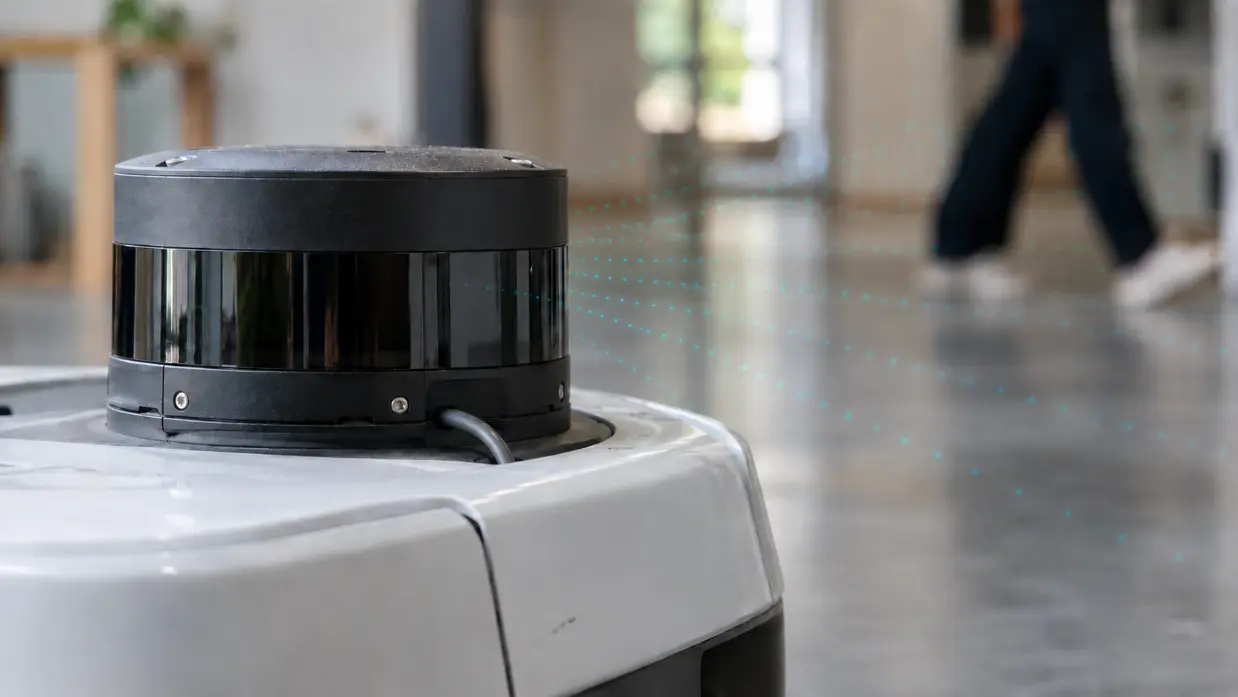
Explore the main types of lidar sensors, how they measure distance, and which types of robots are best suited to 2D, 3D, flash, and FMCW...