Humans make sense of the world by combining multiple senses at once. When you walk into a room, you typically don’t rely on just your eyes to understand your surroundings.
You might hear a sound and turn your head. Judge how far away something is before you reach for it or notice movement that isn’t directly in front of you. Nowadays, AI robots are expected to operate similarly.
They are being used in places like factories, hospitals, and warehouses where environments are dynamic and constantly changing. People move around, objects shift from place to place, and many tasks don’t follow a fixed pattern.

An AI Robot Within a Factory (Source: Pexels)
In such environments, a robot needs a lot more input than images or video clips from a camera to make the right decision. However, many systems today still rely on just one type of input, such as vision. While vision helps a robot see objects, it can’t tell how far away something is, process sounds, or fully understand motion over time.
Physical AI systems driven by a multimodal data stack move beyond this limitation by combining multiple sources of information. They bring together visual data with depth, audio, and motion signals to create a more complete understanding of the environment.
Instead of relying on a single input, these multimodal data systems interpret multiple signals at the same time, allowing them to respond more accurately in real-world situations. By combining these data types, AI systems can understand what is present, how far things are, what is changing, and how actions are happening over time.
Let’s dive in and see how different types of multimodal data support physical AI systems!
Physical AI refers to systems that can sense their surroundings and act in the real world. These systems include AI robots, autonomous machines, and smart industrial systems that need to make decisions while interacting with people, objects, and spaces.
Such systems rely on real-world signals rather than using pre-programmed digital inputs. They observe what is happening through multiple sensors, understand it, and respond through movement or action. For instance, a robot in a warehouse has to pick and place items, navigate to avoid objects and people, and adjust if something is out of place. This requires constant awareness and data processing.
A good example is the 4NE1 Gen 3 humanoid robot. It can move through unstructured spaces, work with humans, and adapt its actions based on what it senses in real time.

A Glimpse of the 4NE1 Gen 3 Humanoid Robot (Source)
This is what makes physical AI different from traditional AI. Traditional AI systems work with inputs like text, images, or audio in controlled settings. On the other hand, physical AI systems can be used directly in the physical world (real world), where every decision affects movement and interaction.
As more systems move into real, physical environments, they need better awareness. That’s why physical AI requires multimodal data. Combining different data signals from multiple sensors can help build a more reliable data stack. Multimodal data can be used to improve how AI systems understand and respond.
A multimodal data stack combines data like RGB (visual), depth, audio, and motion data. Each of these types of data adds a different layer of information to the AI system. Multimodal data makes it easier for the system to respond more accurately in real-world environments.
Next, let’s take a closer look at each part of the multimodal data stack and how it contributes to physical AI systems.
RGB (Red, Green, and Blue) data forms the visual base for most physical AI systems. It captures color images that help identify objects, surfaces, and the overall layout of a scene. This type of data is commonly used for tasks like object detection and basic navigation in AI robots.
For example, an AI robot can recognize items on a shelf, detect pathways, or identify tools needed for a task using visual data from RGB camera systems. However, vision alone doesn’t provide all the necessary details for some AI systems.
It may show what is present, but doesn’t explain how far objects are or how they are positioned in physical space. Two objects can look close in an image, but they may be far apart. This makes it difficult for the AI systems to judge things like depth, alignment, or physical interaction.
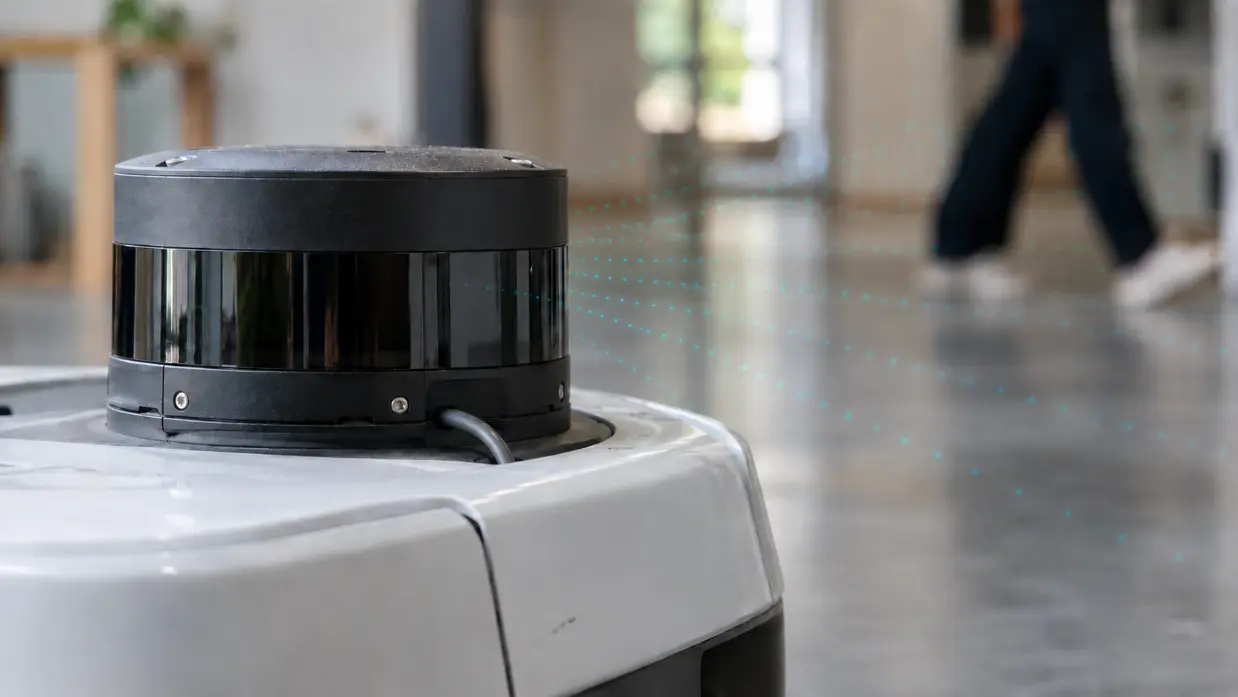
Depth data adds spatial understanding to what an AI system sees. It provides information about the distance, shape, and position of an object, helping the system or AI robot get a clearer, more accurate picture of the environment.
This is crucial for tasks that require precision. For instance, when an AI robot reaches for an object, it has to know how far to extend its arm and how close it is to nearby surfaces. Depth data also supports safe navigation and obstacle avoidance for mobile AI robots.
An interesting use case of depth data is that it can be used to create 3D maps of environments. By capturing structure and geometry, AI systems can plan movement and adjust to changes more effectively.
Audio data adds sound information that cameras can’t capture. It is collected using devices like microphones, which pick up sounds from the environment. These sounds can signal changes, ongoing activity, or even spoken instructions.
In many cases, audio provides early clues. A machine in a factory may start making a different noise before a fault becomes visible.
Audio also improves awareness in dynamic environments. Background sounds, movement noise, and sudden changes can help systems understand what is happening beyond the camera’s view. This is especially useful in busy settings where visual input alone isn’t enough.
Another important use of audio data is in human-to-robot interaction. It enables AI systems to process voice commands and respond to spoken instructions in real time.
In some cases, audio can even support event detection and spatial awareness. For example, a newer technology called Acoustic Detection and Ranging (ADAR) uses ultrasonic sound to detect people and objects in three dimensions. Instead of relying only on cameras or traditional sensors, it allows robots to “hear” their surroundings and understand space using sound waves.

An Example of an ADAR System Using Ultrasound to Detect People and Objects (Source)
This means a system can detect movement and presence even outside the camera’s line of sight. It helps robots stay aware of what is happening around them, especially in situations where visual data isn’t enough.
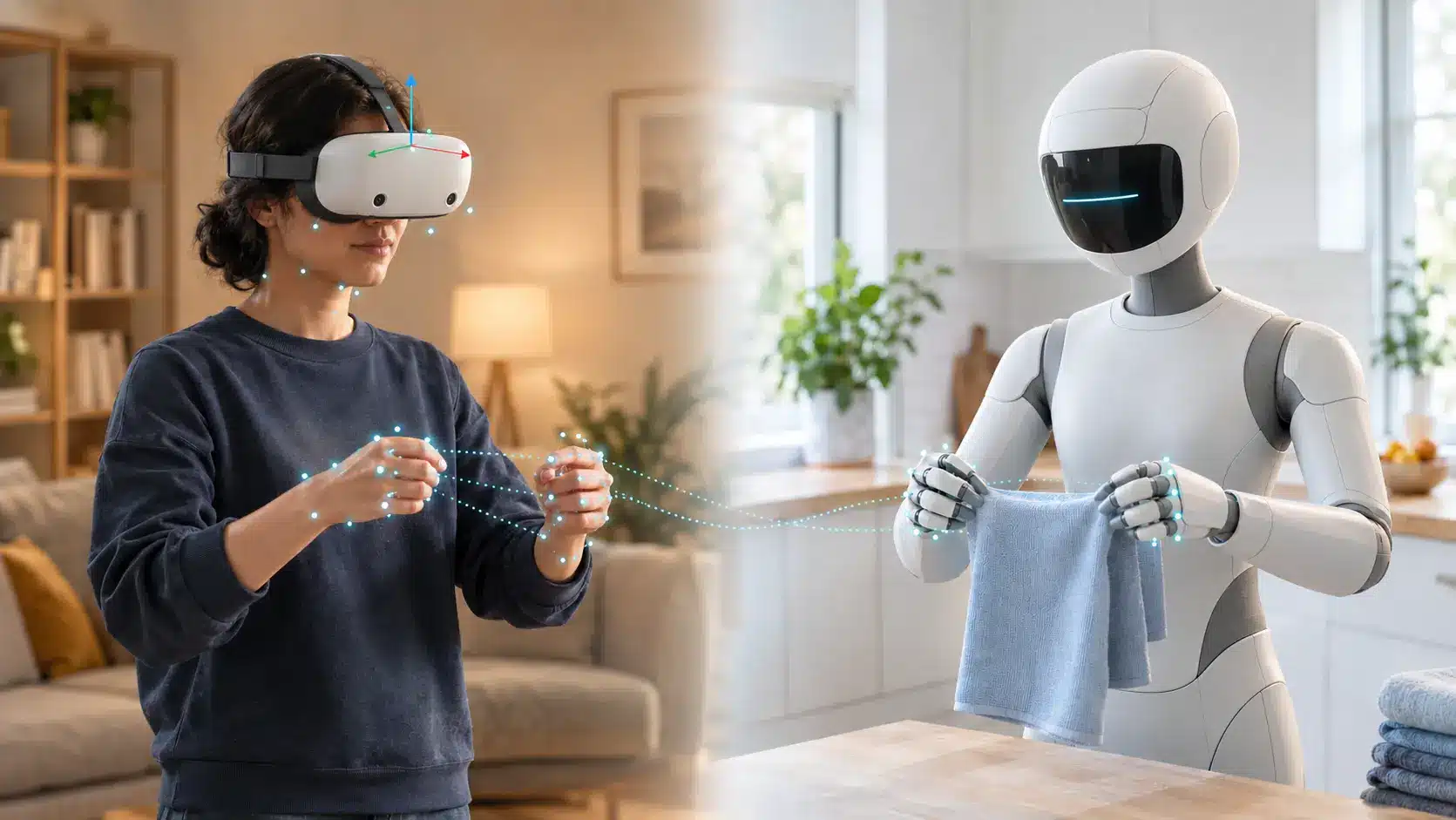
Motion data focuses on how actions happen over time. It captures movement, sequence, and small adjustments of objects during a task. Motion data makes it simpler for AI robotic systems to understand the result of a task as well as the exact steps followed to complete it.
So, why is this significant? A video may show a finished task, but it doesn’t always explain how the movement happened. Motion data fills this gap by showing how hands move, how positions change, and how actions are performed step by step. It enables AI robots to learn tasks more reliably.
Motion data can be collected in many ways. Here’s a quick look at some of them:
The recently introduced UR AI Trainer shows how motion data is changing the way robots learn. Instead of relying on pre-programmed instructions, robots can now learn tasks by directly following human demonstrations. During this process, the system captures high-quality, synchronized motion, visual, and force data as a human guides the robot through real tasks.

UR AI Trainer Enables Lab-to-Factory AI Model Training (Source)
This approach makes motion data especially valuable for tasks that require precision, coordination, and real-world interaction, bridging the gap between controlled training environments and real-world deployment.
So far, we’ve looked at different types of AI robot data, including visual inputs, depth, audio, and motion. Now, let’s see what happens when we bring them all together or fuse them.
Multimodal data fusion is about combining these different signals into one aligned view. Since each type of data comes from different sensors and formats, they need to be synchronized so they represent the same moment in time.
Consider this. A robot hears a sound, sees an object move, and detects a change in distance at the same time. When these signals are aligned, the system can connect them and better understand what is happening. This reduces confusion and improves overall awareness.
It also helps in uncertain situations. If one signal is weak or unclear, the others can support it. When done well, multimodal data fusion improves accuracy and lets AI systems respond more reliably in real-world environments.
Now that we have a clearer understanding of how different data types come together in physical AI, let’s look at how multimodal data works in real-world applications.
In manufacturing, robots aren’t limited to fixed sequences anymore. Instead, they handle variation and adjust actions based on multiple inputs.
For instance, CATL, the world’s largest EV battery producer, has deployed humanoid robots on its battery pack assembly lines in Luoyang, China.

Using Humanoid Robots in Battery Production (Source)
These AI robots perform tasks such as connecting components and end-of-line quality checks. To do this, they use visual input to identify objects, depth data to understand positioning, and motion signals to execute actions with precision.
Similarly, warehouses are constantly changing, with inventory moving and layouts shifting. As a result, AI robots need to respond in real time.
For example, GXO Logistics deployed an AI-based autonomous industrial truck at its Épinoy facility in France. The system navigates around people, tracks items, and adjusts its movement based on floor activity. It combines depth sensing, visual input, and motion awareness to operate safely.
When it comes to healthcare, robots work very closely with people for tasks like remote surgeries, so accuracy is critical. For instance, LEM Surgical developed the Dynamis system, which was showcased at CES 2026 and is used in clinical settings with FDA clearance.

The Dynamis Robotic Surgical System With Multi-Arm Spine Stabilization (Source)
It supports spinal and orthopedic procedures using a multi-arm setup. The system combines visual input, depth sensing, and motion data to maintain sub-millimeter precision during procedures.
Autonomous systems operate in highly unpredictable environments. For example, Amazon’s Proteus robot is used in fulfillment centers and has completed over three billion package moves.

Amazon’s Proteus Autonomous Robot With Object-Detection Capabilities (Source)
It navigates around human workers using multiple sensors and AI systems. This allows it to adapt to changing conditions and maintain safe operation throughout the day.
Even with a clear data strategy, building a multimodal data stack isn’t easy. When multiple data types are involved, even small issues can affect how the system learns and performs.
Here are some common challenges teams face when working with multimodal data:
Handling these challenges properly is vital for building reliable physical AI systems. That’s why working with an experienced high-quality data provider like Objectways can make it easier for you to manage the complexities of creating a reliable physical AI system.
At Objectways, we support teams working on physical AI by managing the complexities of multimodal data.
If you are working on physical AI and need support with multimodal data, Objectways can take care of the heavy lifting. From collecting real-world data to annotating complex multimodal streams and ensuring quality, everything is designed to keep your pipeline efficient and reliable.
We work with data such as depth, motion, egocentric video, and teleoperation recordings, along with rigorous quality checks to maintain consistency across datasets.
With Objectways, teams can move faster, reduce complexity, and build more reliable physical AI systems with confidence.
Multimodal data is key to building reliable physical AI systems. RGB shows what is present, depth adds distance, audio brings extra awareness, and motion explains how actions happen. Combined, these signals make it possible for systems to move from simply seeing to acting correctly.
As real-world use grows, the need for high-quality, well-synchronized data becomes even more important. Teams that invest in structured pipelines and strong data quality are better equipped to handle dynamic environments. Better data leads to better decisions and more reliable actions.
Working on a physical AI project? We can simplify your multimodal data pipeline from start to finish. Reach out to Objectways to learn more.
In robotics, multimodal data means information collected from different types of sensors working together. For example, a robot may use cameras to see, depth sensors to understand distance, microphones to hear sounds, and motion data to track movement. Combining these inputs helps the robot build a clearer and more complete understanding of its environment.

See how SLAM VR tracking works inside a headset, where it fails, and why a drifting head pose weakens egocentric and teleoperation data.
Explore the main types of lidar sensors, how they measure distance, and which types of robots are best suited to 2D, 3D, flash, and FMCW...