When you walk into a dark room, you tend to naturally slow down. You might reach for a wall, listen for anything nearby, and move more carefully. When one of your senses stops helping, another takes over. People make that switch without thinking.
A humanoid robot has fewer options. It can only rely on the sensors its builders chose, which usually means cameras, lidar, or both. Cameras capture color and detail and can estimate depth, while lidar robotics uses laser light to measure how far away things are directly. Together, they give a robot different ways to read the space around it.
In particular, lidar robotics is gaining attention from humanoid makers. For instance, EngineAI’s T800 lists a 360° lidar among its perception features, with millisecond-level processing for obstacle avoidance.
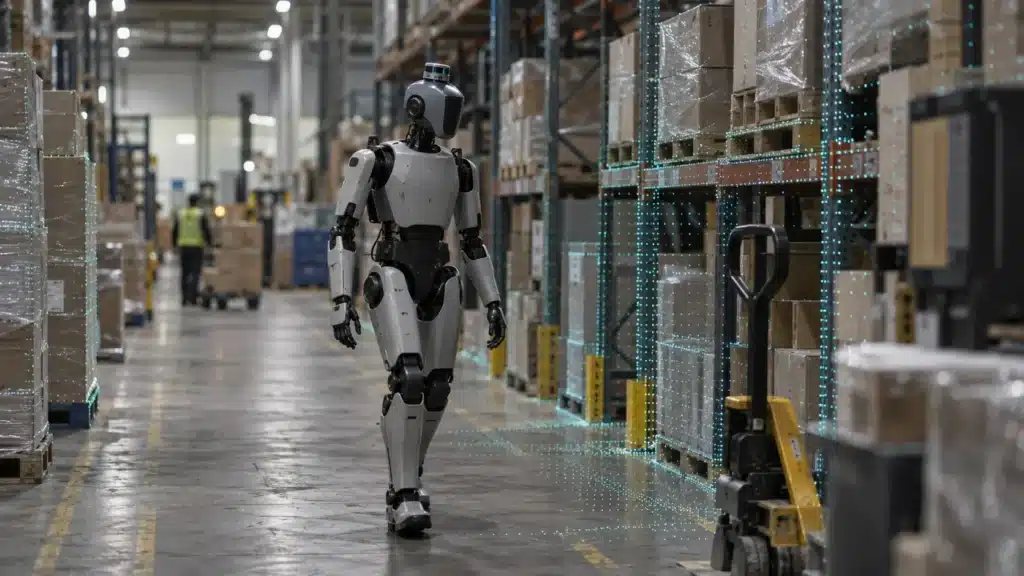
The wider market shows a similar shift. In the second quarter of 2026, one major lidar maker shipped nearly 3 times as many robotics lidar units as in the same quarter a year earlier, with new orders coming from humanoid makers.
However, lidar for robots isn’t standard on every humanoid. Many builders rely on cameras, so two robots designed for similar work can sense their surroundings in very different ways. So, what does that choice actually change?
The answer reaches beyond the hardware. A robot can only learn from what its sensors record, so humanoid robot sensors decide what every demonstration in its training data has to capture. Whether a humanoid needs lidar depends on its job, such as how reliably it must judge distance or spot nearby people. That makes the sensor choice part of the data plan from the start.
In this article, we’ll explore how lidar robotics fits into humanoid design, why some builders add it, why others skip it, and what each approach means for robot training data. Let’s get started!
Before comparing humanoid robots with lidar to those without, let’s understand what lidar robotics actually involves.
Lidar works by sending out rapid bursts of laser light and measuring how long each one takes to bounce off a surface and return. Each return marks a point in 3D space, and thousands of these points together form a point cloud that shows the shape of the space around the robot.
Since lidar uses its own laser, it doesn’t need outside light sources or visible surface details like a camera does. That direct measurement is what lidar robotics brings to a humanoid, giving it a reliable way to tell how far away a wall, shelf, or person is. Lidar’s role in robot perception is to provide a 3D view that helps the robot map its surroundings, know where it is, and avoid obstacles.
However, lidar is only one of the robot sensors a humanoid depends on. Cameras capture color and texture, an inertial measurement unit (IMU) tracks balance, joint encoders report limb positions, and force-torque sensors measure contact.
Every sensor added to a humanoid brings extra weight and takes up space. Each one has to be small and light enough to keep the robot moving and balanced, and lidar has to fit those limits too.
For example, the Livox Mid-360S is a compact 3D lidar sensor built for mobile robots. It weighs 265 g while covering a 360° horizontal and 59° vertical field of view. It can detect objects as close as 10 cm and works in bright or low-light conditions, giving a robot a view of what’s around it in every direction.
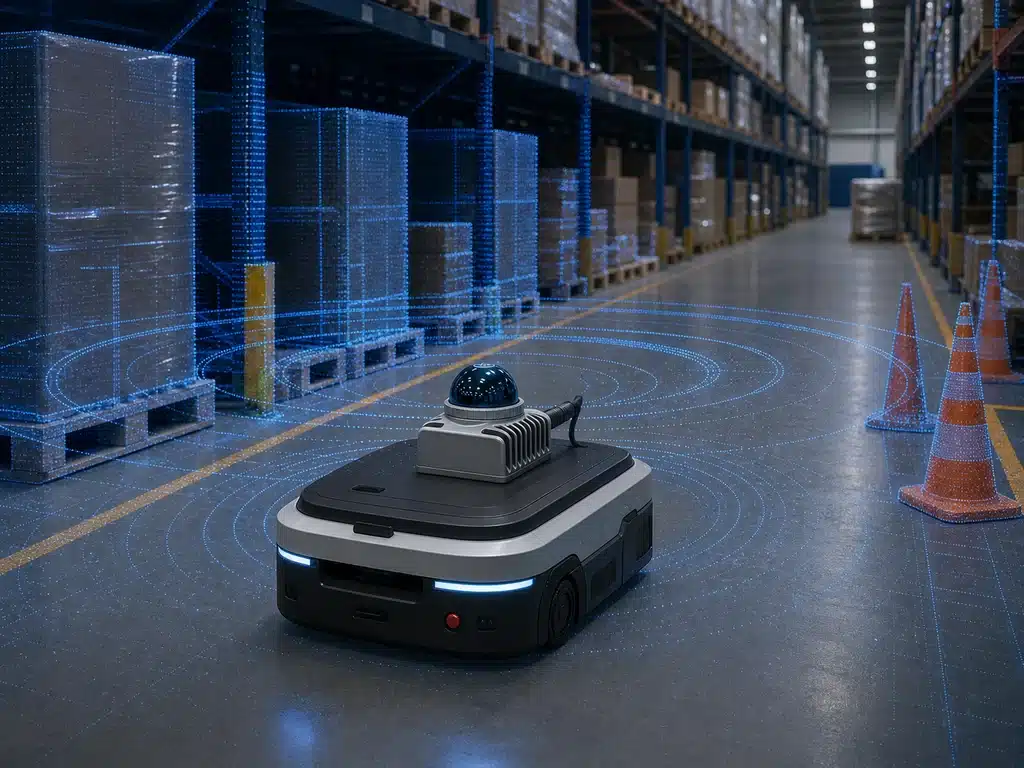
Among humanoid robot sensors, lidar tends to show up when robots have to move through changing spaces. They need to know where they are, what’s around them, and how that changes as they move.
Unitree’s G1 humanoids are a good example. The company used onboard 3D lidar to keep 49 G1 robots in formation during a synchronized martial arts routine at the Temple of Heaven in Beijing.
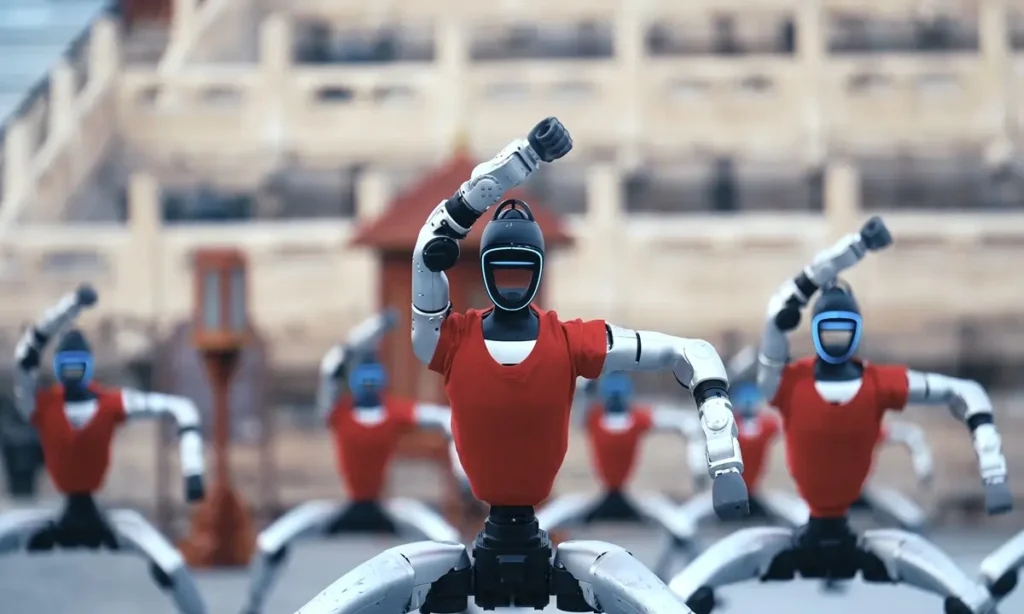
According to Unitree, each robot scanned the stage in real time and used onboard 3D lidar to locate itself. If a robot drifted out of place, it could recover and rejoin the formation. They also improved the robots’ lidar-based localization to handle changing layouts, blocked views, props, and intense movement.
The same technology has uses outside performances too. Unitree has said it could support multi-robot work such as inspection and warehouse sorting, where robots move among people, carts, and machines that keep changing position.
That kind of awareness is crucial as more humanoids start working closer to people. Agility’s newly unveiled Digit 5 is designed to detect people nearby in every direction and slow down, stop, or sit as they approach, so it can work without safety barriers.
For humanoids working alongside people, lidar robotics helps them keep track of what’s moving nearby. A steady distance reading in every direction lets a robot navigate safely and maintain a margin around people, even when they step outside a camera’s view.
Now that we’ve seen how lidar helps some humanoids track the space around them, let’s look at builders who take a different route and rely on cameras instead.
Figure is one of them. When the company rebuilt its humanoid robot from the ground up for Figure 03, it redesigned the hands and battery safety systems.
It also changed the way the robot is manufactured. On the perception side, it centered the design on a new vision system. The camera architecture delivers twice the frame rate, one-quarter the latency, and a 60% wider field of view per camera. Each hand has its own palm camera, so the robot can keep watching an object up close even when its main cameras are blocked.
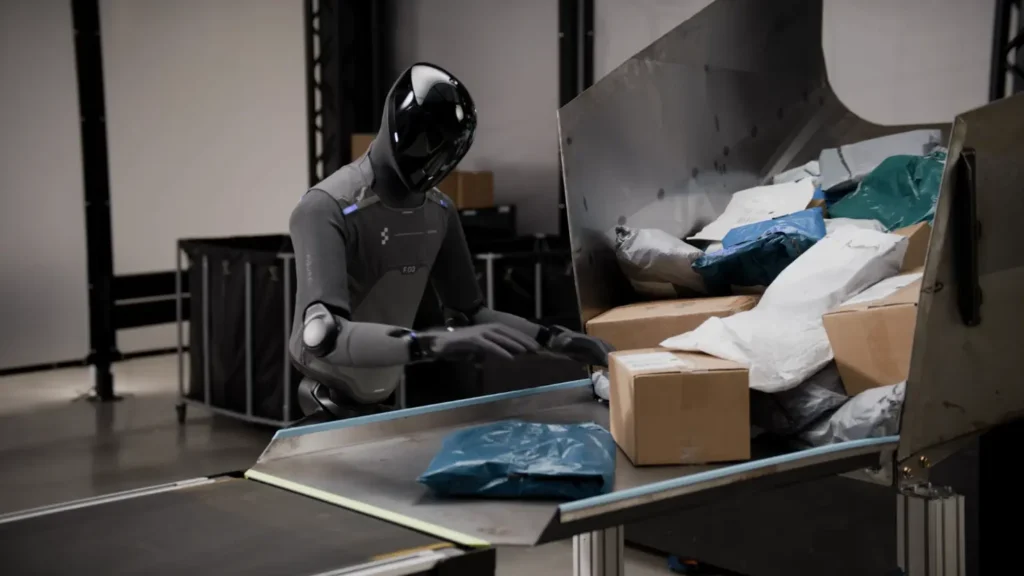
The cameras also play a role in how the robot understands its surroundings. They shape how it learns. Figure designed the robot to learn end-to-end, where it goes straight from camera images to actions without separate steps in between. In addition to this, each robot can upload terabytes of data over a fast wireless link, so the fleet keeps feeding new examples back into learning.
Tesla takes a similar approach. The company believes that advanced AI for vision and planning is the only way to reach a general solution for both self-driving cars and bipedal robots like its Optimus humanoid robot. Its self-driving networks already estimate depth and map 3D objects directly from camera video, a core task in 3D computer vision.
Both choices reflect how cutting-edge robots learn. Many of today’s vision-language-action models are trained on images paired with instructions and actions. A camera-first robot records the same kind of information these models use, making the hardware a natural fit for those models.
So, how do lidar and cameras actually compare once they’re mounted on a humanoid robot? Like all robot sensors, each one handles some conditions better than others, and those differences shape what a robot can rely on them for.
Here’s a closer look at where the two sensors differ:
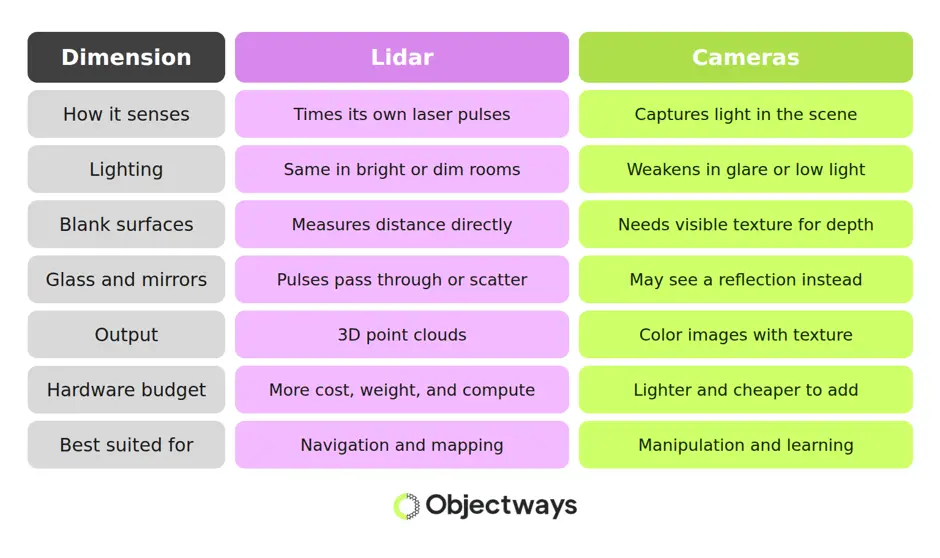
Because of these differences, the two sensors often end up on the same robot. Lidar robotics tend to handle navigation and distance, while cameras provide the visual detail needed for tasks such as grasping.
Combining them makes robot perception more reliable. One locomotion study fused a depth camera and lidar in simulation, and the combined setup mapped terrain more accurately than either sensor alone.
At the same time, advances in 3D computer vision are helping cameras handle depth on their own. In real-world tests of a depth-only framework, a full-sized humanoid climbed stairs and crossed gaps using a single depth camera, and its perception updated faster than a lidar-based mapping setup.
Ultimately, the right choice depends on the robot’s job and where it works. The sensor a builder chooses also determines what the robot’s training data needs to capture.
A trained robot policy learns to act on the inputs it saw during training. If its demonstrations only contained camera footage, adding lidar later gives it nothing to work with. The opposite is also true.
That’s because robot sensors are part of what the robot learns to read, so changing a sensor also changes what the demonstrations contain. Each sensor’s position, angle, and calibration shape every recording, and even a small change in where a camera sits can affect what a policy learns from.
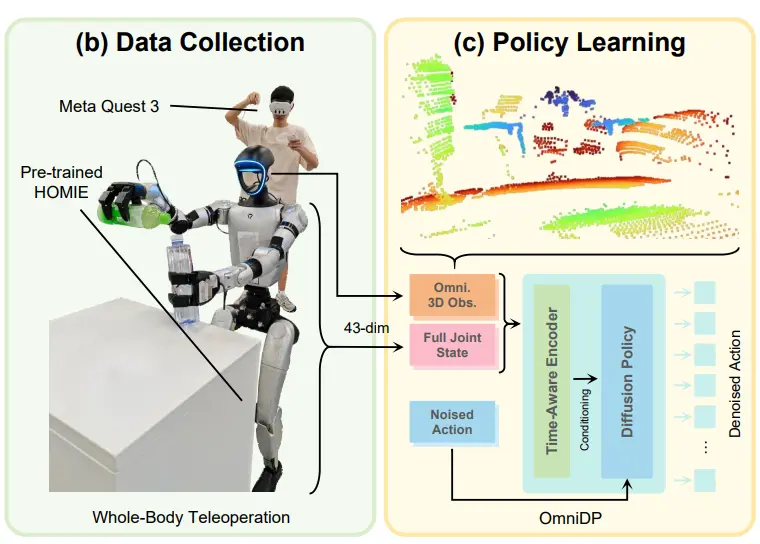
One research team saw this clearly when it trained a humanoid to manipulate objects using a head-mounted lidar as its main visual input. For each teleoperated demonstration, a person remotely controlled the robot through the task while it recorded lidar point clouds alongside its joint positions.
When the team removed the lidar input and relied on depth camera data instead, success on a handover task fell from 12 out of 20 trials to zero. Without the lidar’s 360° view, the robot couldn’t locate objects outside its camera’s field of view.
Beyond the policy itself, the sensor choice also changes what it takes to build the dataset. Lidar adds a point cloud stream that needs to be synchronized and labeled, while camera-first setups need enough viewing angles to capture the hands and surroundings clearly.
The same issue comes up when teams reuse existing human demonstrations, since much of that data is camera-only. Egocentric datasets, which are recorded from a person’s own point of view, show this clearly.
For example, the EgoDex dataset pairs first-person video with hand tracking, making it useful for camera-first robots. But for a robot that relies on lidar, the dataset is missing an entire input stream, since the demonstrations were never captured with lidar.
When planning data collection for a humanoid robot, getting the sensor setup right early can save a lot of work later on. Once you’ve collected thousands of episodes, even a small hardware change means re-recording them all.
Here’s an overview of what teams should lock in before data collection starts:
Locking in these details keeps the dataset aligned with the robot that will use it and avoids costly re-recording later.
For teams that don’t want to manage this themselves, relying on a data expert can save months of setup and rework. At Objectways, we run teleoperation and depth data collection matched to each robot’s sensor stack. We align sensor layouts, recording rates, and calibration with the target robot so every demonstration is ready for training.
The lidar vs camera choice has no single right answer. Lidar robotics gives a humanoid a direct measure of distance, while cameras capture the detail many robot learning models are built around. The better fit depends on what the robot needs to be certain about.
That decision reaches well past the hardware. A policy can only learn from what its data captured, so every demonstration has to capture the same sensor data from the first day of data collection.
List every sensor the deployed robot will carry. Keep each one where it will sit on the final machine. Match recording rates and store calibration with the data. A few hours of planning costs far less than a training run built on the wrong data.
Planning data collection for a humanoid robot? Reach out to Objectways to learn more about our robotics data collection services.
Lidar, short for light detection and ranging, is usually grouped by where the sensor operates. The three main types are airborne lidar mounted on planes or drones, terrestrial lidar used on the ground, and spaceborne lidar carried on satellites.

See how a LeRobot dataset stores robot demonstrations, how it compares with older formats, and what can get lost in the conversion to LeRobot.

Explore what makes the EgoDex dataset useful for robotics, from hand pose and task design to language annotations, and how to evaluate egocentric datasets.