For humans, folding a towel is one of the simplest household tasks. But can we say the same for robots?
When LG’s CLOiD robot demonstrated it at CES 2026, it highlighted just how challenging everyday manipulation really is. What made that demo possible wasn’t only the hardware. It was physical AI annotation, or the way the robot’s training data was labeled.
It’s easy to focus on the hardware, from the seven-degree-of-freedom arms to the five-fingered hands and onboard sensors. But much of the intelligence behind that towel-folding demo comes from something happening well before the demo itself.
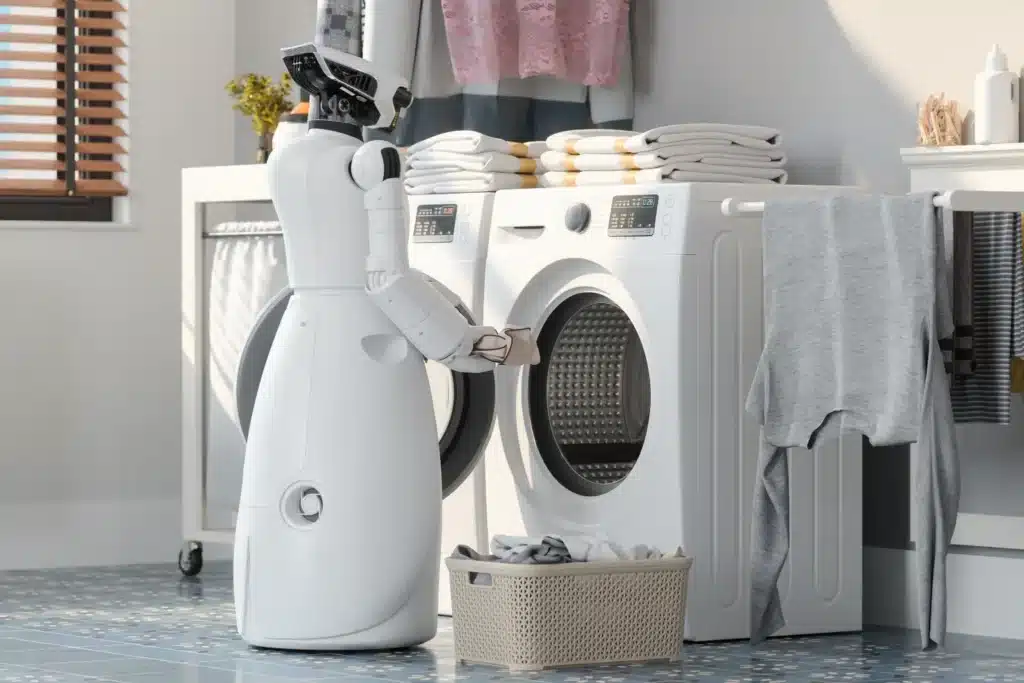
An Example of a Robot Folding a Towel
Every robot policy is trained on annotated episodes, meaning recordings of a robot or a human demonstrating a task. These annotations describe what happens at each step, giving the model the context it needs to learn. The type of physical AI annotation used directly shapes what a robot can understand and perform, and when important information is missing, its ability to learn is limited.
Physical AI annotation also works differently from traditional data annotation. The training data isn’t a collection of static images or text. It’s a sequence of actions happening over time, where each movement depends on the one before it. Robotics annotation has to capture behavior, motion, and interaction with the environment, not just what’s visible in a single frame.
In this article, we’ll explore the seven core types of data annotation used to train physical AI systems, what each one captures, and how it fits into a robot’s learning pipeline. Let’s get started!
Data annotation is the process of adding structured labels to raw data, so AI models can learn from it. Without those labels, a model can’t identify objects, understand actions, or learn the correct outcomes from its training data.
Most AI models within AI systems rely on four familiar types of annotation. They are image, text, audio, and video. These labels describe what’s present in the data, whether that’s identifying objects in an image, transcribing speech, tagging entities in text, or tracking objects across video frames.
Physical AI takes annotation a step further. These robotic AI models learn from recorded episodes where perception, movement, and outcomes are linked over time. The annotations capture what the robot sees, what it does, whether the task succeeds, and how it interacts with its environment.
This extra layer of information enables physical AI systems to learn complex, real-world tasks. Let’s break down how that layer gets built.
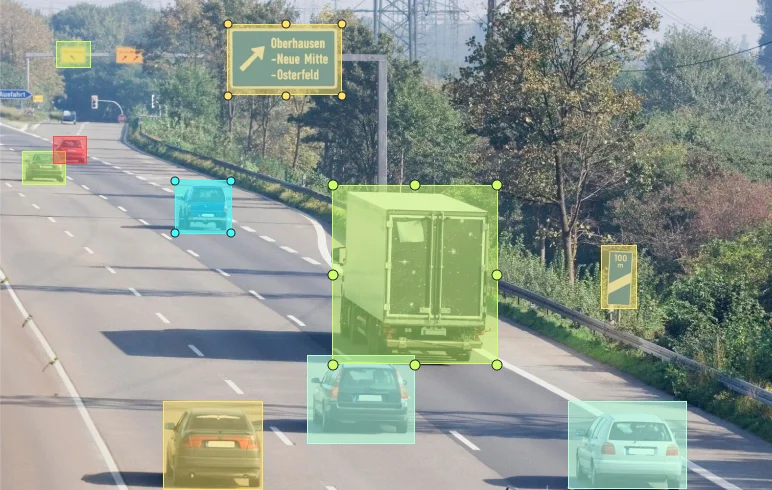
An image of a self-driving car can be annotated with labels for a stop sign, a pedestrian, or a lane marking. Those annotations describe what’s visible in a single frame, and for many visual AI applications, that’s all the model needs (basic image recognition).
Physical AI applications and systems are more complicated than image recognition systems. They need more information in annotations.
For example, when a robot loads a dishwasher, the annotations may record the path its arm followed, whether it grasped the plate securely, and whether the task was completed successfully. The labels capture not just what the robot saw, but what it did and how the task turned out.
This difference exists because robot models learn through a continuous cycle of perception, planning, and action. To improve their behavior, the training data has to connect what the robot observed with the decisions it made and the outcomes those decisions produced. Without that context, the model has no way to determine which actions lead to successful results.
A good example is Figure AI’s Helix vision-language-action (VLA) model. Helix was trained on hundreds of hours of teleoperated robot demonstrations paired with natural language instructions. By linking visual observations, language, and robot actions within the same training episode, the model learns to translate commands like “pick up the dessert item” into coordinated physical movements.
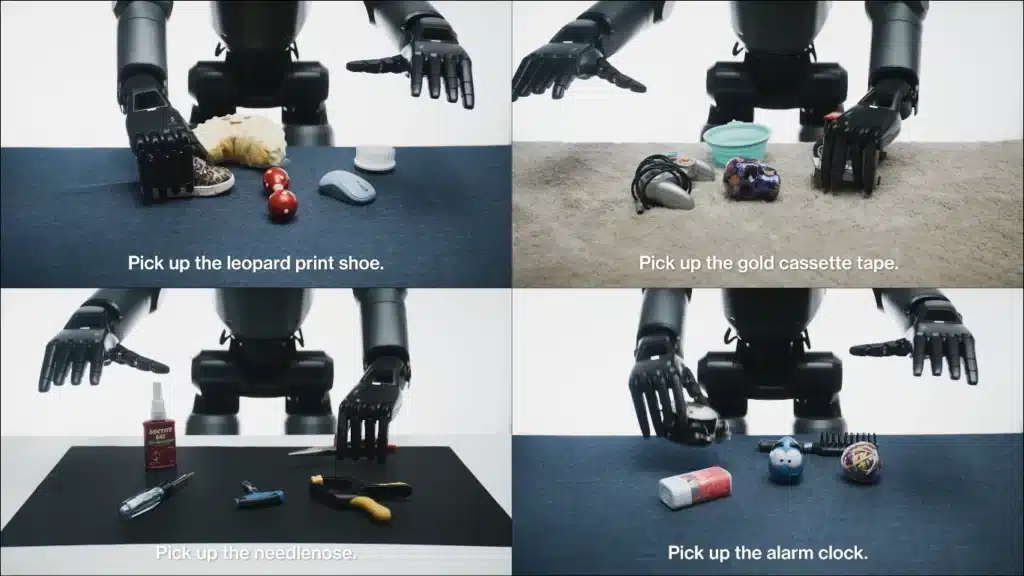
The Helix VLA model helps robots pick up the right object based on commands. (Source)
When it comes to physical AI annotation, there are many types. Some annotation types are based around human annotators, while others are generated automatically and reviewed later. Let’s take a look at the seven core types of physical AI annotation and the role they play in training physical AI models.
Task language labels describe what happens during a robot’s training episode using natural language. They allow the robot models to get a better understanding of naturally given verbal commands.
For example, researchers at Google DeepMind trained their RT-2 model on demonstrations paired with instructions such as “put a strawberry into the correct bowl,” linking each instruction directly to the robot’s actions. This gives the model a clear connection between a language command and the physical behavior needed to carry it out.
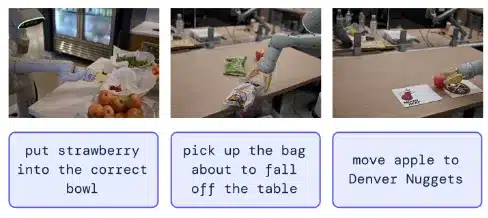
RT-2 Executing Instructions (Source)
These labels are typically written by human annotators because they need to accurately describe the task being performed. They are especially important for vision-language-action models, which learn to translate natural language instructions into physical movements.
In physical AI annotation, an episode is one complete attempt at a task, recorded from start to finish. Once it’s captured, it’s reviewed and labeled as either a success or a failure. A failed episode might involve dropping an object, missing a target, or stopping before the task is complete.
Rather than deleting those failed demonstrations, teams keep them in the training data. They help robots learn what doesn’t work, making them better at recognizing mistakes and recovering from them in future tasks. In many cases, a well-labeled failure can be just as valuable as a successful demonstration.
Most robot tasks are made up of several smaller actions rather than a single movement. For example, picking up a cup involves reaching toward it, grasping it, lifting it, and placing it in a new location.
Episode segmentation breaks a recorded demonstration of a cup being picked up into these individual steps, allowing the model to learn each stage of the task separately.
The initial boundaries between these steps are detected automatically using the robot’s proprioceptive data, such as joint positions, arm movements, and other internal sensor readings. Human reviewers then verify and refine those boundaries before the data is used for training.
Tasks that seem simple to humans are actually made up of very different movements. Robots don’t pick up every object the same way.
For instance, holding a coffee mug by its handle requires a different grasp than lifting a box or picking up a coin. This is why we need grasp type classification.
Grasp type classification labels the type of grip a robot uses when handling an object. Common examples include power, pinch, lateral, and precision grasps. Instead of simply recording that the robot picked something up, these labels describe ‘how’ it held the object.
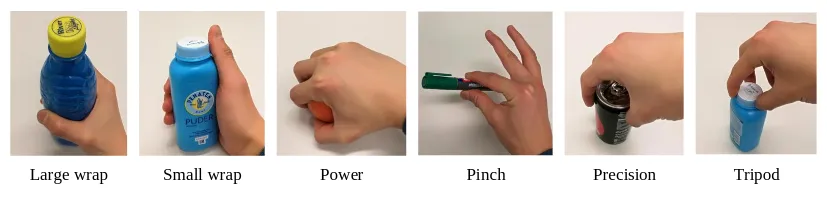
Six Common Grasp Types Used by Robots (Source)
As identifying grasp types requires careful observation, these labels are usually created by human annotators. They also make it easier to transfer learned skills between robots with different grippers or hand designs, since the model learns general grasping strategies rather than motions tied to a specific robot.
Object category and color labels identify the objects a robot interacts with during a training episode. These labels can describe a ceramic plate, a cardboard box, a red cup, or a coiled cable – anything the robot needs to recognize and manipulate.
While this type of physical AI annotation is similar to traditional image labeling, it plays an important role in robotics. By labeling the objects involved in each demonstration, researchers can organize and filter training data based on object type, color, or material. This makes it simpler to evaluate how well a model performs with specific kinds of objects and identify areas where it needs more training.
Completing a task successfully doesn’t always mean the robot performed it well. This is where action quality scoring comes in. It measures how efficiently and smoothly a robot moves while completing an episode.
Many of these scores are generated automatically using metrics such as motion smoothness, dead actions, gripper chatter, and path length. Since the evaluation is based on measurable robot behavior rather than human judgment, this type of physical AI annotation can be produced automatically at scale while maintaining consistent results.
Scene descriptions provide short captions that summarize what’s happening in individual keyframes throughout a robot’s training episode. They are automatically generated using vision language models (VLMs).
These captions add another layer of context by connecting visual scenes with natural language. They help VLA models better understand the relationship among language, perception, and robot actions. As they are generated automatically, many teams include them in their annotation pipeline.
In one study, a VLM was used to generate a caption for each keyframe as a robot performed a bin pick-and-place task, producing a running description like “the robot arm is positioned above the red cereal box” and “the robot arm has gripped the box in the bottom right compartment.” Captions like these give a model a frame-by-frame account of the task without requiring a human to write them.
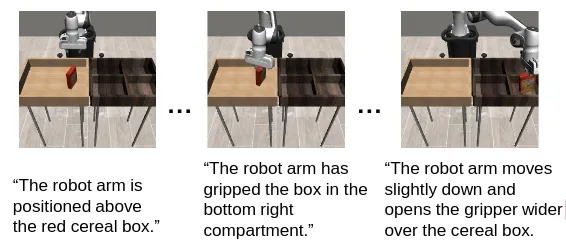
A VLM generating a caption for each keyframe as a robot performs a bin pick-and-place task (Source)
With the seven types covered, the next question is how physical AI annotation actually happens. Some labels come from human annotators, some are generated automatically, and others combine both to balance accuracy with efficiency.
Here’s how each approach works:
Keep in mind that robotic data annotation is a separate line item from data collection. Collection produces the raw demonstrations, and annotation determines how much a model can extract from them. A thousand well-labeled episodes will train a better policy than ten thousand unlabeled ones, which is why annotation sets the ceiling on what the data is worth.
Building a reliable physical AI system takes more than using the latest robotic hardware. In many cases, what separates a successful deployment from one that stalls is the quality of the underlying robotic annotation pipeline.
That pipeline brings together labeled perception data, teleoperation, and motion-capture demonstrations, reinforcement-learning environments, and quality-assurance workflows. All of these layers turn the collected raw robot data into training data that models can learn from.
As more robots are deployed, those high-quality annotations continue to deliver value. Every demonstration that is validated and correctly annotated can be added back into the training pipeline, helping an entire robot fleet improve over time.
That’s easy to describe and difficult to build. Annotating robot data well means understanding grasp taxonomies, motion metrics, and task structure, and keeping that consistent as datasets scale into thousands of episodes. It’s specialized work, which is why many teams bring in a data partner rather than build the capability from scratch.
At Objectways, that’s exactly what we enable. We handle multimodal data collection and annotation through to quality assurance, supporting the end-to-end pipelines that reliable physical AI systems depend on.
Building a physical AI annotation pipeline gets simpler with a few best practices in place. Here’s what to prioritize:
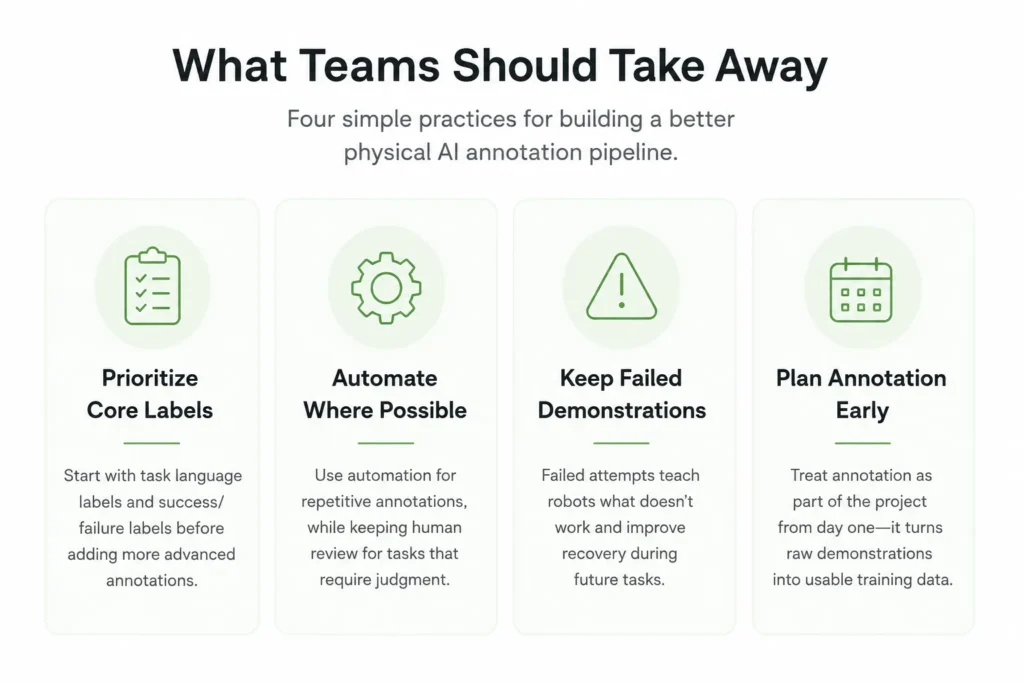
Best Practices for Physical AI Annotation Pipelines
Data annotation turns robot demonstrations into training data that physical AI models can learn from. From task language labels and episode segmentation to grasp classification and quality assurance, each layer lets robots perform tasks more accurately and adapt to real-world environments.
As physical AI advances, the demand for high-quality annotation pipelines will continue to grow. Teams that invest in structured data collection, consistent annotation, and quality assurance will be better equipped to build reliable robotic systems.
Working on a physical AI project? Objectways provides end-to-end support for multimodal robot data, from data collection and robotics annotation to quality assurance. Reach out to learn more.
Physical AI refers to autonomous systems, such as robots, self-driving cars, and smart cameras, that can sense their surroundings, reason about them, and perform real-world physical actions. Common examples include warehouse robots picking and sorting items, humanoid robots performing household tasks, autonomous vehicles navigating traffic, and robotic arms on manufacturing lines.

See how ground truth data powers accurate machine learning models, reduces bias, and strengthens trust in AI systems across industries.

Explore how medical data annotation enables smarter healthcare AI applications, powering imaging analysis, risk prediction, and clinical documentation.