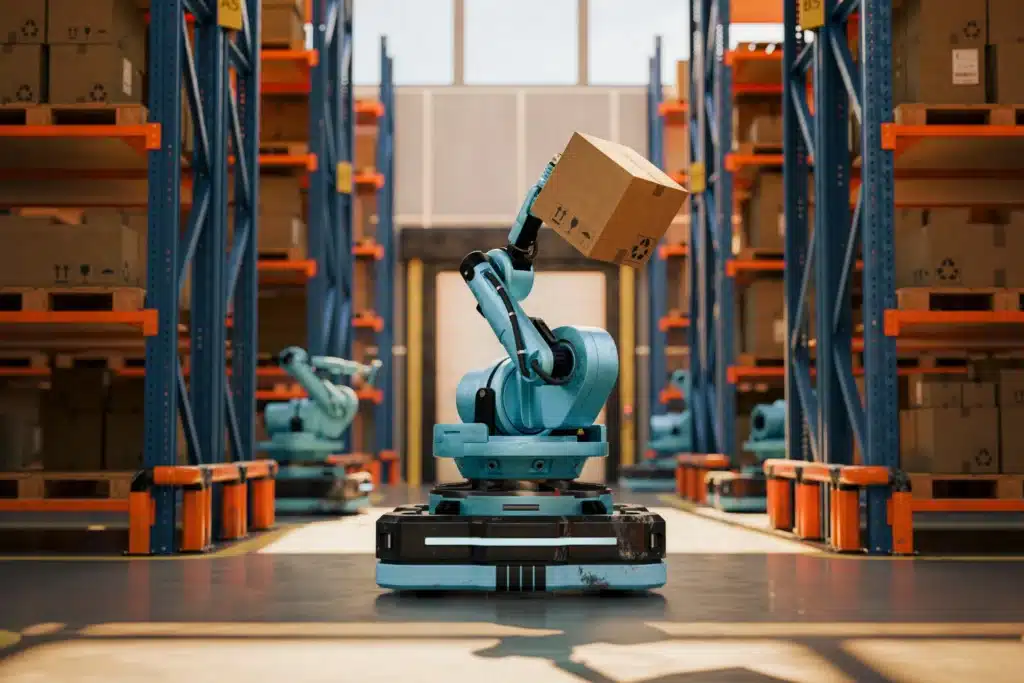
Moving boxes around a warehouse with a robot is relatively straightforward. Unloading a truck packed with cartons, uneven stacks, and boxes tucked behind others is a much more complex robotics challenge.
Today, warehouse robots can follow specific routes, transport inventory, and bring products to picking stations. But handling dynamic situations, like shifting stacks or hard-to-reach cartons, requires robots to do much more than follow instructions.
Robotics in logistics involves recognizing objects, adapting to changing conditions, and figuring out how to grasp and move packages safely, even when the environment is unpredictable. For instance, as logistics companies look to automate physically demanding tasks, truck unloading is becoming a key application for robotics.
In fact, UPS is reportedly investing around $120 million in around 400 Pickle Robot systems for truck unloading. Each robot is expected to unload a typical truck in about two hours, with deployments planned from the second half of 2026 through 2027.
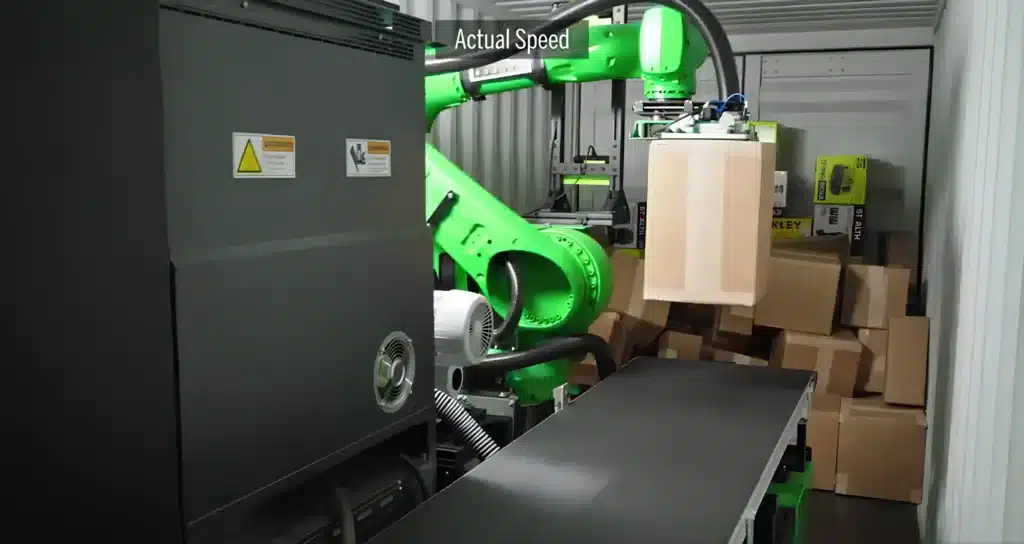
It’s trickier than it sounds. Robots have to handle crushed boxes, uneven stacks, poor lighting, and packages hidden behind one another. Unlike predictable warehouse operations, these conditions require robots to constantly adjust to their surroundings.
Simply put, structured logistics tasks are easier to automate, and unstructured tasks are still a challenge. Bridging this gap requires more than advanced hardware. Robots also need real-world training data that captures variations in packaging, lighting, object positions, and handling conditions.
Next, we’ll explore how these robotics in logistics challenges affect unloading, picking, sorting, and trailer loading, and why real-world data is becoming increasingly important for logistics automation. Let’s get started!
Automating a logistics task often comes down to how predictable the environment is. Tasks can be both structured and unstructured.
Structured tasks follow known routes, use designated storage locations, and involve standardized containers. On the other hand, unstructured tasks are more challenging because robots have to deal with objects and conditions that change from one operation to the next.
For example, autonomous mobile robots (AMRs) transport inventory, automated guided vehicles (AGVs) follow guided routes, and automated storage and retrieval systems retrieve goods from designated locations. These systems work efficiently because their tasks (structured) and operating environments are relatively predictable.
Unstructured environments are a different story. Robots may encounter boxes of different sizes, flexible poly bags, damaged cartons, uneven stacks, and packages hidden behind other objects. Poor lighting and reflective surfaces can make it even harder to identify objects and estimate their positions.
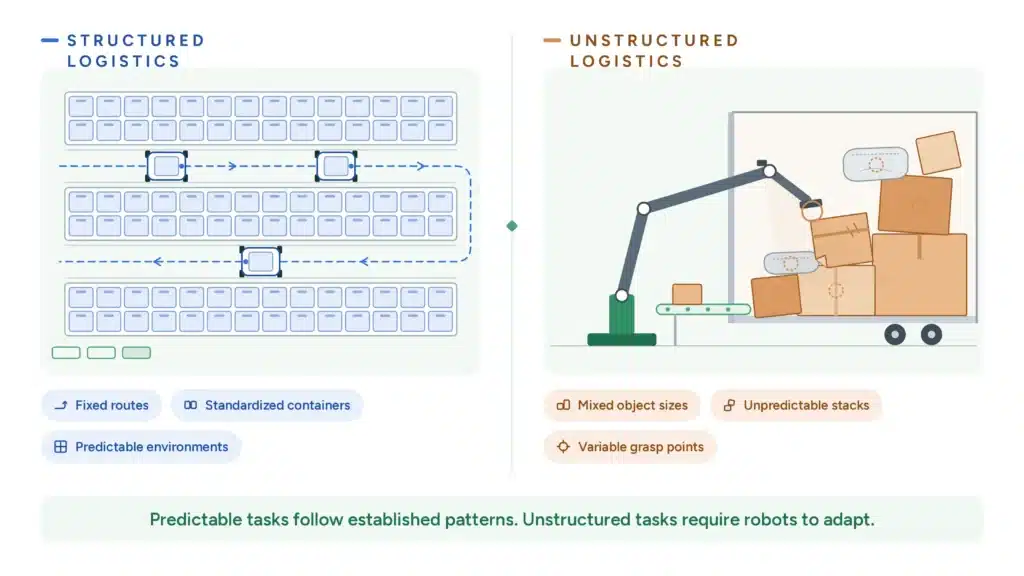
Nowadays, within environments like warehouses, different robots are designed to handle different tasks. Robotic arms pick and depalletize items, automated sorters direct parcels to the right destinations, and humanoid robots are being tested for handling tasks in spaces designed for people. However, a robot that can navigate a warehouse or sort packages may still struggle to pick up an unfamiliar object.
Consider truck unloading: a robot has to identify which boxes it can reach, figure out where to grip them, and remove them without disturbing the rest of the load. As the arrangement changes, new challenges appear.
That’s why real-world high-quality data is essential. Accurate annotations and labels help the AI models powering robots recognize objects, estimate their positions, and predict whether a grasp will succeed. Training and testing these models on data from varied real-world conditions lets robots handle unpredictable situations more reliably.
Truck unloading puts logistics robots to the test, requiring them to handle unpredictable stacks and varying box sizes. DHL’s work with Boston Dynamics’ Stretch robot shows how companies are taking on this challenge.
DHL signed a deal to potentially deploy more than 1,000 additional Stretch robots. Stretch is designed specifically for handling boxes in logistics environments, and DHL has reported unloading rates of up to 700 cases per hour.
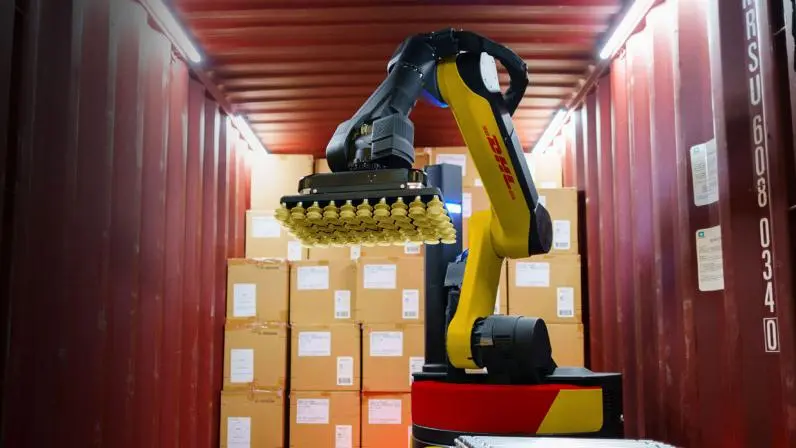
However, the speed of unloading boxes is only part of the challenge. Robots also need to know the differences between trailers, from tightly packed boxes to damaged cartons and changes in daylight conditions.
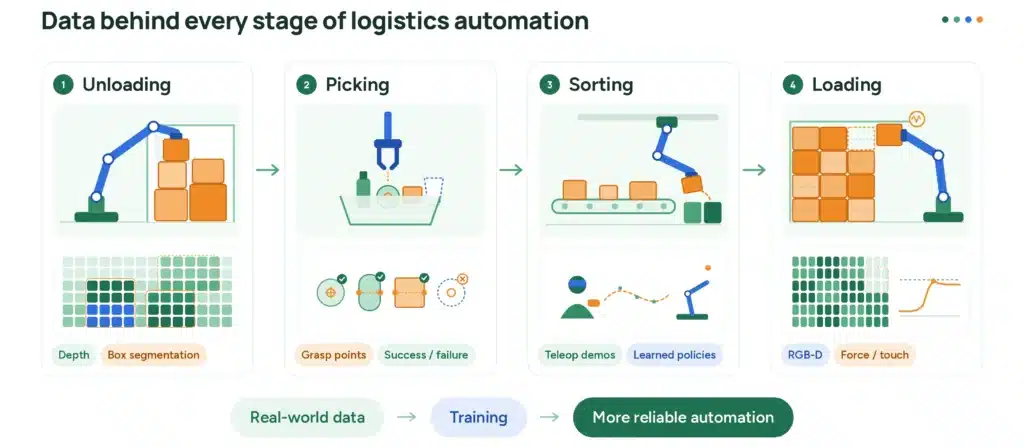
Real-world training data plays an important role in such situations. Images with box segmentation labels (labels that identify and outline individual boxes in an image) help robots identify individual packages in cluttered spaces, while data with depth helps them estimate positions and distances of these boxes. Training on real unloading scenarios, including difficult and unusual cases, makes it possible for robots to recognize unfamiliar loads and handle them better.
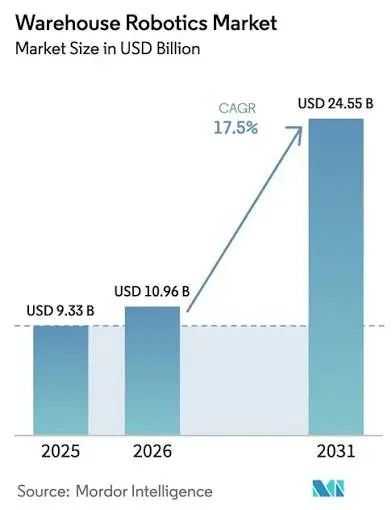
AMRs have become a common part of warehouse picking operations worldwide. The warehouse robotics market is said to reach $24.55 billion in 2031. These logistics robots enable workers to fulfill orders by transporting items and reducing the time spent walking between storage locations.
A great example of how fast this is catching on is Locus Robotics. Its robots have now passed 6 billion picks worldwide, and the most recent billion took only 24 weeks. That’s under six months.
While AMRs support picking workflows, robotic arms have to identify individual products, find suitable grasp points, and handle items without causing damage. This is difficult in warehouses that store thousands of products with different shapes, sizes, and packaging.
In particular, transparent containers and shiny surfaces can throw off a robot’s object detection. Small items in flexible packaging are tricky too, since they’re harder to grip. A robot that picks up a cardboard box with no trouble might fumble a soft plastic pouch. These less common but tricky items make up what’s called the long tail of robotic picking.
Similar to how humans learn to handle tricky objects through experience, robots get better with real-world training data. It starts with recognition. Images of transparent, reflective, and flexible objects taken under different lighting help robots spot these items more reliably.
From there, segmentation labels teach them to tell one item from the next, even in a cluttered bin. Once a robot knows what it’s looking at, grasp annotations show it where and how to grip each type of material. And when things don’t go as planned, records of both successful and failed picks help teams understand why certain objects are harder to handle, so they can keep improving.
Parcel sorting is another important testing ground for humanoid robots and AI systems that learn physical tasks from demonstrations. Unlike conventional automated sorters, robots in logistics handling individual parcels must recognize packages, pick them up, and position them correctly for scanning or routing, even when package sizes, shapes, and positions vary.
Figure’s work with humanoid robots shows how more training demonstrations can boost parcel sorting performance. When the company scaled its demonstration data from 10 to 60 hours, average package handling time dropped from 6.84 seconds to 4.31 seconds. In the same experiment, the robots also got better at orienting barcodes correctly, with success rising from 88.2% to 94.4%.
So where does all this demonstration data come from? One common approach is teleoperation, where a human operator remotely controls a robot while its movements and observations are recorded. That data is then used to train AI models to recognize packages, coordinate movements, and sort parcels more accurately and consistently.
However, just training hours don’t determine how well a robot performs. Data quality, task variety, and how closely the demonstrations reflect real working conditions are just as vital. Training with different package types, orientations, and handling challenges can also reveal faults that repetitive demonstrations might miss.
You might be wondering what makes loading a trailer so hard. After all, it’s just stacking boxes. In reality, it’s more like a giant game of Tetris.
Robots have to fit packages of different sizes and weights into dense, stable stacks, and every placement changes what comes next. Put a box in the wrong spot, and you either waste valuable space or risk the whole stack shifting in transit.
FedEx is tackling this by expanding its collaboration with Dexterity to scale autonomous trailer loading. Its Mech robot runs on Foresight, a physical AI world model that combines vision, depth, and touch to decide where each package should go for the best balance of space, stability, and speed. On the other end of the process, FedEx is also bringing in Berkshire Grey’s Scoop, a robotic system built to unload varied trailer loads.
What these systems have in common is that seeing the boxes isn’t enough. Robots also need to sense how packages press against each other and react as the load shifts. That’s why training data combining synchronized RGB images, depth measurements, and force or touch signals is so valuable, especially when it’s collected in real trailers where layouts, lighting, and available space are never quite the same twice.
From cluttered trailers to slippery plastic pouches, every stage of the logistics workflow throws something different at robots. That means there’s no one-size-fits-all dataset.
Each task calls for its own mix of data to help robots perform reliably. Here’s a quick look at what that looks like at each step:
Collecting training data is only half the job. For that data to be truly useful, it has to reflect the conditions logistics robots will actually face on the floor. Lighting, packaging materials, product mixes, and trailer layouts can differ from one facility to the next, and sometimes even from one shift to another.
Rather than treating this variety as a problem, robotics teams can put it to work. Real-world variations can surface edge cases, measure how robots perform under different conditions, and pinpoint where more training is needed. Data annotation then adds another layer of value by labeling objects, actions, grasp points, and task outcomes, turning raw recordings into data that’s ready for model training and evaluation.
Building datasets like these can take a lot of time and coordination, so many teams choose to work with a data partner like Objectways to make the process easier. Objectways supports robotics data collection across teleoperation, egocentric, depth, and UMI gripper data, along with multimodal annotation.
So far, we’ve looked at how teleoperation helps capture real-world data for logistics robots. Since it needs a physical robot for every operator, teams collecting thousands of hours of data across hundreds of items may look for a more flexible option. One such option is the Universal Manipulation Interface, or UMI.
A UMI gripper is a handheld tool built to work like a robot’s gripper. Its wrist-mounted camera and sensors record the same visual and motion data a robot would as a person picks and places items. Teams can run several workstations at once and set them up to match real fulfillment operations, complete with mixed-product totes, trays, and conveyor belts.
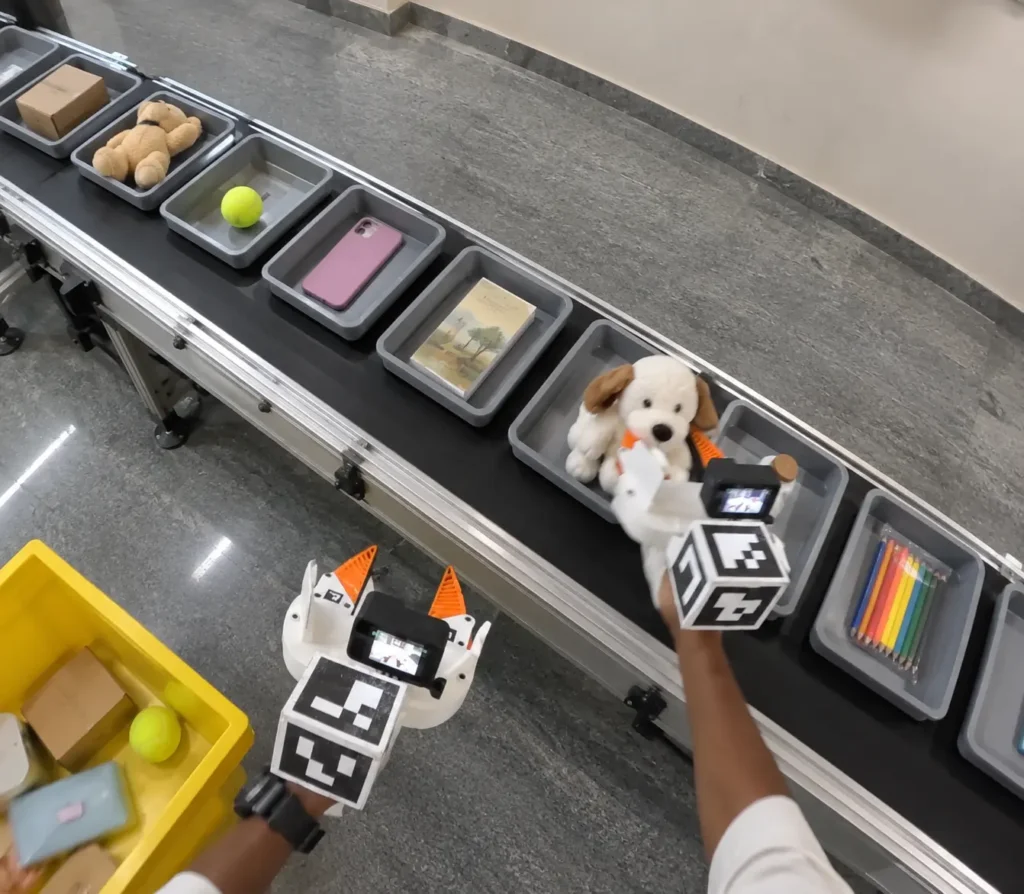
Here are a few warehouse tasks this kind of setup can capture:
To keep the data reliable, AR markers around the workstation track the gripper’s position in 3D space, and video and sensor data are synced for every session. With every operator following the same process, the result is a consistent dataset for training and testing the AI models behind robotics in logistics.
Robots in warehouse logistics have already gotten good at moving inventory from point A to point B. The harder part is everything that doesn’t follow a script, like unloading a messy trailer, picking a shiny plastic pouch, or stacking boxes that never come in the same shape twice.
Handling these moments well comes down to experience, and for robots, that experience comes from data. The more closely their training data reflects real-world conditions, the better prepared they are for the surprises that show up on the warehouse floor.
That’s the kind of data Objectways helps teams build. If you’re working on robotics in logistics and want training data that reflects real-world conditions, reach out to Objectways to learn how our robotics data collection services can support your next project.
Robotics in logistics involves using automated machines and smart software to handle the movement, storage, sorting, and delivery of goods.


See how SLAM VR tracking works inside a headset, where it fails, and why a drifting head pose weakens egocentric and teleoperation data.
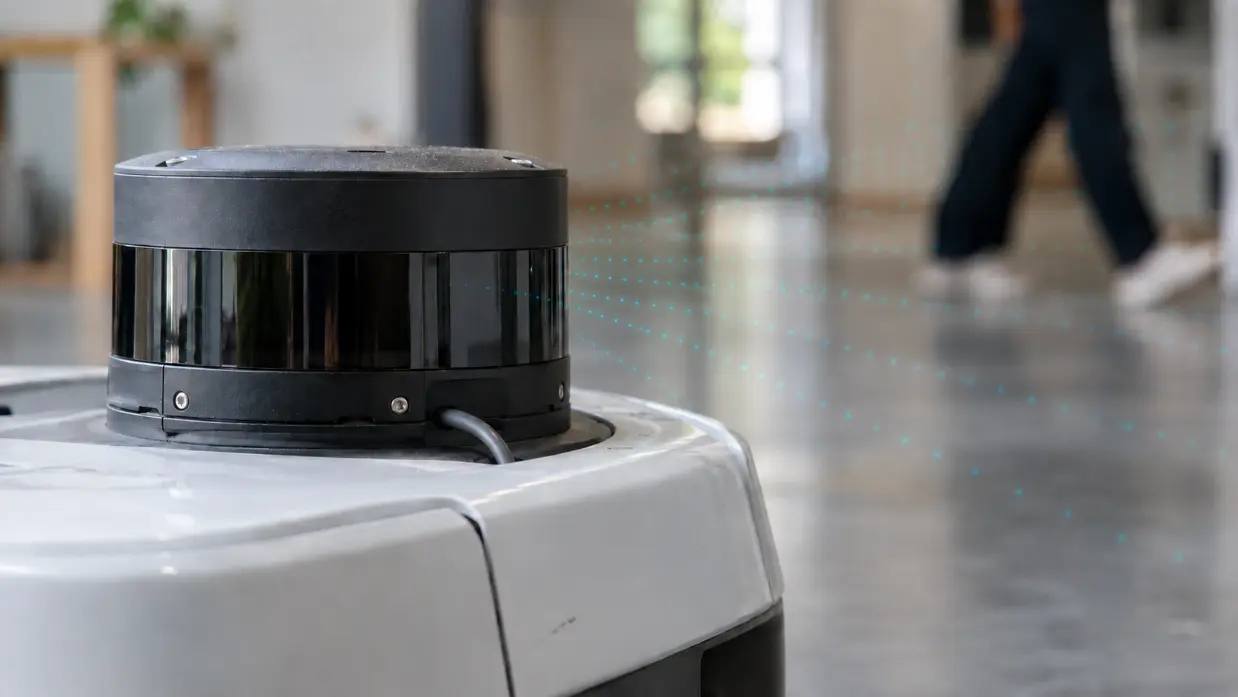
Explore the main types of lidar sensors, how they measure distance, and which types of robots are best suited to 2D, 3D, flash, and FMCW...