Think about the last time you watched a video game cutscene, animated film, or virtual character that moved so naturally it felt almost human. Whether it’s a game like God of War or a cinematic sequence in a sci-fi film, the way a character walks, fights, gestures, or reacts often reflects real human movement rather than an animation created entirely by hand.
This realism is made possible by motion-capture (mocap) suit technology. Actors wear specialized motion capture suits that record their movements and translate them into digital data. Every step, gesture, and action is captured and transferred to a virtual character, helping create believable performances in games, films, simulations, and increasingly, robotics applications.
The basic idea behind the technology is simple. A trained actor or performer wears a mocap suit equipped with sensors, performs ordinary actions, and has every movement converted into digital information. Even facial expressions can be converted this way.
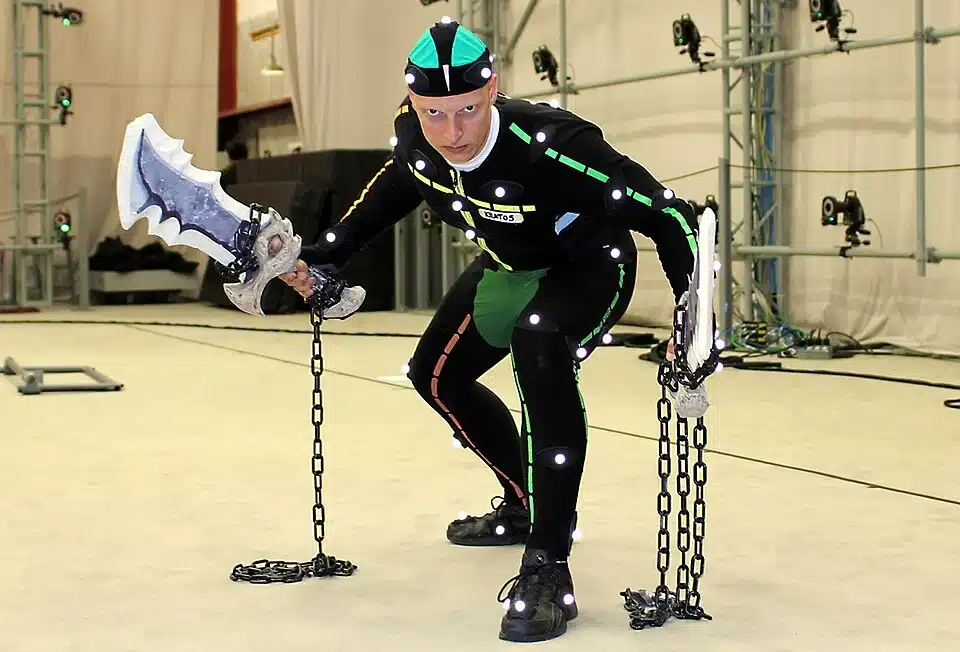
A Performer Wearing a Mocap Suit During the Production of a Video Game (Source)
While motion capture is best known for its role in video games, films, and animation, its applications are now starting to go far beyond entertainment. For example, in robotics research, mocap suits are being used to record human movements and task execution to generate datasets. These datasets help robots learn more natural and effective ways of interacting with the world.
In this article, let’s explore what a mocap suit is, how it works, what it’s made of, and why the data it produces has become such an essential resource for robotics and AI. Let’s get started!
A motion-capture suit, often called a mocap suit, is a wearable garment equipped with sensors or tracking markers. It is used to record a person’s movements and convert them into digital data. By tracking the motion of different body parts, a suit creates a detailed digital representation of a person’s actions in real time.
The data collected can include joint positions, limb movements, body orientation, and the precise timing of each action. Whether a person is walking, running, reaching for an object, or performing complex fight scenes for a video game, a mocap suit captures how every part of the body contributes to the motion. This information is then used by software to reconstruct the movement in a digital format accurately.
In many industries, especially entertainment, mocap suit technology has been adapted for a wide range of use cases. For instance, in the popular movie Avatar: The Way of Water, James Cameron and his team invested in developing new underwater mocap suit technology to capture underwater movement. With such investments, the global motion capture suit market is projected to reach $2.5 billion by 2032.
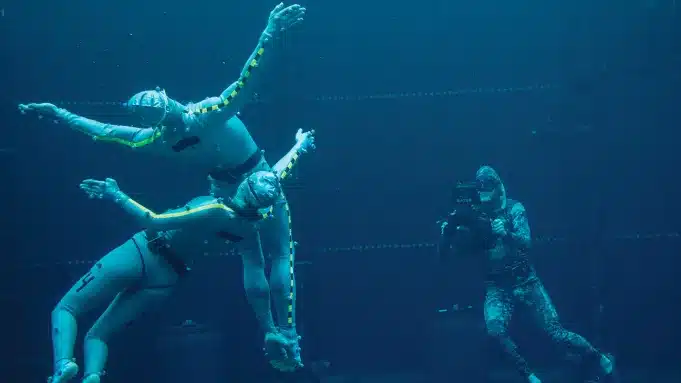
Actors Wearing Underwater Mocap Suits on the Set of Avatar: The Way of Water (Source)
Next, let’s take a closer look at what mocap suits are made of. Although mocap suits vary in design (based on manufacturer), most share the same basic components.
The foundation is a wearable suit or set of straps that holds the tracking hardware in place. Attached to it are either motion sensors, used in inertial systems, or reflective markers, used in camera-based systems. These are positioned at key points on the body to accurately track movement.
The collected data is then transmitted to a receiver, hub, or processing unit, which gathers information from all tracking points and forwards it to software for analysis and visualization. This enables a digital skeleton to be updated in real time as the wearer moves, creating an accurate representation of the person’s motion.
Many mocap suit components also include optional add-ons for capturing finer details. For instance, mocap gloves can track hand and finger movements, making them very important for applications such as gesture recognition. Similarly, head-mounted cameras can record facial expressions and subtle muscle movements.
Several systems are widely used across the motion capture industry today. Common examples include Perception Neuron, Rokoko Smartsuit Pro II, and Xsens MVN Animate, which are widely used across animation, game development, and film production.
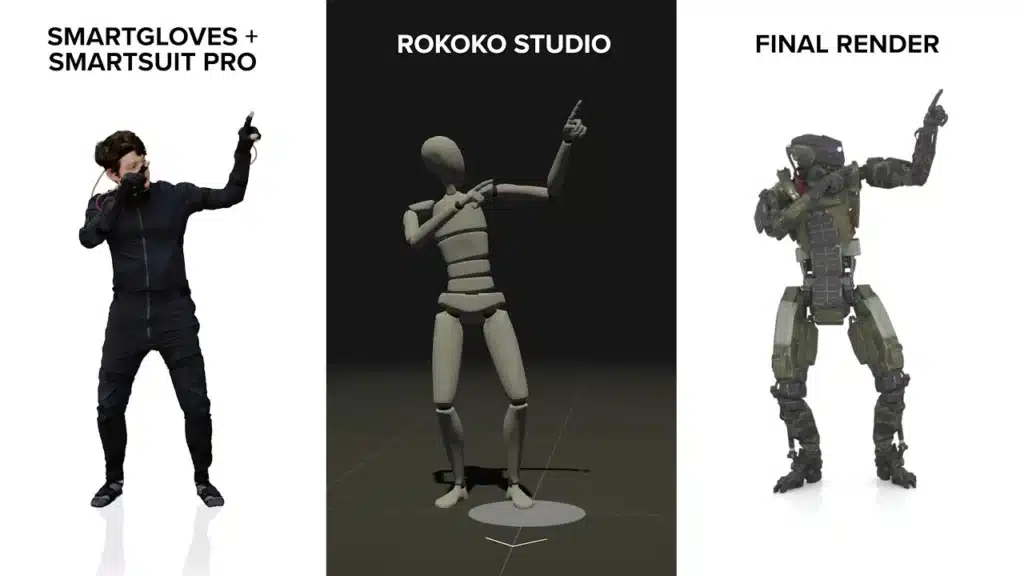
A Demonstration of the Rokoko Smartsuit System (Source)
Pricing varies widely by capability. Entry-level systems start around $1,500, while professional-grade solutions can exceed $100,000.
Not all mocap suits capture movement the same way. Mocap suits generally fall into two categories, inertial and marker-based, each suited to different environments and levels of precision.
Here’s an overview of both:
Some of the most memorable digital characters in cinema were built on motion capture. Rather than animating a creature frame by frame, filmmakers record a real actor’s performance and map it onto a digital character, preserving the timing, weight, and subtle expression that hand animation struggles to match.
A well-known example is the character Caesar in the Planet of the Apes films. Actor Andy Serkis wore a motion-capture suit covered with tracking markers while multiple cameras recorded his body movements and facial expressions. The captured data was then mapped onto a digital ape character, allowing filmmakers to preserve the nuances of his performance in the final computer-generated imagery (CGI) character.
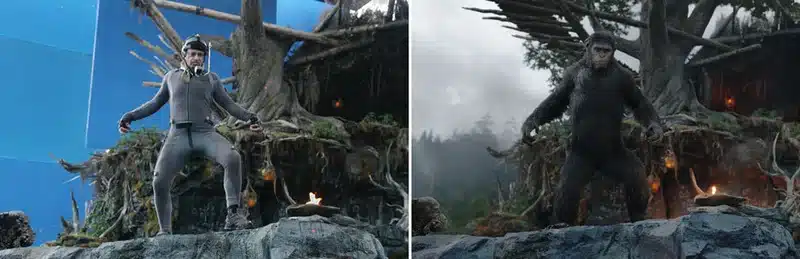
Actor Andy Serkis as Caesar in a Mocap Suit (Source)
While motion-capture suits have long been associated with the entertainment industry, mocap technology is also widely used in sports science and biomechanics. Coaches, trainers, and researchers use it to analyze movement patterns to improve athletic performance, reduce injury risk, and gain deeper insights into human motion.
Similarly, in healthcare and rehabilitation, clinicians use it to assess patient movement and track recovery progress. There are also applications in manufacturing and the military. For instance, manufacturing companies analyze worker movements to improve ergonomics and workplace safety, while military and defense organizations use motion capture to study and simulate human performance in complex training scenarios.
Beyond this, mocap suits are playing an important role in robotics and artificial intelligence. Researchers use mocap suits to capture how humans perform real-world tasks. Actions such as walking, picking up objects, opening doors, and manipulating tools can be recorded in detail and transformed into datasets that AI models within robots can learn from.
This shift reflects a trend in robotics: teaching machines through observation instead of manually programming every movement. By analyzing large volumes of human motion data, robots can learn more natural, efficient, and adaptable ways of interacting with their environment.
For example, motion capture data of humans walking can be used to teach humanoid robots to walk. These types of use cases make mocap suits a critical resource for training robots to perform complex tasks and advancing the next generation of physical AI systems.
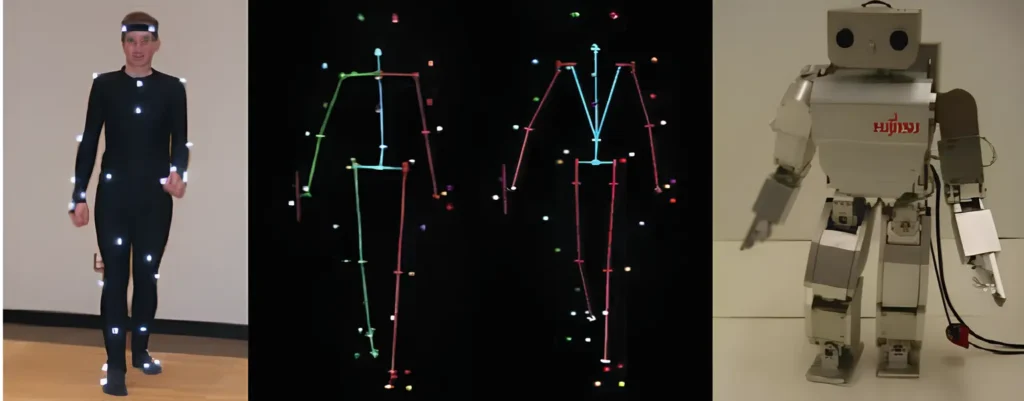
Human Movement From a Mocap Suit Can Be Converted to Robotic Motion (Source)
Now that we have a better understanding of what mocap suits are and how they work, let’s dive into how they make a difference in robotics.
The value of a mocap suit extends far beyond creating realistic animations. The technology produces a clean, structured record of human movement. Instead of recording a video, a mocap suit records precise information about joint positions, body orientation, motion trajectories, and timing. Machines can use this data as a reference for learning.
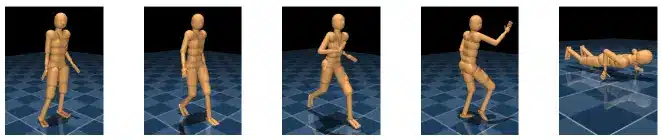
An Example of Data Collected Using a Mocap Suit (Source)
For robotics researchers, this movement data provides a detailed reference for how humans perform tasks. Robotics developers can study mocap suit data of people walking, picking up objects, using tools, or navigating obstacles, and use those examples to learn more natural and efficient robotic behaviors.
Instead of programming every action manually, engineers can train AI models in robots using demonstrations of real human movement. This helps the robots acquire skills through observation.
Using mocap data for robotics is already gaining traction across the embodied AI industry. Just as large image datasets helped drive advances in vision AI, detailed human motion datasets are viewed as a key ingredient for building capable robots.
Capturing movement with a mocap suit is only the first step. Although the mocap suit records detailed motion data, the raw output isn’t ready for robot training right away. Before it can be used, the data has to be cleaned, checked, and combined with other sources such as camera footage, sensor data, or robot telemetry.
Researchers also need to correct tracking errors, fill in missing information, and ensure the recordings are consistent. Even small mistakes in the data can affect how well a robot learns from it.
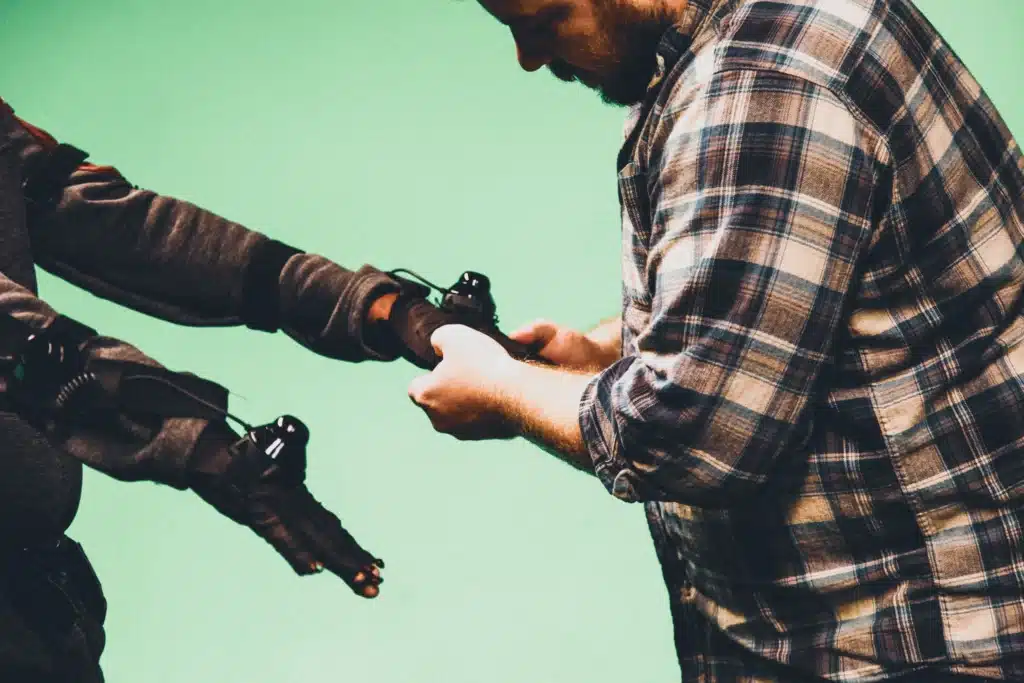
Mocap suits need to be used carefully to capture high-quality data. (Source: Pexels)
Another challenge is that humans and robots are built differently. A movement performed by a person can’t simply be copied onto a robot with different joints, proportions, or ranges of motion. The mocap data has to first be adapted to match the robot’s body and capabilities.
Simply put, preparing motion-capture data is just as important as collecting it. These challenges are why many robotics and AI teams work with specialized data partners. Managing large-scale motion-capture datasets requires expertise in data collection, processing, and data annotation to ensure the final dataset is accurate and training-ready.
Objectways can be that expert data partner for you. We are an AI data solutions company that helps robotics and AI teams build high-quality datasets for training and evaluation.
As part of our broader robotics data pipeline, we collect, process, and annotate motion-capture data alongside other sensor and perception data. We have in-house AI data specialists who can transform raw recordings into training-ready datasets that support the development of more capable robotic systems.
A key part of our process is ensuring that different data sources stay accurately aligned. We synchronize motion-capture data with video, sensor readings, and task annotations to create a complete view of each recorded task.
Our robotics-focused quality assurance workflows and expert review processes ensure that data is accurate, consistent, and ready for AI and machine learning applications. The result is high-quality, production-ready training data that supports a wide range of robotics use cases, from object manipulation and navigation to broader physical AI applications.
A mocap suit is much more than a tool for creating digital characters. By turning human movement into structured data, it captures detailed information about how people move, interact with objects, and perform tasks. Today, that data is being used to train robots and physical AI systems.
As robotics advances, high-quality motion data is becoming a critical part of the AI data pipeline. The better the data, the more effectively robots can learn to move, adapt, and operate in real-world environments.
Working on a robotics project and looking for data support? Connect with us to see how we can support your data workflows from capture to deployment.
A motion-capture (mocap) suit tracks and records a person’s body movements, converting them into digital data. This data can be used to animate characters in films and video games, create immersive VR experiences, analyze human movement, and train or control robotic systems by teaching robots to replicate human motions.

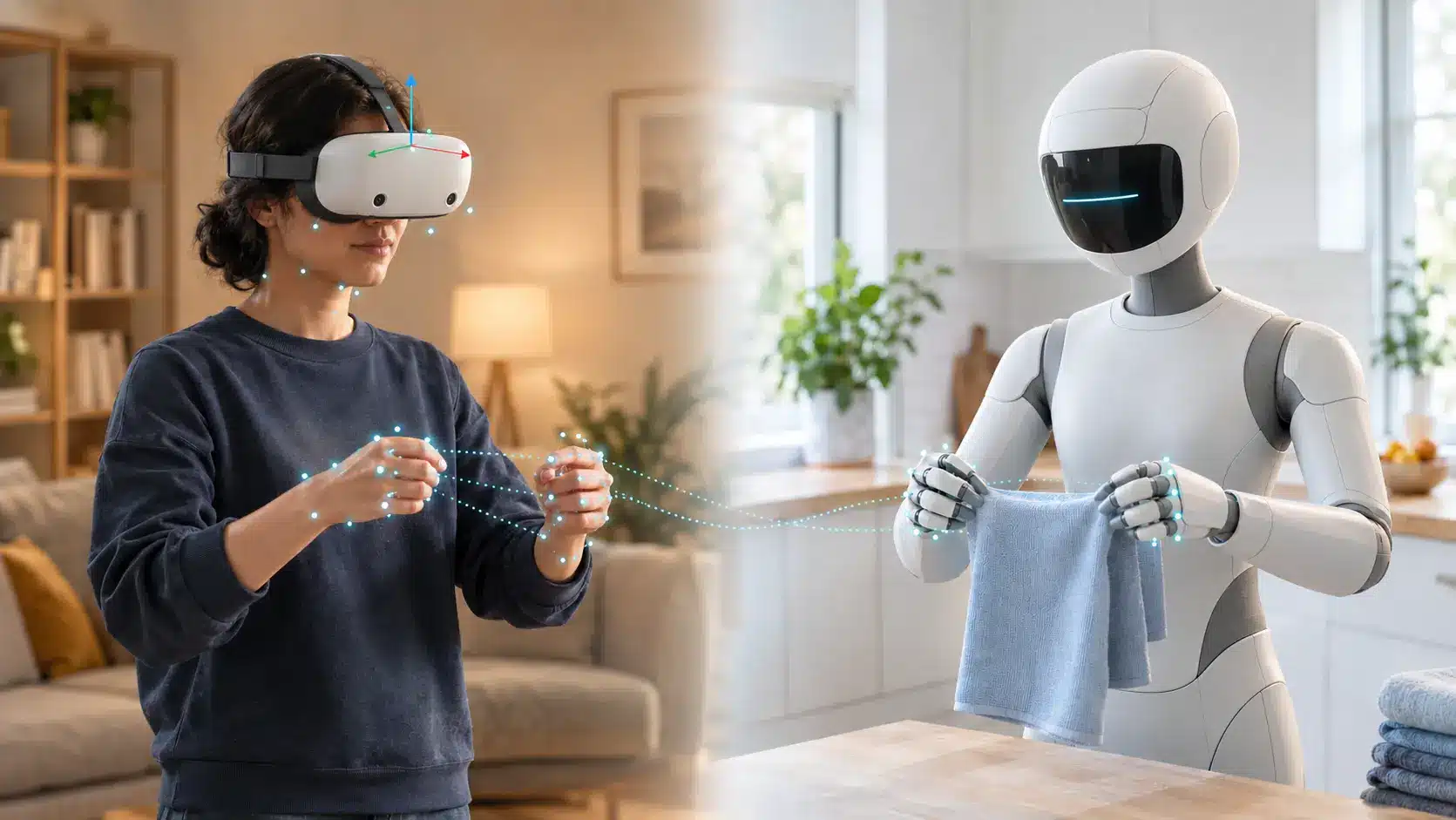
See how SLAM VR tracking works inside a headset, where it fails, and why a drifting head pose weakens egocentric and teleoperation data.
Explore the main types of lidar sensors, how they measure distance, and which types of robots are best suited to 2D, 3D, flash, and FMCW...